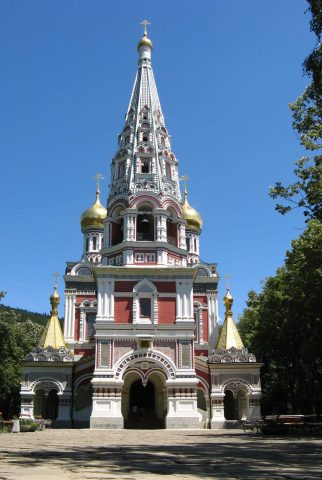
Perched on a hill above the quiet town of Shipka in central Bulgaria, the Church of the Nativity stands as more than just an architectural marvel. It is a monument to sacrifice, a symbol of national resilience, and a place where history feels almost tangible. Built in the late 19th century, the church honors the Russian and Bulgarian soldiers who fell during the Russo-Turkish War of 1877–1878, a conflict that played a pivotal role in Bulgaria’s struggle for independence from Ottoman rule. For many Bulgarians, this site is not just a memorial but a cornerstone of their identity, a reminder of the price paid for freedom.
The church’s design draws heavily from 17th-century Russian ecclesiastical architecture, a deliberate choice that reflects the deep ties between the two nations during that era. Its golden domes, shimmering under the Balkan sun, dominate the landscape, while the vibrant frescoes inside tell stories of faith and heroism. The walls are adorned with scenes from the Bible alongside depictions of key battles, blending religious devotion with historical memory. Russian and Bulgarian artists worked side by side to create these intricate mosaics and paintings, ensuring that the church would serve as both a spiritual sanctuary and a tribute to those who fought for Bulgaria’s future.
Construction of the church began in 1885, but financial struggles and political upheavals delayed its completion for nearly two decades. It was finally consecrated in 1902, by which time Bulgaria had already gained its independence. What makes the church’s origins particularly moving is that its creation was not just a local initiative—it was also driven by Russian veterans of the war, who saw its construction as both a religious duty and a patriotic obligation. Their involvement underscored the shared history between the two nations, a bond forged in the fires of conflict.
Today, the Church of the Nativity remains an active place of worship and a site of pilgrimage for those seeking to honor the past. Memorial services are held here on anniversaries of Bulgaria’s liberation, and visitors can leaf through the Book of Remembrance, which contains the names of over 20,000 soldiers who died in the war. For many, standing within its walls is a humbling experience, a moment to reflect on the fragility of peace and the enduring connections between people and nations.
The church’s location adds to its significance. From the hilltop, the view stretches across the Shipka Pass and the rugged peaks of the Stara Planina mountain range, where some of the war’s fiercest battles took place. Nearby, a memorial complex includes mass graves and monuments to the fallen, offering a stark reminder of the human cost of war. On clear days, the surrounding valleys and forests seem almost serene, a stark contrast to the violence that once unfolded here. Walking these grounds, it’s impossible not to feel the weight of history pressing in from all sides.
Yet the church is not just a relic of the past. It remains a living part of the community, where locals and visitors alike come to light candles, attend services, or simply find a moment of quiet reflection. The air inside is thick with the scent of incense and wax, the silence broken only by the soft murmur of prayers or the occasional hymn. For older Bulgarians, the church may evoke childhood memories of family visits, while younger generations often arrive as part of school trips, learning about the sacrifices that shaped their country.
What makes the Church of the Nativity so powerful is its ability to bridge the gap between history and the present. It is a place where the past is not just remembered but actively felt—whether through the solemnity of a memorial service, the curiosity of a tourist studying the frescoes, or the quiet contemplation of a visitor tracing the names in the Book of Remembrance. The church doesn’t just tell a story; it invites you to become part of it, if only for a moment.
For those who visit, the experience is often deeply personal. Even those who don’t consider themselves religious may find themselves moved by the atmosphere of reverence and remembrance. The church has a way of slowing time, of making the weight of history feel immediate and real. It’s not just a stop on a travel itinerary but a place where the ideals of freedom, memory, and faith converge. In a world that often feels disconnected from the past, Shipka’s church offers a rare opportunity to pause and reflect on what it means to belong to something larger than oneself.