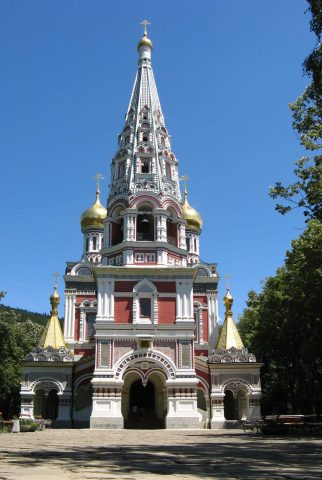
Shipka is one of those rare places where history isn’t just remembered—it lingers in the air, in the rustle of the wind through the mountain pines, in the way the sunlight catches the golden domes of the memorial church. This isn’t just a mountain pass in central Bulgaria; it’s a landscape shaped by sacrifice, where the fate of a nation was decided in the late 19th century. The battles fought here during the Russo-Turkish War weren’t just skirmishes—they were turning points, moments when the dream of Bulgarian independence hung by a thread. Today, the Shipka National Park-Museum stands as both a tribute to those who fought and a quiet reminder of the cost of freedom.
At the heart of the complex is the Church of the Nativity, often called the Shipka Monastery, its white stone walls and gilded domes rising against the green slopes of the Balkan Mountains. Built in the early 1900s with donations from across Bulgaria, the church was meant to honor the Russian and Bulgarian soldiers who died here. Its architecture blends traditional Orthodox design with Russian influences, a deliberate choice to reflect the bond between the two nations. Inside, the walls are covered in frescoes depicting scenes from the war, while marble plaques bear the names of the fallen. The space feels solemn, almost reverent, as if the weight of history presses gently against the stone.
Just steps from the church lies the mass grave where over twenty thousand soldiers are buried. It’s a place of quiet reflection, where visitors often leave flowers or stand in silence. A granite obelisk marks the spot, its base crowned by an eternal flame that flickers even in the wind. Around it, memorial plaques list the regiments and divisions that fought here, their names worn smooth by time. Every August, descendants of the fallen, veterans, and ordinary citizens gather for commemorations, their voices mingling with the sound of church bells echoing through the valley.
The pass itself is as much a part of the story as the monuments. The road winding up to Shipka is narrow and steep, cutting through forests and meadows that change with the seasons. In summer, the air is cool and crisp, carrying the scent of pine and wild herbs. Winter transforms the landscape into something almost otherworldly, with snow blanketing the hills and muffling the world in silence. Walking the trails here feels like stepping into a different time—one where the only sounds are the crunch of gravel underfoot and the distant call of a bird. One path leads to the Monument of Liberty, a towering bronze lion gazing out over the mountains. The lion’s posture is one of watchfulness, as if guarding the memory of those who fought below.
The Battle of Shipka in August 1877 was brutal, a clash of endurance as much as strategy. Outnumbered Russian and Bulgarian volunteers held the pass for days against Ottoman forces, their positions carved into the rocky slopes. The fighting was close and desperate, with hand-to-hand combat in the trenches that still scar the hillsides. Today, you can walk among the remnants of those fortifications, their earthworks barely visible beneath the grass but still palpable. It’s easy to imagine the chaos—the smoke, the shouts, the sheer exhaustion of men who knew they were fighting for something bigger than themselves.
Beyond the memorials, the park-museum offers glimpses into the daily realities of war. Open-air exhibits display weapons, uniforms, and personal items from the conflict, each object telling a small part of the story. A reconstructed field hospital gives a sense of the conditions soldiers endured, with crude medical tools and stretchers laid out as they might have been over a century ago. Nearby, scale models of artillery positions and trenches help visitors understand the tactics of the battle, how the terrain dictated every move. It’s one thing to read about history; it’s another to stand where it happened and feel the slope of the land under your feet.
What makes Shipka special is how it refuses to let you stay detached. This isn’t a place for passive observation. The wind carries the same chill it did in 1877, the same sunlight warms the stones, and the same mountains loom over the valley. On clear days, the view stretches for miles, the horizon blurred by distance but sharp with memory. There’s a sense of timelessness here, as if the past isn’t just preserved but still alive, breathing in the quiet between the trees. It’s the kind of place that makes you slow down, not because you have to, but because the weight of it demands it.
For Bulgarians, Shipka is sacred ground, a symbol of resilience and national identity. It’s where schoolchildren come to learn about their history, where veterans gather to share stories, where families lay wreaths on anniversaries. But even without knowing the details of the battles, the place has a power of its own. The combination of natural beauty and human history creates something rare—a landscape that feels both vast and intimate. The mountains, the forests, the monuments, the silence: they all work together to leave an impression that lingers long after you’ve left.
Shipka isn’t just a stop on a tourist route. It’s a place where the land itself seems to remember, where every rock and tree has a story to tell. It’s a reminder that freedom isn’t given; it’s fought for, paid for, and preserved by those who refuse to forget. And in a world that moves too fast, that’s a lesson worth slowing down for.