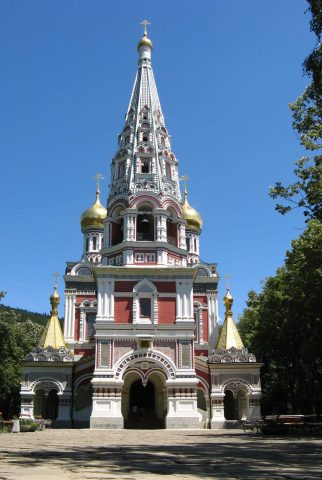
Shipka Pass is one of those rare places where history isn’t just remembered—it lingers in the very air, woven into the landscape like an old story half-forgotten yet impossible to ignore. Tucked into the heart of the Balkan Mountains, this high-altitude crossing has long served as a bridge between northern and southern Bulgaria, though its significance runs far deeper than its role as a route through the peaks. At around 1,200 meters above sea level, the pass feels suspended in time, where the scent of pine and wild herbs mingles with the crisp mountain breeze, and the only sounds are the whisper of wind through the trees and the occasional murmur of visitors drawn here by something greater than scenery.
The pass is best known for the brutal battles fought here during the Russo-Turkish War of 1877–1878, when Russian troops and Bulgarian volunteers held off Ottoman forces in a desperate struggle for the country’s liberation. The most intense fighting took place in August 1877, when a small garrison of defenders, outnumbered and cut off, clung to the pass for nearly five months. Their resistance became a defining moment in Bulgarian history, a testament to endurance in the face of overwhelming odds. Today, the name Shipka carries the weight of that sacrifice, and the pass is often called a sacred place—a site where the past isn’t just commemorated but palpably present.
Dominating the landscape is the Shipka Memorial Church, also known as the Church of the Nativity, built to honor those who died in the battles. Constructed in the late 19th century with funds collected across Bulgaria, the church blends Orthodox traditions with Russian architectural influences. Its white stone walls and golden domes stand out against the green slopes, while inside, intricate mosaics and solemn murals create an atmosphere of quiet reverence. The crypt beneath the church holds the remains of over 9,000 soldiers, their names etched into the walls—a stark reminder of the cost of freedom. The church isn’t just a monument; it’s a place of pilgrimage, where visitors light candles and leave flowers in memory of those who never left these mountains.
The area around the church is dotted with memorials, each telling a fragment of the story. The most striking is the bronze lion perched on a hilltop, its gaze fixed on the valley below where the fiercest fighting once raged. From this vantage point, the view stretches across rolling ridges and deep gorges, a landscape that looks much the same as it did over a century ago. On clear days, the snow-capped peaks of the Stara Planina range shimmer in the distance, and it’s easy to imagine the pass as it was then—isolated, windswept, and fiercely contested. The silence here isn’t just the absence of noise; it’s the weight of history pressing down on the land.
Yet Shipka Pass isn’t only a place of remembrance. It’s also part of a protected natural reserve, where rare plants and wildlife thrive in the rugged terrain. In summer, the slopes burst into color with wildflowers, while winter transforms the pass into a snowy expanse, popular with skiers and snowboarders. Locals still occasionally turn up bullets or shrapnel from the battles, small relics that serve as a reminder of how fragile peace can be. The contrast between the serene beauty of the landscape and the violence it once witnessed is striking, a tension that lingers in the air.
Many visitors combine a trip to Shipka with a stop in nearby Kazanlak, a town famous for its rose valleys and ancient Thracian tombs. But even on its own, the pass leaves a lasting impression. The road winding up to the memorial is a journey in itself, twisting through forests and rocky outcrops, with small cafés along the way where you can pause for strong Bulgarian coffee or sample local honey and cheese. There’s no rush here, no crowds jostling for the best view—just the slow, steady climb toward a place where the past feels closer than anywhere else.
What makes Shipka different from other historical sites is its lack of commercialism. There are no souvenir stalls hawking trinkets, no guided tours herding visitors from one spot to the next. Instead, there’s space—space to walk, to think, to absorb the quiet dignity of the place. The memorials aren’t just for show; they’re part of the landscape, as much a feature of the mountains as the rocks and trees. That authenticity is what draws people back, time and again. Some come to pay their respects, others to hike the trails or simply to stand on the ridge and take in the view. But everyone leaves with the sense that they’ve touched something enduring, something that connects the present to a past that still matters.
The pass doesn’t demand attention in the way more famous landmarks do. It doesn’t need to. Its power lies in its understatement—in the way the wind carries echoes of old battles, in the way the light falls on the church’s golden domes, in the way the mountains stand as silent witnesses to history. Shipka isn’t a place you visit once and forget. It’s a place that stays with you, a quiet corner of the world where the weight of memory is as real as the stones beneath your feet.