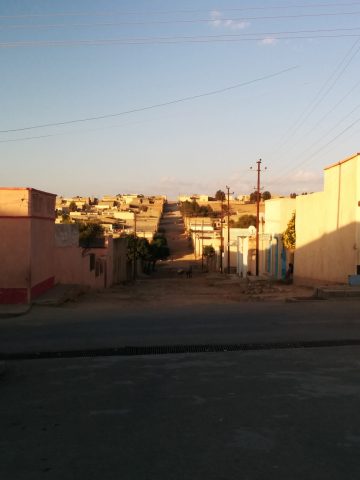
Mary Park in Addi Keyh is one of those places that doesn’t demand attention at first glance but slowly reveals its quiet charm. Tucked on a gentle rise in the heart of the city, it offers a view over the rooftops and the surrounding hills, a small elevation that feels like a pause in the urban landscape. There are no flashy attractions or neon signs here, just the rustle of leaves, the shade of old trees, and the sense that time moves a little differently within its boundaries.
The park’s origins trace back to Eritrea’s Italian colonial period, when Addi Keyh was a key administrative center. In the early 20th century, public gardens were laid out across the colony, modeled after European designs—neat pathways, fountains, and spaces meant for leisure. Mary Park likely emerged during this era, though the exact date of its founding has faded from record. The name itself may honor a local or colonial figure, but today, that detail matters less than the role the park has come to play in the life of the city. It has become a familiar gathering place, somewhere people return to for walks, conversations, or simply a moment of stillness.
The park’s design is unassuming and practical. A central path leads to a small square where a fountain once drew crowds. The fountain may no longer flow, but its marble basins and weathered figures still hint at its past elegance. Around the edges, wrought-iron benches, some showing patches of rust, remain sturdy enough for visitors. The trees—mostly native species like acacias and figs—cast dense shade, offering relief from the midday heat. There are no grand monuments or museums here, just the quiet persistence of a place that has endured.
What makes Mary Park special is the way it reflects the layers of time. Italian colonial influences linger in the layout of the paths, while traditional Eritrean patterns appear on some of the benches. Nearby buildings bear the marks of modern life, their walls occasionally tagged with graffiti. On weekends, the park comes alive in small, unscripted ways: families stroll with children, elders play backgammon under the trees, and groups of young people gather to talk or listen to music. It’s a space where the past and present coexist without fanfare.
For Addi Keyh, the park is more than just a green space. In a city where history and modernity often collide, Mary Park remains a pocket of calm. It isn’t a tourist hotspot, and that’s precisely why it feels authentic. There are no crowds, no guided tours, just the everyday rhythm of the city unfolding around it. For locals, it’s a place for meetings, quiet reflection, or a break from the bustle of daily life.
In recent years, Addi Keyh has seen changes—new neighborhoods, restored buildings, the steady pulse of growth. Yet Mary Park seems to stand apart from it all, as if time moves more slowly within its borders. Perhaps that’s because it has become something more than a park. It’s a place of memory, where each visitor finds their own connection: a childhood memory, a quiet corner in a busy city, or a tangible link to the past.
There’s no set itinerary for visiting Mary Park, no list of must-see sights. The best way to experience it is simply to wander in and let the place reveal itself. Come early in the morning, when the city is just waking up, or linger into the evening as the first streetlights flicker on. The park doesn’t follow any schedule; it moves to its own quiet beat. That’s what makes it worth visiting—not for what it displays, but for what it quietly preserves.