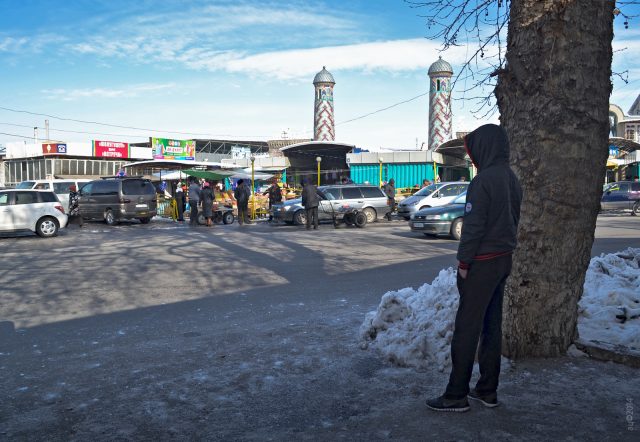
Uzgen is a quiet town in southern Kyrgyzstan, where time moves at its own unhurried pace. The past lingers here—not in grand monuments, but in the worn stones of old buildings, the gentle slopes of surrounding hills, and the way people still speak of history as something alive. Tucked among these hills, just off Manasa Street, lies a small park named after Alexander Pushkin. It’s an unassuming place, the kind you might walk past without a second thought if you didn’t know its story.
At first glance, it looks like any other neighborhood park: shaded paths winding between trees, benches worn smooth by years of use, a playground where children chase each other in the late afternoon. But for those who grew up here, or for anyone who understands the layers of meaning beneath the surface, this park is more than just a patch of green. It’s a quiet testament to how culture, memory, and daily life intertwine in unexpected ways.
The park was established in the mid-20th century, part of a wave of similar spaces that appeared across the Soviet Union. Pushkin, of course, never set foot in Uzgen—his life and work were rooted in European Russia, in the imperial courts of St. Petersburg and the rural estates of the countryside. Yet his name found its way here, as it did to countless other towns, not because of any direct connection, but because of what he represented. In an era when literature was seen as a unifying force, a way to bind together a vast and diverse country, Pushkin became a symbol. His poetry, his language, his very name were woven into the fabric of public spaces, a reminder of a shared cultural heritage.
The centerpiece of the park is a bronze bust of Pushkin, mounted on a modest pedestal. He’s depicted in a moment of quiet reflection, his gaze directed slightly downward, as if lost in thought. The statue isn’t grand or imposing—it doesn’t demand attention, but it doesn’t fade into the background either. Around it, flowerbeds bloom in season, their colors shifting with the months. School groups sometimes gather here, listening as a teacher recites lines from *Eugene Onegin* or *The Bronze Horseman*. Older residents bring their grandchildren, pointing out the familiar face and sharing stories of their own school days, when Pushkin was a name every child knew by heart.
The park’s design is simple, almost austere. The trees—planted decades ago—are now tall and broad, their branches forming a dense canopy that offers respite from the summer sun. The paths are paved with tiles, some cracked with age, their edges softened by moss. In the heat of midday, the air here is cooler, thick with the scent of leaves and earth. Autumn turns the ground into a carpet of gold, the rustle of fallen leaves accompanying every step. Winter brings a hush, the snow muffling sounds, the bare branches creating a lattice against the sky. Spring arrives with the fragrance of lilacs, their purple clusters hanging heavy in the air.
Uzgen itself is a town with deep historical roots. Centuries ago, it was a stop along the Silk Road, a place where merchants, travelers, and ideas passed through on their way east or west. The remnants of that era—a minaret, a mausoleum—still stand, their weathered stones bearing witness to the town’s past. The Pushkin Park, though much younger, has become part of this continuum. It doesn’t compete with the ancient landmarks, but it doesn’t feel out of place either. Instead, it exists as a quiet counterpoint, a reminder that history isn’t just about the distant past, but also about the ways people choose to remember and honor it in their own time.
For the residents of Uzgen, the park is woven into the rhythm of daily life. In the mornings, retirees gather on the benches, sipping tea from thermoses and watching the town wake up. By midday, the playground fills with children, their laughter mixing with the calls of street vendors selling fresh bread or seasonal fruit. In the evenings, couples stroll along the paths, their voices low, their steps unhurried. On summer weekends, the park occasionally hosts small concerts—local musicians playing traditional Kyrgyz songs or classical pieces, the music drifting through the trees.
Pushkin parks like this one can be found across the former Soviet Union, from the Baltic states to Central Asia. Some have become tourist attractions, their statues polished and their paths meticulously maintained. Others, like the one in Uzgen, remain local treasures—places that matter deeply to those who live nearby, even if they don’t draw crowds. There are no guided tours here, no souvenir stands, no plaques listing the park’s "must-see" features. What makes it special isn’t any single element, but the way it has settled into the life of the town, becoming a familiar, comforting presence.
In recent years, Uzgen has seen a renewed interest in preserving its cultural heritage. Historic mosques have been restored, old buildings given new life, and public spaces like this park refreshed. The benches have been replaced, the paths repaved, and new flowers planted. Yet the changes have been subtle, careful not to erase the park’s character. The trees still cast the same dappled shadows, the statue still stands in quiet contemplation, and the air still carries the same mix of scents—dust, greenery, the faint tang of woodsmoke from nearby homes.
If you find yourself in Uzgen, it’s worth taking a detour to this park. There are no grand monuments here, no rare artifacts, no dramatic vistas. What you’ll find instead is something quieter, but no less meaningful: a place to sit and listen to the wind in the leaves, to watch the play of light and shadow on the poet’s face, to feel the weight of history not as something distant and abstract, but as something lived and breathed every day. Pushkin’s name may have arrived here by chance, but over the decades, it has become part of the land itself. And the park, in its unassuming way, has become a place where the past and present meet, where a moment of stillness can feel like a small act of connection.