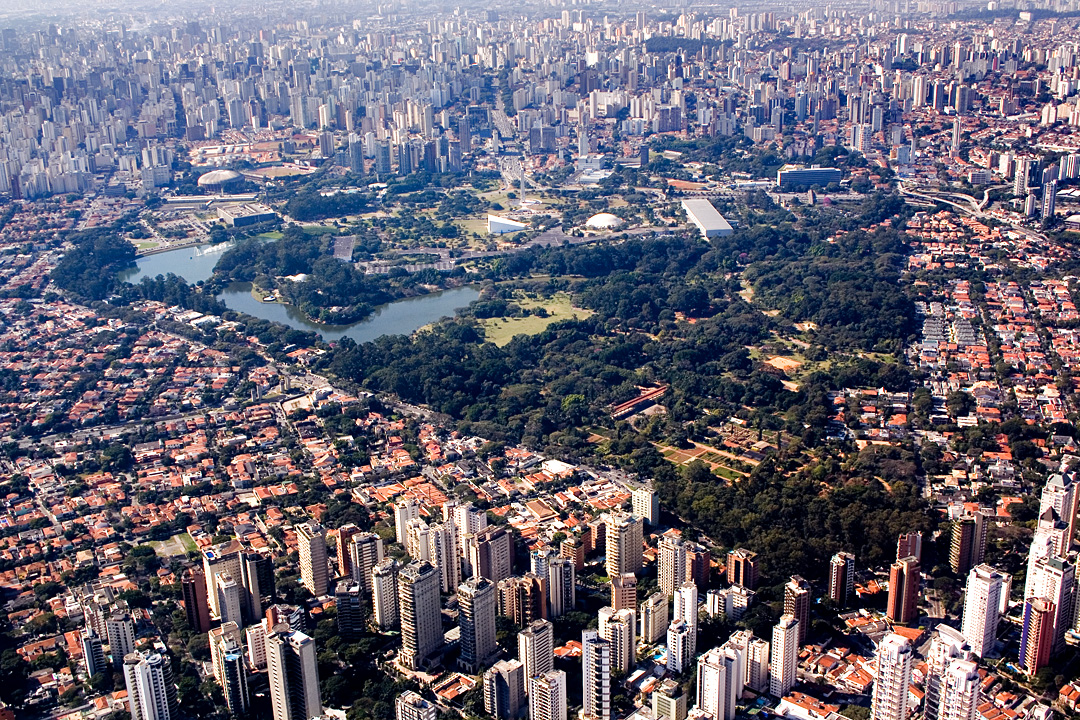
Ibirapuera Park is one of those rare places in São Paulo where the city’s relentless energy fades into something quieter—where concrete and steel give way to trees, open skies, and the kind of stillness that feels almost rebellious in a metropolis this size. Tucked into the Vila Mariana district, it’s more than just a park; it’s a breathing space for a city that never seems to pause. Locals come here to jog, cycle, or simply wander beneath the canopy of leaves, but there’s no forced spectacle, no crowds jostling for the perfect photo. Instead, there are wide paths, artificial lakes reflecting the sky, and a handful of buildings that feel like they’ve always belonged here, as if they grew from the earth rather than being placed upon it.
The park’s origins trace back to the mid-20th century, when São Paulo’s leaders envisioned a grand public space modeled after the great urban parks of Europe and the United States. The site was once a marshy, neglected area, but the transformation was ambitious: ponds were dug, bridges built, and pavilions designed to host everything from art exhibitions to stargazing sessions at the planetarium. Ibirapuera opened in 1954, timed to coincide with the city’s 400th anniversary, and it quickly became a stage for São Paulo’s cultural and civic life. Over the decades, it has hosted everything from political rallies to music festivals, though it has never quite become the kind of place tourists flock to in droves. That might be part of its charm—it feels like a secret, even though it’s anything but.
Architecture plays a quiet but defining role in the park’s identity. Some of Brazil’s most celebrated architects left their mark here, including Oscar Niemeyer, whose signature curves and minimalist lines shape several of the park’s structures. His pavilions, with their sweeping roofs and airy interiors, are among Ibirapuera’s most recognizable features. Nearby stands the Obelisk, a stark, towering monument dedicated to the heroes of the 1932 Constitutionalist Revolution—a sharp contrast to the softness of the surrounding greenery. Not far from it is the Museum of Contemporary Art, where the works of Brazilian and international artists share space in a building that feels as much a part of the landscape as the trees around it.
But Ibirapuera isn’t just about buildings. It’s a place where nature and city life coexist, sometimes uneasily, but often in a kind of truce. The park is home to hundreds of tree species, some native to Brazil, others brought from distant corners of the world. On weekends, the paths fill with runners, cyclists, and families pushing strollers, while weekdays bring a slower rhythm—students reading on benches, elderly men playing chess, or office workers stealing a moment of quiet during lunch. The ponds are dotted with ducks and swans, and tucked beneath the trees are small cafés where you can grab a coffee or a pastel without the urgency of the city pressing in around you.
Beyond its role as a green escape, Ibirapuera has long been a cultural hub for São Paulo. The park’s open spaces and pavilions regularly host exhibitions, festivals, and open-air concerts. The Oca Pavilion, with its distinctive dome, often houses temporary art shows, while the large lawn in front of it becomes an impromptu stage for musicians and performers. In the summer, the park buzzes with activity—film screenings, craft fairs, even salsa nights—but the atmosphere never feels forced. There’s no pressure to do anything other than what you came for, whether that’s lying in a hammock with a book or joining a crowd for a live performance under the stars.
For many Paulistanos, Ibirapuera is woven into the fabric of daily life. Some come every morning for a run, others reserve weekends for picnics or bike rides, and some just wander, lost in thought or conversation. There are no rigid rules here, just the unspoken agreements of shared public space: don’t litter, don’t be too loud, don’t harm the plants or animals. Even on busy days, it’s easy to find a quiet corner—just step off the main path onto one of the smaller trails that wind through the trees.
The park has also mirrored the broader changes in Brazilian society over the decades. In the 1960s and 70s, it was a gathering place for political protests and demonstrations. In the 90s, it became a symbol of environmental activism when residents rallied to protect it from development plans. Today, it remains a vital public space, not just for relaxation but for expression—whether that’s through art, music, or simply the act of claiming a patch of grass for an afternoon.
What makes Ibirapuera special isn’t any single feature—it’s the way it manages to feel both grand and intimate at the same time. There are no extravagant fountains or exotic animals here, just the quiet luxury of space and light. You could spend hours walking its paths, watching the play of shadows through the leaves, listening to the birds, or sitting by the water’s edge, watching clouds drift across the sky. The park doesn’t try to impress or entertain; it just offers a place to be, to breathe, to step outside the relentless pace of the city for a little while. In a place like São Paulo, that might be the rarest gift of all.