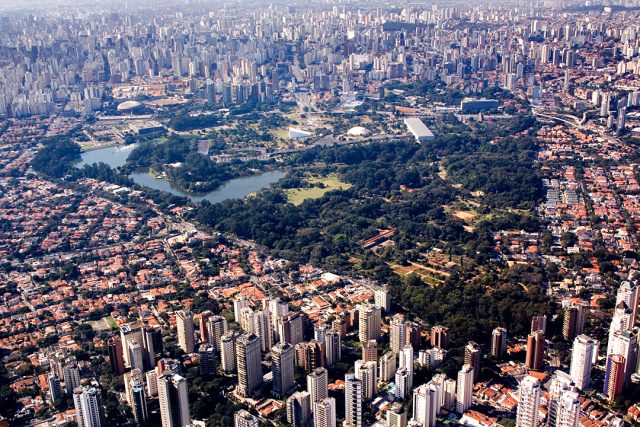
In the heart of Vila Mariana, one of São Paulo’s quieter neighborhoods, Jardim Botânico offers a rare escape from the city’s relentless pace. Unlike the crowded parks and tourist hotspots that dot the metropolis, this place feels almost secret—small enough to explore in an afternoon, yet vast in its tranquility. The paths wind beneath towering trees, their branches forming a canopy that softens the sounds of the city. There are no amusement rides or souvenir vendors here, just wide lawns where people spread out blankets, open books, or simply sit in silence. It’s the kind of park that doesn’t demand attention; it invites you to slow down.
The land has a history that stretches back to the late 1800s, when it was a private estate used for agriculture. By the early 20th century, the government acquired the property, and São Paulo’s first botanical garden took root. Over the decades, it expanded into a living collection of plants, not just from Brazil but from around the world. Some of the oldest trees here have stood for over a century, their trunks thick with time. Walking beneath them, you might spot araucarias, their spiky crowns reaching toward the sky, or clusters of bamboo swaying in the breeze. The garden became a place where science and nature intertwined, a tradition that continues today.
The architecture is understated, blending seamlessly with the landscape. The main gates, with their wrought-iron details and gentle arches, hint at an era when botanical gardens were as much about leisure as they were about research. Inside, the old greenhouses still stand—glass structures that once housed rare specimens and now host exhibitions or workshops. Small bridges cross over ponds, their surfaces dotted with lily pads, while stone benches, worn smooth by decades of use, offer places to rest. There’s a sense of timelessness here, as if the park has always existed just as it is now.
One of the most striking features is the dendrology collection, a curated assortment of trees meant to preserve and study Brazil’s biodiversity. Some are common to the region, while others are rare, their survival threatened by deforestation. A few giants dominate the landscape, their roots spreading wide and their leaves casting deep shadows. Nearby, themed gardens offer glimpses into different ecosystems: a section dedicated to medicinal plants, for instance, where visitors can learn about the herbs used in traditional Brazilian remedies. It’s a reminder that this park isn’t just a pretty space—it’s a living archive.
Wildlife thrives here in ways that feel almost surprising for a city park. Birds are the most visible residents—parrots squawk from the treetops, their bright feathers flashing against the green, while ducks glide across the ponds. After rain, small lizards dart across the paths, and if you’re lucky, you might spot a turtle sunning itself on a rock. The occasional opossum, drawn from the surrounding areas, makes a quiet appearance at dusk. These moments of encounter feel like small gifts, a reminder that nature persists even in the middle of a sprawling city.
Beyond its role as a public space, Jardim Botânico is an active research center. Parts of the park are closed to visitors, reserved for experiments and the cultivation of endangered species. Universities and environmental organizations collaborate here, conducting studies on everything from urban ecology to plant conservation. For those curious about the science behind the scenery, the park offers guided tours, lectures, and hands-on workshops. You might learn how to grow native plants in a balcony garden or discover the challenges of restoring degraded ecosystems. It’s a place where education and recreation overlap, where visitors leave with more than just memories.
The park’s mood shifts with the seasons. In summer, when São Paulo’s heat and humidity press down, families flock here, spreading out picnics and letting children run across the grass. Autumn brings a quieter beauty, as leaves turn gold and crimson, painting the paths in warm hues. Winter is the most subdued time—fewer visitors, longer shadows, and a hush that makes the rustling of leaves sound louder. But spring is when the garden truly comes alive. Magnolias burst into bloom, their petals soft against the bark, while jacarandas splash the landscape with purple. The air fills with the scent of flowers, and for a few weeks, the park feels like a celebration.
There’s an unspoken ease to Jardim Botânico, a lack of pretension that makes it welcoming to everyone. Children play freely, photographers frame shots of gnarled roots or sun-dappled paths, and strangers strike up conversations on benches. On weekends, small events sometimes take place—a local musician playing acoustic guitar, a craft fair with handmade goods—but they never disrupt the park’s calm. The rules are simple: don’t pick the plants, don’t leave trash, don’t disturb the peace. Beyond that, the space is yours to use as you like.
This isn’t the kind of place that makes it onto postcards or travel brochures. There are no grand fountains or monumental statues, no crowds jostling for the perfect photo. Instead, Jardim Botânico offers something far more valuable in a city like São Paulo: stillness. It’s a place where the noise of traffic fades, where the air smells of earth and leaves, where time seems to stretch just a little longer. Some visitors stumble upon it by accident and return again and again; others have known it for years, treating it like a second home. But no matter how you find it, the park leaves you with the quiet satisfaction of having stepped outside the rush, if only for a little while.