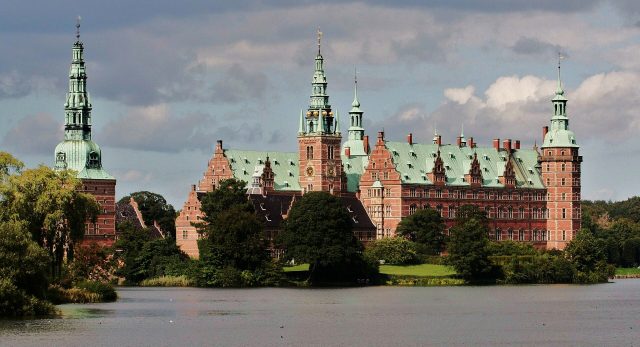
Frederiksborg isn’t just a park—it’s part of one of Denmark’s most significant historical ensembles, where nature and architecture merge into something greater than the sum of its parts. At its heart stands Frederiksborg Castle, a Renaissance masterpiece that once served as the royal residence and now stands as a testament to Denmark’s golden age. The castle and its surrounding gardens feel inseparable, their harmony making it easy to imagine the grandeur of court life in the 16th and 17th centuries. The red-brick towers, the intricate spires, and the still waters of the moat all contribute to an atmosphere that lingers between the past and the present.
The castle itself was the vision of King Christian IV, a ruler whose ambition shaped much of Denmark’s architectural legacy. Built in the early 1600s, it wasn’t meant to be a fortress but a statement—a display of wealth and power that would rival the great palaces of Europe. Architects drew inspiration from Italian and Dutch designs, yet the result was distinctly Nordic. The warm hues of the brickwork, the steep gables, and the elaborate stone carvings give the building a character all its own. Even the canals, originally part of the castle’s defenses, now add to its charm, their reflective surfaces mirroring the towers above.
The gardens came later, in the 18th century, when the fashion for formal French landscapes reached Denmark. The initial design followed strict geometric principles—straight paths, symmetrical flowerbeds, and manicured lawns that framed the castle’s facade. Over time, though, the influence of the English landscape movement softened the rigidity. Today, the park balances both styles: the precision of the parterres near the castle gradually gives way to wilder, more natural spaces where paths meander past ponds and groves. It’s a place where you can stroll along a perfectly aligned avenue one moment and find yourself on a secluded bench by the water the next.
Water is one of the park’s defining features. The canals and ponds, once practical elements of the castle’s defenses and fish farms, now create a serene setting. Swans glide across the surface, willows dip their branches into the water, and in spring, the air fills with the scent of blooming chestnuts and lilacs. Autumn transforms the scene again, painting the trees in shades of gold and crimson. The reflections in the water double the beauty, turning the castle into a floating mirage of brick and stone.
Among the park’s smaller details, the Badstuen pavilion stands out—a delicate Baroque structure built in the 18th century as a retreat for the royal family. Today, it occasionally hosts intimate concerts or exhibitions, its elegant proportions a quiet contrast to the castle’s imposing bulk. The statues scattered throughout the gardens are another reminder of the past. Most depict mythological figures or allegorical scenes, their stone forms weathered by time but still carrying the grandeur of the era that created them.
Frederiksborg’s history is woven into the broader story of Scandinavia. In the 19th century, it became the coronation site for Danish monarchs, and its halls witnessed decisions that shaped the region’s future. But in 1859, a fire ravaged much of the castle’s interior, leaving only the outer walls intact. Restoration efforts, funded by private donations, brought it back to life, and today it houses the Museum of National History. Walking through its rooms, you’ll find royal portraits, antique furniture, and artifacts that offer a glimpse into the lives of Denmark’s rulers—from the opulence of the Renaissance to the more restrained tastes of later centuries.
What makes Frederiksborg special is how alive its history feels. The park’s paths seem to echo with the footsteps of courtiers, hunters, and monarchs who once walked them. Yet it’s not a place frozen in time. Locals come here to picnic, children play near the ponds, and visitors pause to photograph the castle’s reflection in the water. In summer, open-air concerts fill the air with music, while winter lends the scene a quiet magic, with frost dusting the trees and ice forming on the canals.
For anyone drawn to history, architecture, or simply the beauty of a well-loved place, Frederiksborg offers something rare. There’s no rush here, no crowds—just the quiet pleasure of wandering through a landscape shaped by centuries of human care. You could spend hours exploring, moving from the castle’s grand halls to the gardens’ hidden corners, each turn revealing something new. And if the light is just right, the sight of the castle mirrored in the water might stay with you long after you’ve left.