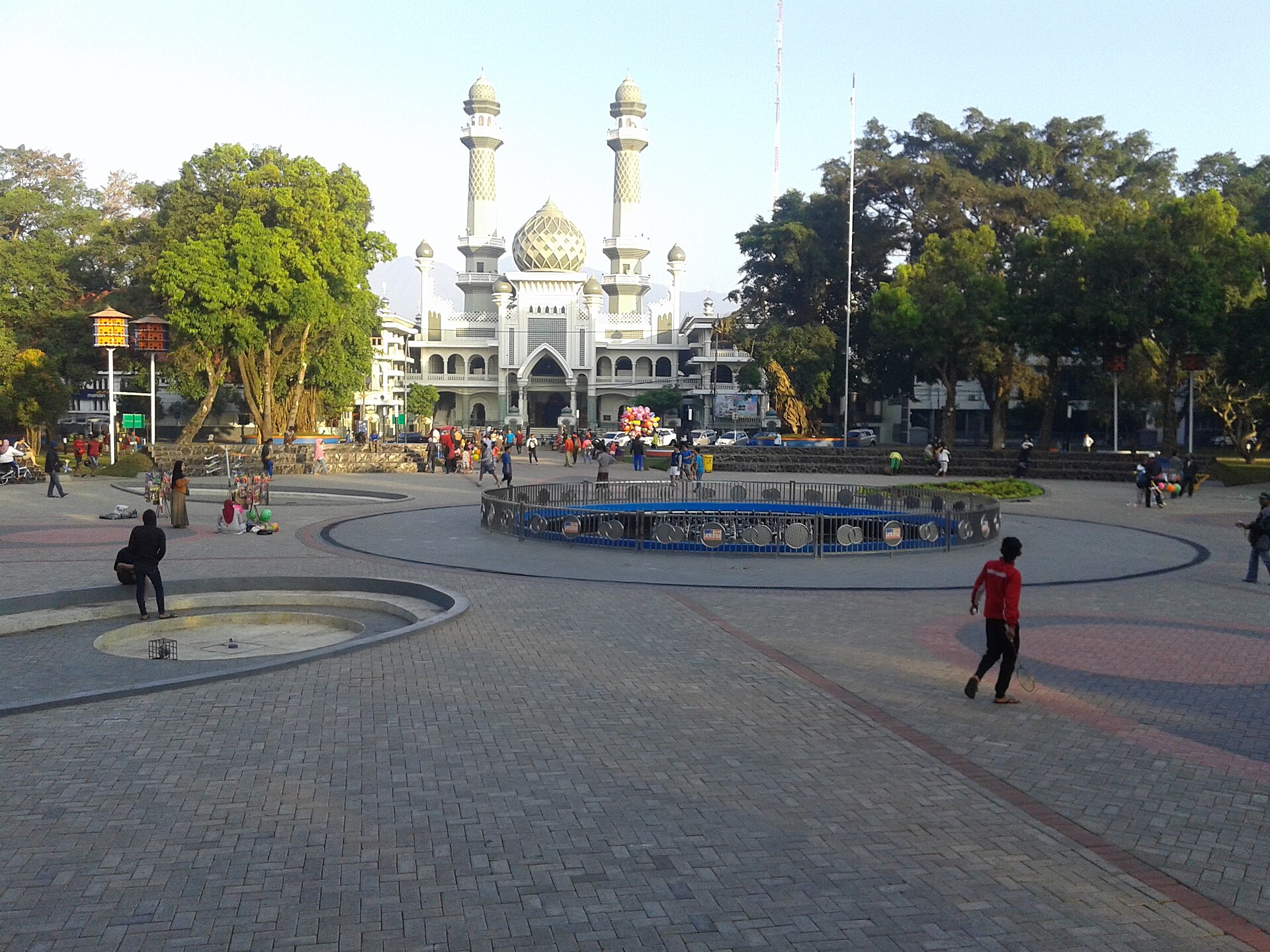
Malang’s Alun-Alun is one of those rare urban spaces where the city exhales, slowing down just enough to invite you to pause and simply be. It isn’t merely a patch of green in the heart of Malang—it’s a place where history, daily life, and Javanese tradition intertwine without pretense. There’s no tourist hustle here, just the quiet authenticity of a park that belongs to the people who use it. Locals come with their families to unwind, stroll, or spread out a picnic, while visitors get a glimpse of the unhurried rhythm that defines this Indonesian city.
The concept of an alun-alun is deeply rooted in Javanese urban design, and Malang’s version follows the tradition. These squares were historically placed in front of palaces or government buildings, symbolizing the connection between rulers and the community. In Malang, the park is framed by key landmarks: the Jami Mosque to the north, the city hall to the south, and rows of low-slung shops and homes on the east and west sides. This layout reflects the Javanese ideal of harmony between people, nature, and society—a balance that still feels tangible today.
At the center of the park, a cluster of ancient banyan trees dominates the space. In Java, the banyan is considered sacred, its sprawling roots and dense canopy offering shade and shelter. Even on the hottest days, the air beneath its branches stays cool, making it a favorite spot for locals to sit, chat, or simply enjoy the quiet. Paved paths wind around the grove, and in the evenings, soft lighting transforms the area into a gathering place. The trees aren’t just decoration; they’re living witnesses to the park’s history, their gnarled trunks holding stories of generations who have passed beneath them.
What makes Malang’s Alun-Alun special is its unpretentious inclusivity. There’s no division between spaces for tourists and spaces for locals—everyone shares the park equally. Mornings bring joggers circling the perimeter and groups practicing tai chi or yoga under the trees. By midday, families take over, children chasing each other across the grass while parents relax on benches. As the sun sets, the atmosphere shifts again: street vendors set up stalls, music drifts from portable speakers, and clusters of young people gather to talk or play games. On weekends, the park buzzes with activity—impromptu markets, live performances, or just the hum of conversation filling the air.
The architecture surrounding the park adds another layer to its character. The Jami Mosque, built in the early 20th century, blends Javanese and colonial influences, its white walls and graceful arches standing in contrast to the lush greenery. Across the square, the city hall’s facade is adorned with reliefs depicting Malang’s history, a subtle reminder of the park’s role in the city’s civic life. These buildings aren’t just backdrops; they’re part of the park’s identity, tying it to the broader narrative of Malang’s past and present.
Beyond its physical beauty, the Alun-Alun offers a window into old Java. Despite Malang’s modern growth, the park retains a sense of timelessness, where traditions aren’t performed for visitors but lived naturally. Cultural events often spill into the square—craft fairs, gamelan performances, or wayang shadow puppet shows. Sometimes, you’ll stumble upon children learning traditional instruments or artisans demonstrating batik techniques. These moments turn the park into an open-air museum, where culture isn’t preserved behind glass but woven into everyday life.
For travelers, the Alun-Alun is an ideal starting point for exploring Malang. From here, it’s easy to wander to nearby museums, markets, or cafes serving local dishes like bakso or rawon. But the real draw isn’t the proximity to attractions—it’s the chance to sit and observe. The park reveals Malang not as a checklist of sights, but as a living, breathing place shaped by its people. Here, the line between visitor and local blurs, and the city reveals itself in unexpected ways.
There’s nothing forced or staged about the Alun-Alun. It doesn’t exist to impress; it simply is—a part of the city’s fabric, a space for rest and connection. Whether tourists come or not, the park carries on, its rhythms unchanged. That’s perhaps why it feels so magnetic. It’s a place where time moves differently, where you can lose an hour under a banyan tree or get swept up in the scent of sizzling street food. The Alun-Alun doesn’t offer grand revelations; it offers something quieter, more enduring—the chance to belong, if only for a moment, to the life of the city.