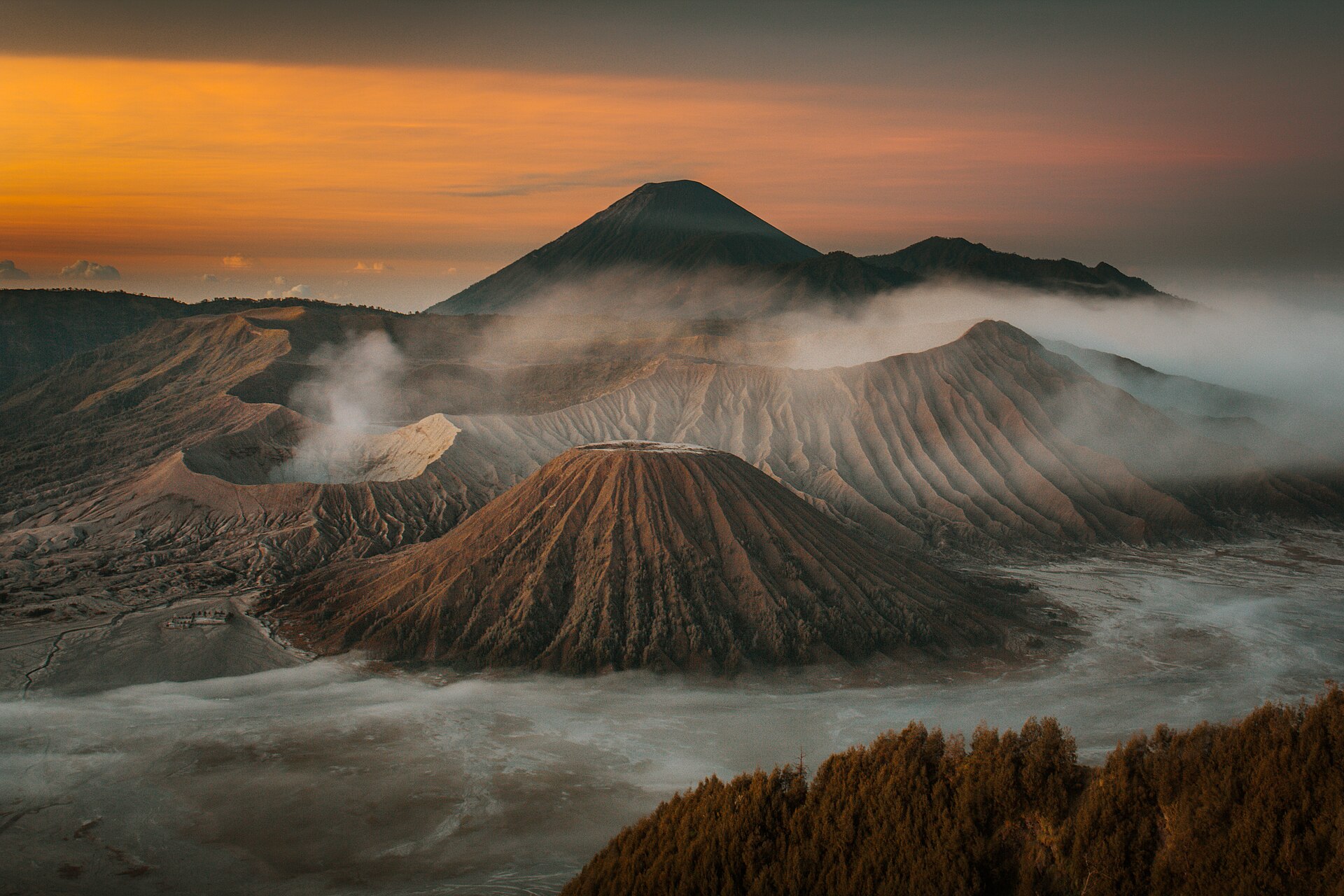
East Java holds one of Indonesia’s most striking landscapes, where the earth feels alive in ways few places can match. The Bromo Tengger Semeru National Park unfolds across a highland plateau, a world of smoldering volcanoes, vast sand seas, and jagged peaks that rise like sentinels over the island. At its heart lies Mount Semeru, Java’s tallest mountain, its summit often wreathed in clouds, a constant reminder of the forces that shaped this land. The park isn’t just a collection of geological wonders—it’s a place where time moves differently, where the air carries the scent of sulfur and damp earth, and where every path seems to lead deeper into a story older than memory.
The Tengger Caldera dominates the landscape, a colossal depression nearly ten kilometers wide, its walls dropping steeply into a basin where several volcanoes stand. The most famous of these is Mount Bromo, its name derived from the Javanese pronunciation of Brahma, the Hindu god of creation. For the Tenggerese people, who have lived in these highlands for centuries, the volcanoes are sacred. Each year, during the Yadnya Kasada festival, they gather at the crater’s edge to offer fruits, vegetables, and even livestock, casting them into the abyss as a tribute to the mountain spirits. The ceremony is a vivid reminder of how deeply the land and its people are intertwined, a tradition that has endured despite the passage of time.
Watching the sunrise over Bromo is an experience that lingers long after the last light fades. Before dawn, the caldera is shrouded in mist, the air cool and still. As the first hints of daylight touch the horizon, the sky ignites in shades of pink and gold, revealing the black sand sea below and the silhouette of Bromo’s smoking cone. From the viewpoint on the caldera’s rim, the scene feels almost otherworldly. Those who venture down into the basin walk across the volcanic plain, where the ground crunches underfoot and the air grows thicker with the acrid tang of sulfur. The final approach to Bromo’s crater is short but steep, often made on foot or by horseback, the animals guided by local handlers who know the terrain as well as their own homes. At the summit, the crater exhales thin plumes of smoke, its edges stained yellow by sulfur deposits, a stark contrast to the surrounding darkness.
Semeru, the park’s towering giant, is an active volcano that commands respect. Climbing it is a serious undertaking, a two- or three-day journey through dense forests, rocky scree, and alpine meadows. The trail is demanding, but those who reach the summit are rewarded with a view that stretches across the entire region—rolling hills, distant peaks, and, on clear days, the shimmering coastline of Java far below. Yet Semeru is unpredictable. Its eruptions, though infrequent, serve as a reminder that this is a living mountain, one that demands caution. For many, the climb is less about conquest and more about humility, a chance to stand in the presence of something far greater than oneself.
Beyond the volcanoes, the highlands are a patchwork of fertile farmland, where the cool climate nurtures crops like potatoes, cabbage, and carrots. The Tenggerese have cultivated these slopes for generations, their terraced fields clinging to the hillsides like steps carved into the earth. Small villages dot the landscape, their wooden houses built in the traditional style, with steeply pitched roofs to shed the heavy rains. Markets in nearby towns brim with fresh produce, the air thick with the scent of spices and earth. The Tenggerese themselves are a distinct community, their language and customs closely tied to the land. Though their way of life has adapted to modern times, traces of their ancient beliefs remain, woven into the fabric of daily existence.
The park’s mood shifts with the hours. Mornings are quiet and mysterious, the mist clinging to the caldera like a veil. By midday, the sun burns through, sharpening the contrasts—the black sand, the gray rock, the vibrant green of the hills. As evening falls, the crowds thin, and the land settles into a silence broken only by the wind or the distant call of a bird. Night here is profoundly dark, the stars so bright they seem almost within reach. Without the glow of cities, the Milky Way stretches across the sky like a river of light, a sight that feels increasingly rare in a world awash with artificial brightness.
Bromo Tengger Semeru is more than just a destination for adventure. It holds hidden corners that reward those willing to stray from the well-trodden paths. Tucked away in the forests are waterfalls like Madolowo, where cold, clear water cascades down moss-covered rocks, the sound drowning out everything but the present moment. Nearby, Lake Ranu Kumbolo mirrors the sky, its surface so still it seems to hold another world beneath. In the rainy season, the water turns a deep, glassy blue, reflecting the surrounding bamboo groves and eucalyptus trees. These places feel untouched, as if time has forgotten them, offering a quiet counterpoint to the drama of the volcanoes.
There’s a sense of perspective that comes with standing in a place like this. The sheer scale of the landscape—its raw, untamed beauty—makes the concerns of daily life feel small by comparison. The volcanoes, with their slow, relentless power, remind you that the earth is still being shaped, still changing. The Tenggerese, with their deep connection to the land, show how people can live in harmony with forces far greater than themselves. And the silence, when you find it, is a rare gift, a chance to listen to the wind and the distant rumble of the mountains. Perhaps that’s why people keep returning. Not just for the views, or the thrill of the climb, but for the quiet understanding that comes from standing in a place where the world feels both vast and intimate at the same time.