The monument known as the Kosovo Maiden stands in Kruševac not as a grand statement, but as a quiet witness to one of Serbia’s most enduring legends. It commemorates a figure from the epic poetry that has shaped the nation’s identity—a young woman who, according to folklore, wandered the battlefield of Kosovo in 1389, searching for her fallen lover and offering water to the wounded. Her story is one of devotion and sorrow, a tale passed down through generations in songs and stories until it became part of Serbia’s collective memory. The sculpture captures this moment of quiet resilience, a fleeting pause in a tragedy that has echoed through centuries.
Created in 1933 by the Croatian sculptor Antun Augustinčić, the monument reflects his fascination with themes of struggle and human endurance. Augustinčić’s work often carried a sense of raw emotion, and the Kosovo Maiden is no exception. Unlike the idealized heroines of romantic art, this figure is grounded in reality—her posture is neither dramatic nor triumphant. She stands with a pitcher in hand, her gaze distant, as if caught between movement and stillness. The simplicity of the composition makes it all the more powerful; there is no grand gesture, only the weight of a single moment, frozen in bronze.
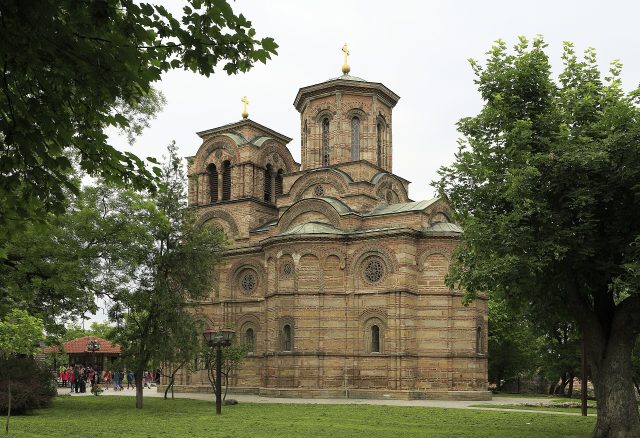
Kruševac was a fitting place for the monument, as the city holds deep ties to the events of the Kosovo battle. In the 14th century, it served as the seat of Prince Lazar, the Serbian leader who gathered his forces here before marching to meet the Ottoman army. After the defeat, the city became a symbol of both resistance and loss—Lazar’s wife, Princess Milica, was captured and executed nearby. Today, remnants of that era remain: the Lazarica Church, built in the prince’s honor, and the ruins of his fortress, which still stand as silent reminders of the past. The Kosovo Maiden fits naturally into this landscape, another layer in the city’s long history.
The sculpture itself is modest in scale, made of bronze and set on a low stone pedestal. It doesn’t dominate the space but invites closer inspection. The details—the folds of her dress, the way her fingers curl around the pitcher, the subtle expression on her face—reveal a depth of emotion that isn’t immediately obvious from a distance. There’s no despair in her stance, nor is there defiance; instead, there’s a quiet determination, as if she knows the weight of what she carries, both literally and metaphorically. This understated approach makes the monument feel more personal, as though it’s speaking directly to those who take the time to notice it.
There are no barriers around the monument, no plaques with lofty inscriptions. It exists without fanfare, allowing each visitor to interpret it in their own way. For some, it’s a tribute to the women who cared for the wounded and mourned the dead in times of war. For others, it’s a reminder of how conflict reshapes lives, leaving behind only memories and scars. And for many, it’s simply a striking piece of art, a small but meaningful part of the city’s fabric. The lack of overt symbolism means the monument doesn’t impose a single narrative; instead, it becomes whatever the viewer needs it to be.
Kruševac is not a city that draws crowds of tourists, and the Kosovo Maiden is rarely the reason people visit. There are no guided tours here, no souvenir stands, no grand ceremonies. This absence of spectacle is part of what makes the monument special. It’s a place where you can stand in silence, undisturbed, and feel the past pressing in around you. In summer, chestnut trees cast dappled shadows over the square; in winter, snow sometimes dusts the statue’s shoulders. But no matter the season, the monument remains a quiet presence, a bridge between history and the present day.
The Kosovo Maiden is more than just a statue—she’s a thread in the tapestry of Serbian culture, one that connects oral tradition to physical form. Her story has been sung in ballads, written in poems, and now stands in bronze, enduring as the legends themselves. What makes the monument compelling is its refusal to be pinned down. It doesn’t offer answers or moral lessons; it simply exists, much like the stories it represents—open to interpretation, yet deeply felt. In this way, it mirrors the nature of memory itself: personal, shifting, but always resonant.
If you find yourself in Kruševac, take a moment to pause by the Kosovo Maiden. There’s no need to rush. Look at her face, at the way the light catches the curve of her pitcher, and listen. You might not hear the echoes of ancient songs, but you’ll sense something just as powerful—the quiet persistence of history, not locked away in museums, but alive in the streets, in the air, in the stories people still tell. That’s the real magic of this place: it doesn’t just commemorate the past; it lets you step into it, if only for a little while.