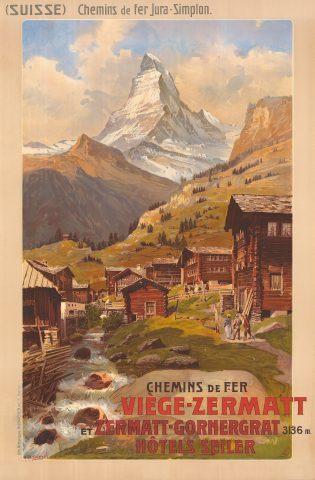
Stellisee is one of those places in Zermatt where people come not just for the view, but for the silence. Tucked away from the usual tourist paths at around 2,500 meters above sea level, it’s only reachable on foot. The hike takes a couple of hours, but the journey is gentle—first through alpine meadows, then over rocky slopes, until you finally see the small lake cradled between the mountains. The water is so clear it’s almost invisible, reflecting nothing but the sky and the towering Matterhorn nearby.
The locals call it the mountain’s mirror. When the wind dies down, the lake’s surface becomes perfectly still, and the Matterhorn’s reflection appears so sharp it’s hard to believe it’s real. On clear days, the image is so vivid it seems as if the peak is floating in midair. But the moment a breeze stirs, the water ripples, and the reflection dissolves like mist, leaving only the mountain itself standing in the distance.
Stellisee wasn’t always this quiet. In the early 20th century, there were plans to build a small hut for visitors, but the project never took off. All that remains now is a faint outline of a foundation and a few scattered stones, barely noticeable among the grass. Maybe it’s for the best—the lake has kept its untouched quality, and even in peak season, you’ll rarely find more than a handful of people here. Most come early in the morning or late in the afternoon, when the light is soft and the landscape takes on an almost dreamlike quality.
There are no signs or markers around the lake, just a narrow path winding between boulders. The local herders have known this place for generations, but they’ve never tried to make it famous. To them, Stellisee is just part of the mountains, as ordinary as snow on the peaks or fog in the valleys. That’s probably why it’s so easy to lose track of time here—nothing distracts you, nothing reminds you of the world beyond.
The water is icy even in summer, but that doesn’t stop some from taking a quick dip. You won’t last long—after a minute or two, your teeth start chattering, and your body feels like it’s been jolted awake. But afterward, there’s a strange sense of renewal, as if you’ve washed away more than just dust. The locals say the water has healing properties, though there’s no science to back it up. Still, if the legends are true, anyone who swims in Stellisee will find their way back to Zermatt someday.
In autumn, the lake changes. The water darkens, and the reflections become sharper. The surrounding slopes turn golden, though there are hardly any trees—just low shrubs and grass that fades to straw by September. The silence deepens, broken only by the occasional rustle of stones underfoot or the distant rumble of a rockfall high in the mountains.
Winter transforms Stellisee completely. The lake freezes over, its surface covered in thick ice. Snow buries the paths, making the journey nearly impossible. But those who brave the cold say the frozen lake is a different world entirely. The ice glitters in the sunlight, and the Matterhorn’s reflection becomes ghostly, as if the mountain has dissolved into the frosty air. On those days, time seems to stand still.
Stellisee isn’t like other Swiss lakes. There are no manicured shores, no cafés, no scenic walkways—just the raw beauty of the mountains. It’s a place for those willing to put in the effort, who don’t mind solitude, and who appreciate the simple things: crisp air, silence, and a view of peaks that have stood unchanged for millennia. Maybe that’s why it stays so compelling—because here, you can feel like you’re part of something far greater than just a landscape.