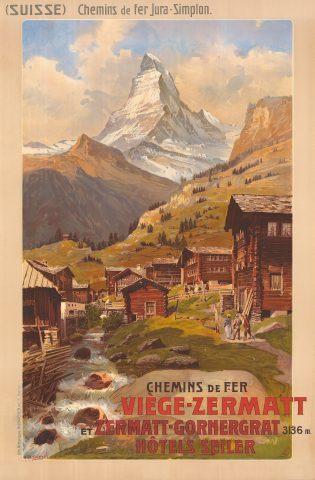
The Matterhorn rises where Switzerland meets Italy, a jagged silhouette that needs no introduction. Its near-perfect pyramid shape, with four distinct faces aligned to the cardinal points, has made it one of the most recognizable mountains in the world. You’ve likely seen it before—on chocolate wrappers, in logos, or in photographs—long before you ever set foot in the Alps. There’s something almost unreal about its symmetry, as if it were carved rather than shaped by time and ice.
For centuries, the mountain resisted all attempts to conquer it. Before 1865, more than a dozen expeditions tried and failed, most approaching from the Italian side. Then, in July of that year, a team led by Edward Whymper finally reached the summit. The victory was short-lived. On the descent, four of the seven climbers fell to their deaths, a tragedy that would overshadow the achievement itself. The story of that ill-fated climb turned the Matterhorn into a legend, far beyond the world of mountaineering. In Zermatt, you can still see remnants of that expedition—the torn rope, the gear—preserved in the local church and the Alpine Museum, silent witnesses to a moment that changed the mountain’s fate.
Climbing the Matterhorn today is no casual endeavor. The route remains technical, requiring a guide, proper equipment, and an overnight stay at the Hörnli Hut before the final push. It’s not a hike; it’s a serious alpine challenge, demanding experience and respect. For those who prefer to admire the mountain from a distance, Zermatt offers other ways to get close. The Gornergrat Railway, a creaking cogwheel train, climbs from the village to over three thousand meters, where the Matterhorn appears alongside the Gorner Glacier, its ice stretching like a frozen river. On the opposite side, the cable car to the Matterhorn Glacier Paradise lifts you even higher, to nearly four thousand meters—the highest viewing platform in the Alps. Inside the glacier, a tunnel of ice glows with an eerie blue light, a quiet contrast to the drama of the peak above.
Zermatt itself feels like a place suspended in time. Cars with combustion engines are banned, so the only way in is by train from the nearby town of Täsch. The streets hum with electric carts, their quiet motors blending into the sound of cowbells from the surrounding pastures. The village has a way of making even the most ordinary moments feel special—whether it’s sipping coffee on a sunlit terrace or watching the first light touch the mountain’s summit. One of the most photographed views is from Stellisee, a small lake reached by a short hike from the Blauherd lift. On still mornings, the water mirrors the Matterhorn perfectly, doubling its sharp edges against the sky.
The mountain isn’t always visible. Clouds often cling to its upper slopes until late morning, so those hoping for a clear view usually set out early. The lifts don’t run year-round either; between seasons, some lines close for maintenance, and schedules can change with little notice. It’s worth checking ahead, especially if you’re planning to visit in the shoulder months. Even when the weather cooperates, the Matterhorn has a way of keeping its distance, appearing and disappearing as the light shifts, as if reminding you that some things are best admired from afar.
There’s a quiet magic in watching the mountain at different times of day. In the early hours, it glows pink in the dawn light, its ridges softened by shadow. By midday, the sun bleaches the snow, making the peak appear almost white against the blue sky. As evening falls, the shadows deepen, and the Matterhorn takes on a darker, more imposing presence. It’s easy to see why this mountain has inspired so many stories—why it feels less like a part of the landscape and more like a character in its own right.
For all its fame, the Matterhorn remains a place of contrasts. It’s both accessible and remote, welcoming and unforgiving. You can stand at its base in Zermatt, surrounded by tourists and souvenir shops, or you can hike for hours into the high valleys, where the only sounds are the wind and the occasional chime of a cowbell. The mountain doesn’t care how you experience it—whether you’re a climber testing your limits or a traveler content to watch its silhouette from a café. It has stood here for millennia, and it will stand long after we’re gone. That, perhaps, is the real reason it feels so timeless.