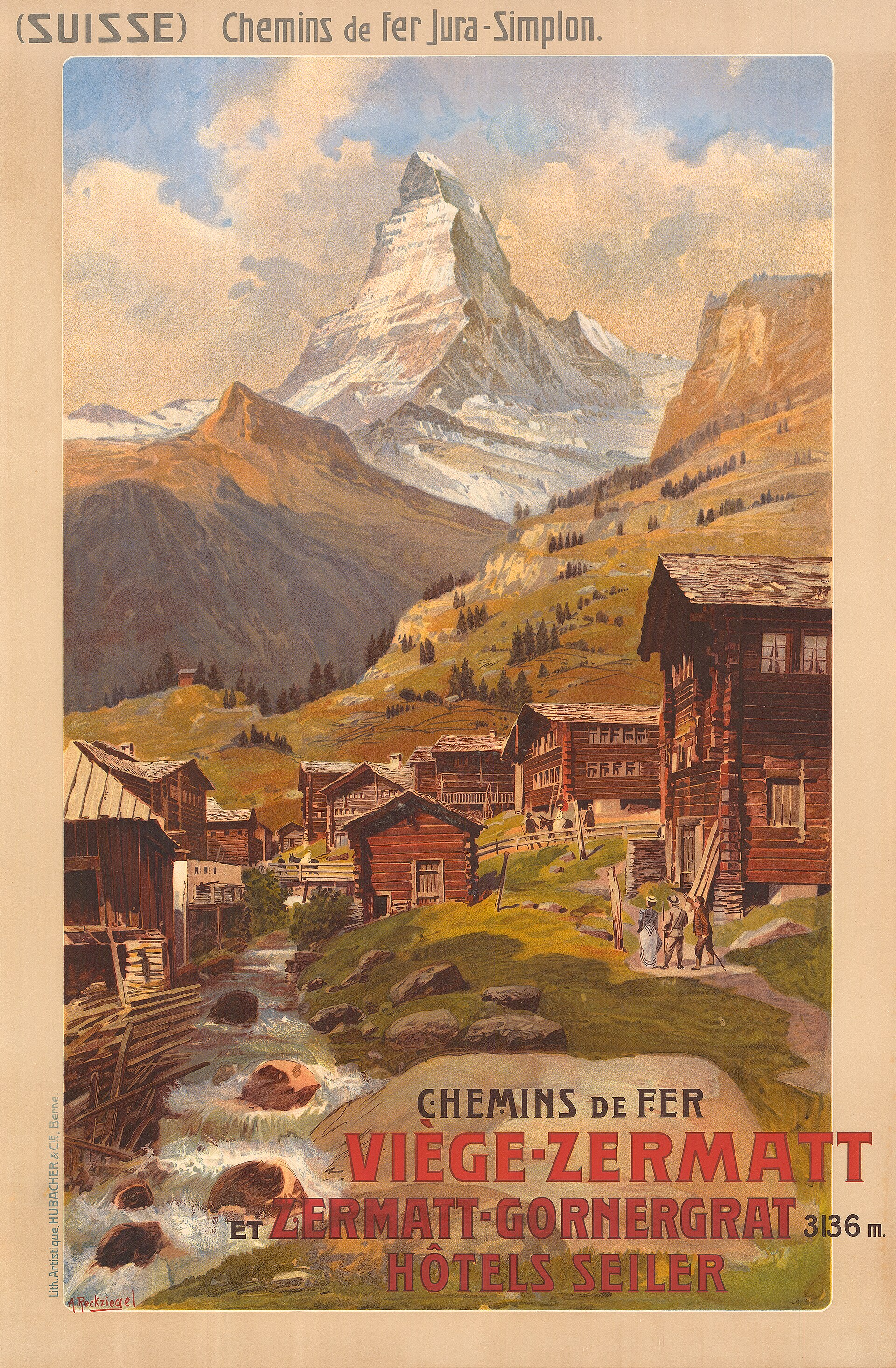
Gornergrat isn’t just a mountain railway—it’s one of those rare places in Switzerland where nature and human ingenuity come together so seamlessly that it feels as if they’ve always belonged. The journey begins in Zermatt, a car-free village where the only way in is by train, a deliberate choice that preserves the quiet and the crisp alpine air. From here, the narrow-gauge railway climbs over three thousand meters, revealing one of the most breathtaking panoramas in the Alps. Thirteen peaks over four thousand meters rise in the distance, but none command attention quite like the Matterhorn, its jagged silhouette looming over the valley like a silent sentinel.
The idea of connecting Zermatt to the high-altitude pastures and glaciers above took shape in the late 19th century, when ambition outpaced skepticism. Construction was a feat of both engineering and endurance, relying on the labor of Italian immigrants who worked through harsh conditions to lay the tracks. When the first trains ran in 1898, it was a marvel of its time—a railway that could conquer steep gradients using a rack-and-pinion system, allowing the locomotives to grip the rails as they ascended. Over a century later, little has changed. The same narrow-gauge trains, the same steep climbs, the same sense of wonder as the landscape unfolds outside the window.
The ride takes about thirty minutes, and with each passing minute, the scenery shifts. The train starts through dense pine forests, where the air is thick with the scent of resin and damp earth. Then it emerges onto open slopes, where wildflowers dot the alpine meadows in summer. Higher up, patches of snow cling to the ground even in warmer months. Around two and a half thousand meters, the train stops at Rotenboden, where the Gorner Glacier comes into view—one of the largest in the Alps. Many passengers step off here, drawn to the viewing platform or simply to stand on the platform itself, breathing in the thin air and listening to the silence broken only by the occasional gust of wind.
At the summit, 3089 meters above sea level, the station isn’t just an endpoint but a destination in its own right. There’s no hustle here, no crowds jostling for space. Instead, a small restaurant with a terrace offers a place to sit and watch the light play across the peaks. A few trails lead to quieter viewpoints, where the Matterhorn dominates the horizon, its colors shifting from pink at dawn to deep gold at sunset. In winter, skiers carve paths through untouched snowfields, while in summer, hikers wander along high-altitude trails or simply linger on a bench, soaking in the view.
What makes Gornergrat special isn’t just the scenery—it’s the way the altitude makes itself known. The air is thinner, the sky feels closer, and on clear days, visibility stretches a hundred kilometers, making every ridge and crevasse of distant mountains seem within reach. Even when clouds drift between the peaks, the effect is mesmerizing, as if the mountains are floating. And when mist rises from the glaciers, the landscape takes on an almost mystical quality, as though the world beyond has dissolved into something softer, more elusive.
For many, the journey to Gornergrat becomes one of the most memorable experiences in Switzerland, not just because of the views but because of the sense of timelessness. There’s something distinctly old-world about the place, where schedules exist but no one rushes. Trains run on time, yet passengers can linger as long as they like—whether for half an hour or the entire day. In summer, a small museum at the summit tells the story of the railway’s construction, with old photographs, tools, and models of the first trains. It’s less a formal exhibit than a tribute to the visionaries who turned an impossible dream into reality over a century ago.
The best time to visit might be in the shoulder seasons, when the crowds thin and the landscape is in transition. In spring, melting snow reveals rocky slopes, and glacial streams swell into rushing torrents. In autumn, the meadows turn golden, and the air becomes so clear it’s as if the mountains have been sharpened. These are the moments when Gornergrat feels most intimate, a place where you can stand alone with the peaks and forget the rest of the world. You don’t need to be a mountaineer or an adrenaline seeker to appreciate it—whether it’s a short walk along the glacier, a cup of hot chocolate with a view of the Matterhorn, or just a few minutes of silence on the observation deck, there’s something here for anyone willing to slow down.
This isn’t a place for shopping, nightlife, or luxury. There are no grand hotels or trendy restaurants, no distractions from the raw beauty of the mountains. What it offers instead is something increasingly rare: the chance to pause, to look around, and to realize that beauty doesn’t always need to be grand or complicated. Maybe that’s why people keep coming back—not for new thrills, but for the quiet contentment that comes from standing at the edge of the world and discovering that it’s not a frightening place at all, but one of extraordinary, understated grace.