Loch Ness is the kind of place that feels like it was always meant to be more than just a lake. Nestled in the Scottish Highlands, it has long since outgrown its role as a simple body of water, becoming instead a symbol of mystery that lingers in the imagination. The dark, peaty waters stretch between rolling hills, their surface rarely still, as if the lake itself is breathing. There’s a sense that every ripple, every gust of wind carries a story—some whispered by locals, others lost to time. It doesn’t give up its secrets easily, and perhaps that’s why it endures in the way it does.
Geologically, Loch Ness is part of the Great Glen, a vast fault line that cuts diagonally across Scotland from the southwest to the northeast. It’s one of the deepest lakes in the UK, plunging nearly 250 metres at its lowest point. The water is cold and almost black, stained by peat washed down from the surrounding moors. This gives the lake an eerie depth, as if it could go on forever. The wind sweeps across the surface, stirring up waves that never quite settle, adding to the feeling that something beneath is always shifting, always just out of sight.
The history of Loch Ness stretches back centuries, woven into the fabric of Scottish folklore. Ancient Celtic tales speak of mythical creatures dwelling in its depths, and by the 6th century, the lake had already entered written records. It was here that St. Columba, the Irish monk who brought Christianity to Scotland, reportedly encountered a beast that rose from the water to attack his followers. The story, recorded in medieval chronicles, marked the first documented sighting of what would later become known as the Loch Ness Monster. Whether the tale was born from genuine fear or simply the power of local legend, it set the stage for everything that followed. Nessie, as the creature came to be called, is now inseparable from the lake itself—a figure that may or may not exist, but has long since become part of Scotland’s cultural identity.
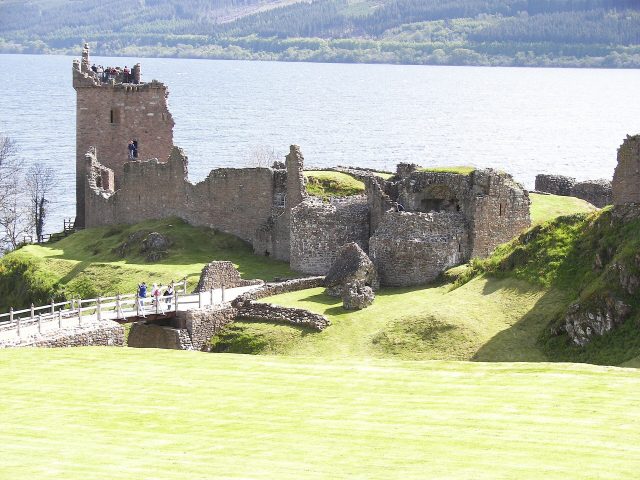
The shores of Loch Ness aren’t lined with grand architecture, but there are still traces of the past worth noticing. On the southern bank, the ruins of Urquhart Castle stand as a reminder of Scotland’s turbulent medieval history. Built in the 13th century, the fortress changed hands countless times during the wars between Scotland and England, serving as a strategic stronghold before falling into disrepair. Today, only fragments remain—crumbling walls, a half-collapsed tower—but the site still commands attention, especially when viewed against the backdrop of the lake and the surrounding hills. From its vantage point, it’s easy to imagine sentries scanning the water for approaching enemies, their eyes drawn to the same dark expanse that now draws visitors from around the world.
The small village of Drumnadrochit, perched on the loch’s western shore, has become the unofficial gateway to Loch Ness. It’s a quiet place, where life moves at its own unhurried pace, but there’s an undercurrent of something larger at play. Tourist shops sell Nessie-themed souvenirs, museums display grainy photographs and sonar readings, and cafés serve hearty Scottish fare to travellers who’ve come in search of the unknown. The locals have a wry affection for the legend, acknowledging its role in putting their home on the map while never quite taking it too seriously. After all, the mystery of Loch Ness is as much about the people who tell its stories as it is about the creature itself.
What makes Loch Ness so compelling isn’t just the possibility of a monster lurking beneath the surface—it’s the way the place blurs the line between reality and myth. On one level, it’s simply a stunning Highland lake, where you can walk along the shore, take a boat out onto the water, or try your luck at fishing. But on another, it’s a place where the past feels alive, where the wind carries echoes of old tales, and where the water seems to hold secrets older than memory. It’s easy to lose yourself in the idea that something extraordinary could emerge from the depths at any moment. That sense of anticipation, of not quite knowing, is what keeps people coming back.
Over the years, Loch Ness has been the subject of countless scientific studies, each one adding another layer to its story. In the mid-20th century, expeditions equipped with sonar and underwater cameras scoured the lake, searching for evidence of Nessie. Some claimed to have found anomalies—strange shapes moving in the deep, unexplained signals—but others dismissed them as natural phenomena or technical glitches. The debates never really settled anything, and if anything, they only deepened the mystery. Today, Loch Ness remains one of those rare places where science and folklore exist side by side, so intertwined that it’s hard to tell where one ends and the other begins.
For many who visit, Loch Ness is more than just a stop on a tour of Scotland—it’s a place that makes you think about why legends endure. There’s something about standing by the water, watching the light play across its surface, that invites reflection. How many stories has this lake inspired? How many people have stood in this same spot, wondering what lies beneath? The magic of Loch Ness isn’t in the answers it provides, but in the questions it leaves unanswered. It doesn’t promise certainty, only the chance to believe, if only for a moment, in something beyond the ordinary. And even if the monster never appears, the journey itself becomes part of the story—one that stays with you long after you’ve left.