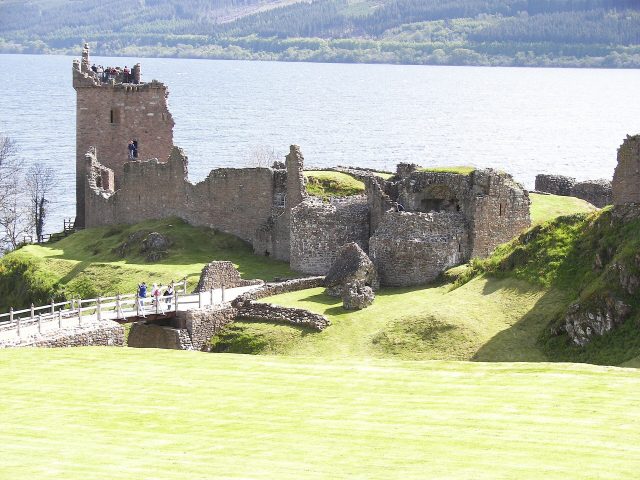
Nestled in the quiet village of Drumnadrochit, where the hills roll gently toward the shores of Loch Ness, the Loch Ness Centre feels less like a museum and more like a quiet conversation with the past. There’s no fanfare at the entrance, no neon signs or oversized replicas of the famous creature. Instead, the building blends into the landscape, its low stone walls and simple design almost disappearing against the backdrop of the Scottish Highlands. Inside, the air is cool and still, as if the place itself is holding its breath, waiting for visitors to step into a story that began long before the first tourist arrived.
The loch itself is a place of contradictions. Its waters are deep—nearly 250 metres at their lowest point—yet they feel strangely intimate, as if the darkness below could swallow secrets whole. The centre doesn’t claim to solve the mystery of what, if anything, lurks beneath the surface. Instead, it traces the origins of the legend, unspooling the threads of history that have woven the idea of a monster into the fabric of this place. There are fragments of Celtic myths, where water spirits and shape-shifters were as real as the rocks and trees. Medieval chronicles speak of strange beasts in the lochs, their descriptions vague but persistent. And then there are the modern accounts—blurry photographs, shaky videos, the testimonies of those who swear they saw something break the surface. The centre presents these not as proof, but as part of a much older human impulse: the need to explain the unknown.
Loch Ness wasn’t always a symbol of mystery. For centuries, it was simply a working lake, a vital part of life in the Highlands. Fishermen cast their nets into its depths, merchants transported goods along its length, and on its shores, castles and monasteries stood as silent witnesses to the passage of time. The centre maps this transformation, showing how the loch has been shaped by forces both natural and human—from the retreat of the glaciers that carved its basin to the construction of the Caledonian Canal, which turned it into a thoroughfare for trade. The exhibits don’t just focus on the legend; they remind visitors that this was, and still is, a place where people lived, worked, and died long before the first whispers of a monster began to circulate.
The building itself is unassuming, designed to feel like a natural extension of the landscape rather than a disruption of it. Inside, the galleries are spacious and softly lit, with exhibits that invite contemplation rather than quick glances. A reconstructed Celtic settlement offers a glimpse into the lives of the people who first called this place home. Nearby, models of ancient boats—clumsy, sturdy things—hint at the challenges of navigating the loch’s unpredictable waters. And then there are the photographs and film clips, the grainy images of those who claimed to have seen something extraordinary. The centre doesn’t sensationalise these; it simply presents them, leaving room for doubt, curiosity, or even a quiet thrill.
One of the most compelling parts of the collection is the assortment of everyday objects dredged from the loch’s depths. A rusted horseshoe, a fragment of a clay pipe, the remains of a fishing net—these are not the stuff of legend, but they speak volumes about the lives that have unfolded here. They remind visitors that Loch Ness is more than a myth; it’s a repository of real history, layered with the detritus of centuries. The water may hide its secrets well, but it also preserves them, offering up these small, tangible pieces of the past to anyone willing to look.
For many, the real discovery at the Loch Ness Centre isn’t the legend itself, but the way the loch has become a mirror for something deeper—the human fascination with the unknown. The centre doesn’t just dwell on the mystery; it explores how that mystery has shaped the culture of the Highlands. There are lectures on local traditions, workshops on traditional crafts, and evenings where historians share stories of the loch’s role in everything from clan warfare to the Highland Clearances. In one of the galleries, visitors can listen to old Scottish ballads about the secrets of the lochs, their haunting melodies filling the air. Nearby, excerpts from medieval texts describe encounters with water-dwelling creatures in a way that feels both familiar and strange, as if the past is reaching out to touch the present.
Drumnadrochit itself is the kind of village that seems to exist outside of time. Its stone houses huddle together along narrow, winding streets, their slate roofs weathered by centuries of rain and wind. From here, it’s easy to walk down to the loch’s edge, where the water is so dark it seems to absorb the light. The paths along the shore lead to quiet coves and hidden inlets, where the silence is broken only by the cry of a gull or the distant hum of a boat’s engine. On clear days, the view stretches the entire length of the loch, its narrow ribbon of water disappearing into the distance. Many who come here aren’t searching for monsters; they’re searching for something quieter—a sense of place, a connection to the land and its stories.
The centre doesn’t offer answers. It doesn’t need to. Instead, it provides the space for visitors to form their own conclusions, to sit with the uncertainty and wonder that have always been part of Loch Ness. There are no grand pronouncements, no attempts to convince or convert. The approach is one of quiet respect—for the loch, for the people who have lived alongside it, and for the mystery itself. Perhaps that’s why the centre endures. It doesn’t sell the legend; it lets it breathe, allowing it to exist as it always has—as one small, enduring part of a much larger world, full of things we may never fully understand.