Perched on a gentle hill above Loch Ness, the little church of St Ninian’s feels like a quiet sentinel over the passing centuries. Its stone walls, worn smooth by time and weather, stand apart from the bustle of tourist trails, offering a sense of stillness that’s rare in places so closely tied to legend. For locals and visitors alike, this unassuming building carries a weight far greater than its size suggests—a tangible link to the earliest days of Christianity in the Scottish Highlands.
The story of St Ninian’s begins in the sixth century, when Ninian, one of Scotland’s first Christian missionaries, is said to have established a small chapel here. At the time, this was the land of the Picts, a people whose conversion to the new faith was gradual but enduring. The original structure would have been modest, perhaps little more than a wooden shelter, but its presence marked the beginning of a slow transformation in the spiritual life of the region. By the twelfth century, a stone church had risen in its place, forming the core of the building that stands today. Over the centuries, it witnessed Viking raids, the upheavals of the Reformation, and the shifting tides of religious practice, yet it endured, its walls holding the echoes of countless prayers and quiet moments.
The architecture of St Ninian’s is simple, almost austere, but that simplicity is part of its charm. The grey stone, quarried from the surrounding hills, blends seamlessly with the landscape, as if the church grew from the earth itself. Narrow, arched windows—typical of medieval Scottish churches—allow soft, diffused light to filter into the interior, casting gentle shadows on the dark wooden pews. The bell tower, added in the eighteenth century, gives the building a sense of completeness without overshadowing its humble origins. Inside, the air is cool and still, the scent of old wood mingling with the faint dampness of stone. The altar is unadorned, save for a simple crucifix, a reminder that this is still a place of worship, not just a relic of the past.
One of the most enduring aspects of St Ninian’s is its connection to Loch Ness. Local lore claims that Ninian blessed the waters, imbuing them with a sacred quality that lingers to this day. Whether or not one believes in such legends, there’s no denying the power of the view from the churchyard. On clear days, the loch stretches out like a sheet of glass, its surface reflecting the sky and the distant hills. When mist rolls in, the water seems to merge with the horizon, creating an almost otherworldly sense of vastness. It’s easy to see why this place has long been a site of pilgrimage, not just for the devout, but for anyone seeking a moment of quiet reflection.
Today, St Ninian’s serves as both a working church and an open-air museum of sorts. Guided tours offer insights into its history and the broader story of Christianity in Scotland, though the building’s true appeal lies in its atmosphere rather than any grand displays. In summer, visitors often linger outside, sitting on the low stone walls or the wooden benches, soaking in the view of the loch. Locals might stop by to light a candle or simply to enjoy the peace. Winter transforms the scene entirely—the churchyard blanketed in snow, the loch’s surface still and silent, the only sounds the distant call of a bird or the crunch of footsteps on frozen grass.
For those with an interest in Scottish history, St Ninian’s offers a glimpse into how faith shaped the culture of the Highlands. Unlike the grand cathedrals of Europe, with their soaring arches and elaborate carvings, this church is unpretentious, its beauty lying in its restraint. There are no gilded altars or frescoes here, just stone and wood and the quiet passage of time. It’s a place that reminds you that spirituality doesn’t always require grandeur—sometimes, all it needs is a space where the past and present can meet in silence.
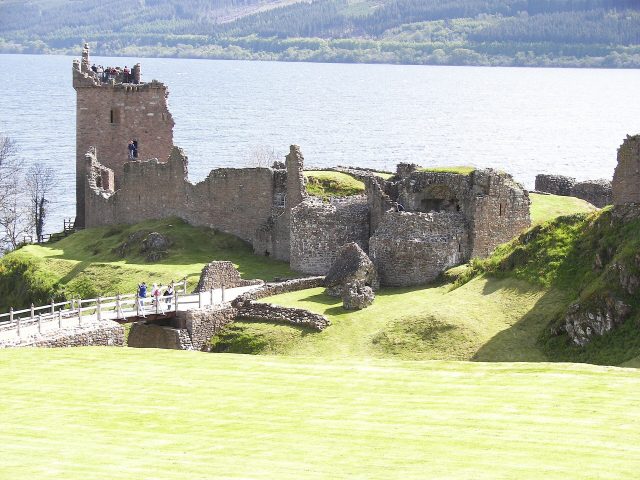
A visit to St Ninian’s can easily be combined with other explorations around Drumnadrochit. The ruins of Urquhart Castle, perched on the loch’s edge, are a short distance away, their crumbling towers a stark contrast to the church’s modest solidity. Walking trails wind through the surrounding hills and forests, offering glimpses of the same landscapes that have inspired stories for centuries. Locals are often happy to share tales of Loch Ness’s mysteries, though the church itself seems to guard its own secrets just as closely. Whether you’re drawn by history, legend, or simply the desire for a quiet moment, this place has a way of making you feel as though you’ve stepped slightly outside of time.
St Ninian’s is more than just a historical site—it’s a living piece of the past, one that has weathered wars, religious upheavals, and the slow march of centuries without losing its essence. Perhaps that’s because time moves differently here. The loch’s waters, still and deep, mirror the church’s own sense of timelessness. To stand in its shadow is to feel a connection to something larger than oneself, a reminder that some places hold their magic not in spectacle, but in the quiet persistence of memory.