Our Lady of La Salette Cathedral in Antsirabe is the kind of place that doesn’t announce itself with fanfare but lingers in the mind long after you’ve left. Tucked into the heart of the city, it sits on a gentle rise, surrounded by low-slung houses with terracotta roofs and streets where life moves at the unhurried pace of a Malagasy provincial town. Unlike the grand cathedrals of Europe, with their soaring spires and gilded interiors, this one is unassuming—smaller in scale, yet no less meaningful. It feels as though it has always been here, woven into the fabric of the city rather than imposed upon it.
The cathedral’s history is tied to Madagascar’s colonial past, when French influence shaped not just the island’s architecture but its religious life as well. Built in the early 20th century, when Antsirabe was emerging as a retreat for European settlers drawn by its mild climate and mineral springs, the cathedral became a symbol of that era. Its name references La Salette, a French village where an apparition of the Virgin Mary was reported in the 19th century, a deliberate nod to the European roots of Catholicism on the island. At the time, Antsirabe was transforming into an administrative and resort hub, and the cathedral stood as a quiet testament to the changes sweeping through Madagascar—railways, hospitals, and missions arriving alongside colonial rule.
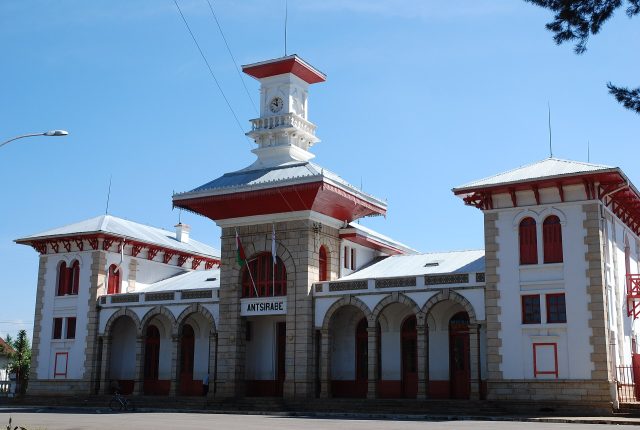
The architecture is simple and functional, free of ornate flourishes but not without its own quiet elegance. Constructed from local stone and brick, the building features tall, arched windows that filter soft light into the interior, creating a sense of calm. The facade is modest, with a small portal adorned by reliefs of saints, and a slender bell tower that doesn’t dominate the skyline but blends into the surrounding streets. Inside, the space is airy, with high vaulted ceilings and wooden pews darkened by decades of use. The altar, crafted in a classical style, incorporates marble and statues likely imported from Europe. There are no gold leaf embellishments or elaborate frescoes, yet the cathedral feels authentic, as if every stone and beam carries the weight of the prayers offered here over generations.
For Antsirabe, Our Lady of La Salette is more than a place of worship—it’s a piece of the city’s identity. In a town where Catholicism coexists with traditional Malagasy beliefs, the cathedral serves as a meeting point for different spiritual and cultural traditions. On Sundays, the congregation gathers—locals, descendants of French settlers, and migrants from other parts of the island. Services are held in both French and Malagasy, a reflection of the cathedral’s role in bridging divides. On weekdays, the space is quiet, the only sounds the occasional footsteps of a priest or the rustle of prayer book pages. But on feast days, the cathedral comes alive with organ music, choir songs, and the scent of incense and candle wax.
Antsirabe itself is an unassuming city, far from the bustle of Antananarivo or the tourist crowds of the coastal resorts. Life here unfolds at its own rhythm: mornings bring markets brimming with vegetables and spices, bicycle rickshaws ferry goods through the streets, and evenings find residents gathered in small cafés, catching up on the day’s news. The cathedral fits seamlessly into this rhythm, neither demanding attention nor fading into the background. It’s visible from the road into town, a subtle landmark that hints at Antsirabe’s layered history—more than just an administrative center, but a place with stories of its own.
A small park surrounds the cathedral, a favorite spot for locals to unwind. Children kick soccer balls across the grass, elderly men sit on benches chatting, and groups of young people gather in the evenings to talk or listen to music. The park acts as a buffer between the sacred space of the cathedral and the everyday life of the city. Under the shade of the trees, it’s easy to escape the midday heat, and on weekends, small fairs sometimes spring up, selling homemade pastries and handcrafted goods. Together, the cathedral and park create a sense of quiet continuity—no rush, no neglect, just a place where time seems to slow down.
For visitors who come to Antsirabe for its mineral springs or mountain hikes, the cathedral offers a chance to reflect on how different cultures and eras intersect in one place. There are no grand declarations or exotic legends here, just the quiet story of how faith and architecture become part of a city’s landscape. The cathedral doesn’t seek to impress; it simply exists, a reminder that even in a distant Malagasy town, European tradition and local life can coexist naturally. Perhaps that’s its greatest value—not in spectacle, but in the way it quietly belongs.