Novodevichy Convent in Kolomna, known as the Novo-Golutvin Monastery, feels like a place where time has gently settled into stillness. Perched on the banks of the Moskva River, it stands apart from the well-trodden paths of tourists, its quiet presence almost untouched by the rush of modern life. The monastery isn’t just a relic of the past—it’s a living space where faith and history continue to breathe. Over the centuries, its walls have witnessed the rise and fall of empires, the quiet devotion of monks, and the slow cycles of neglect and revival. Today, it remains a refuge for those seeking solace, a glimpse into the past, or simply the peaceful sight of the river flowing by.
The origins of the monastery are shrouded in some mystery, with historians debating its exact founding date. Some attribute its establishment to Metropolitan Platon, a prominent figure in the late 18th century who played a key role in restoring and building Orthodox monasteries across Russia. Others suggest it may have grown from an even older settlement, possibly linked to the era of the Golden Horde. Whatever its beginnings, by the early 19th century, the Novo-Golutvin Monastery had firmly taken root, becoming a spiritual anchor for Kolomna and the surrounding region.
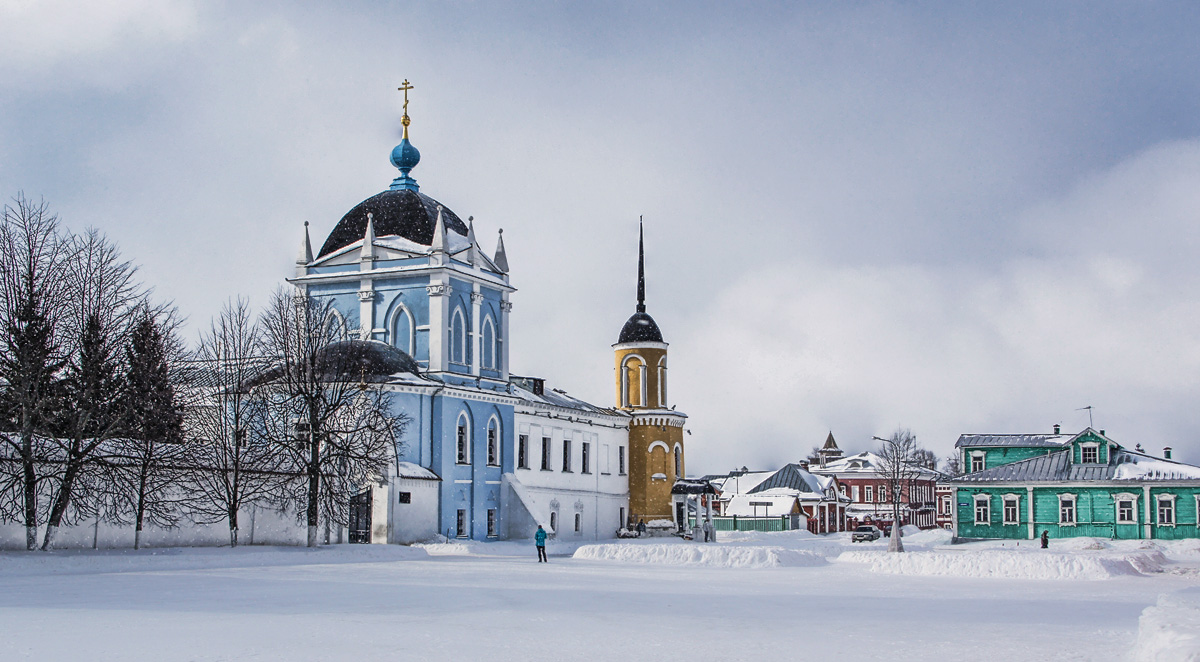
The architecture of the monastery reflects the restrained elegance of late Neoclassicism. The main cathedral, dedicated to the Dormition of the Mother of God, dominates the complex with its white-stone bell tower, drawing the eye upward. The facades are adorned with subtle yet striking details—pilasters, pediments, and arched windows—that lend a sense of harmony to the structures. Inside, the cathedral feels spacious and luminous, its iconostasis a testament to traditional Russian religious art, evoking a sense of reverence. Surrounding the main building are the monks’ quarters, a refectory, and other outbuildings, all arranged around a closed courtyard that feels like a world unto itself.
The 19th century marked a period of flourishing for the monastery, particularly when it became home to a theological seminary. For a time, the monastery thrived, housing dozens of monks and novices, and earning a reputation for its library and workshops. Though the seminary’s existence was relatively brief, its legacy endured. Like many religious institutions in the Soviet era, the monastery faced hardship—its doors were closed, and its buildings repurposed as warehouses, dormitories, and even industrial workshops. It wasn’t until the late 20th century that the monastery began to reclaim its spiritual purpose, gradually returning to the fold of the Russian Orthodox Church.
Walking through the monastery grounds is like stepping into a living history. Ancient linden trees, planted in the 19th century, cast dappled shadows over the paths, while the stone slabs underfoot seem to remember the footsteps of countless visitors. In the quiet hours, when few people are around, the rustling of leaves and the distant chime of bells from the bell tower create a sense of timelessness. The river nearby adds to the tranquility, its slow current a reminder of the enduring rhythms of life beyond the hustle of everyday existence.
Though the monastery is part of Kolomna, it feels distinct from the city, as if it exists in its own quiet corner of the world. Kolomna itself is one of the oldest fortified towns in the Moscow region, steeped in history, and the Novo-Golutvin Monastery is just one thread in its rich tapestry. From the monastery walls, you can see the contrast between old and new—the city’s modern life hums just beyond, but within the monastery’s boundaries, that noise fades away. It’s a place that draws not only pilgrims but also those who simply want to pause, reflect, or take in the beauty of the landscape.
Life at the monastery continues at its own unhurried pace. Services are held regularly, and workshops restore icons and religious artifacts, keeping traditions alive. On feast days, the grounds fill with people, their voices blending with the sounds of the river and the wind. The monastery is especially striking in late summer, when apples ripen in the orchard, or in winter, when snow dusts the domes and tree branches, transforming the scene into something out of an old postcard.
The Novo-Golutvin Monastery isn’t a museum frozen in time—it’s a place where history is still unfolding. Every stone, every tree, and every visitor becomes part of that ongoing story. You might come for a short visit, just to wander the grounds, or stay longer to experience the rhythm of monastic life. Either way, leaving feels difficult. There’s something about the quiet here that makes it easy to think, to breathe, and to simply be.