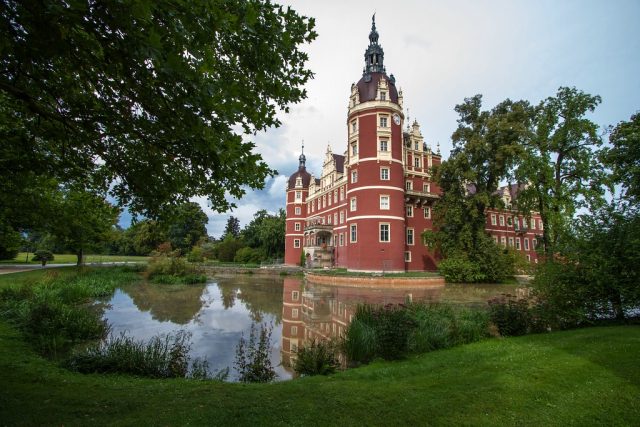
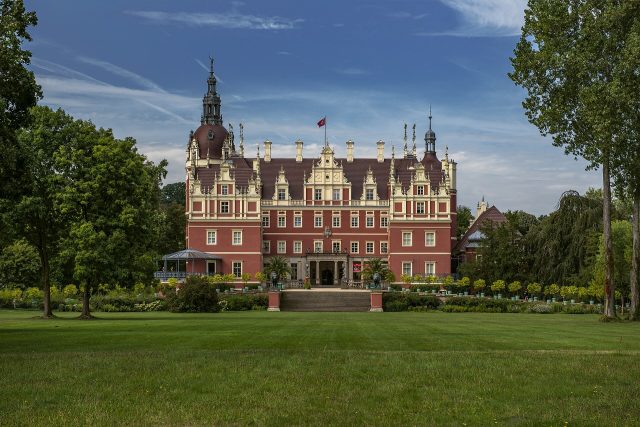
Muskau Park is one of those places where the boundary between nature and human design blurs so thoroughly that it feels unplanned. At its heart stands Neues Schloss, or the New Castle, a modest yet elegant building that has witnessed nearly two centuries of shifting borders, wars, and quiet reinvention. Perched on the banks of the Neisse River, which divides Germany and Poland, the castle is more than just a structure—it’s part of a larger vision. That vision belonged to Prince Hermann von Pückler-Muskau, an aristocrat, traveler, and landscape designer who, in the early 1800s, set out to create a garden that would harmonize art and nature. The New Castle was never meant to dominate the landscape but to complement it, serving as both a residence and a focal point in a carefully crafted world where every path, bridge, and tree had its place.
The castle itself is unassuming, especially when compared to Europe’s grand palaces. Built in the 1820s in a refined neoclassical style, it lacks the ostentation of a royal seat but carries quiet elegance. Its facades feature simple pilasters and pediments, while large windows flood the interiors with light. Inside, some original features remain—ornate stucco ceilings, marble fireplaces, and spacious halls that once hosted gatherings of European high society. Yet much of the interior has been altered over time, either through neglect or repurposing. What survives is a sense of understated grace, a reminder that this was a home designed for living rather than impressing.
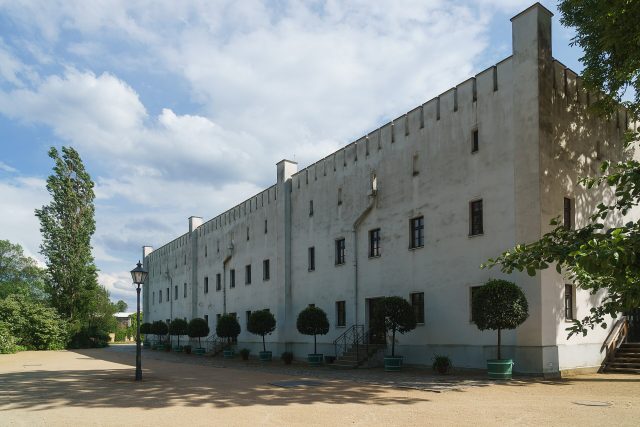
The New Castle was never the primary residence of the Pückler family. That role belonged to the Old Castle of Muskau, a medieval fortress that had served the family for generations. By the early 19th century, the old structure no longer suited Prince Hermann’s ambitions. He wanted something modern, something that would blend with his landscape garden, a place where architecture and nature could exist in balance. The New Castle was his answer—a building that looked outward, toward the park. The Old Castle was left as a historical relic, though both suffered extensive damage during World War II. While the Old Castle was restored, the New Castle languished in ruins for decades.
The postwar years were unkind to Neues Schloss. After the war, it found itself in East Germany, where it was repurposed—a school, a library, even a hotel. It wasn’t until the 1990s, after German reunification, that the castle was returned to the Muskau Park Foundation and restoration began. The building has been stabilized and made functional, but it lacks the opulence of its original interiors. Today, it serves as a cultural space, hosting exhibitions, concerts, and private events. The rooms, though no longer furnished as they once were, still carry echoes of the past.
What makes the New Castle special is its relationship with the park. Prince Pückler-Muskau believed a garden should extend the home, and the home should extend the garden. This philosophy is evident in Muskau Park, where manicured lawns, winding paths, and tranquil ponds create a sense of space. The castle sits at the center, not as a commanding presence but as part of the scenery.
In spring and summer, the park bursts into color with blooming rhododendrons and magnolias. Autumn transforms the landscape into gold and crimson. Even in winter, when the trees stand bare and the Neisse River freezes, the scene retains a quiet beauty.
For those interested in landscape design, Muskau Park is a masterclass in the English garden style. Unlike the rigid, geometric gardens of the Baroque era, Pückler-Muskau’s vision was one of controlled wildness—nature shaped by human hands but never dominated. The park is home to an astonishing variety of trees and shrubs, many imported from distant lands, as well as bridges, grottos, and pavilions that appear to have grown from the landscape. Walking through Muskau feels like stepping into a Romantic-era painting, a time when beauty was found in the untamed and harmony in nature.
Muskau Park is unique as a UNESCO World Heritage Site spanning two countries. The Neisse River, which flows past the New Castle, marks the border between Germany and Poland, and the park stretches across both sides. Visitors can cross the boundary without realizing it. Bridges connect the two halves, and the landscape flows uninterrupted. This adds an extra layer of intrigue, a reminder of how arbitrary borders can be when nature is the architect.
Neues Schloss won’t overwhelm you with grandeur. There are no gilded halls, no priceless art collections, no sweeping staircases. Instead, it offers something subtler: a sense of place, a feeling of being somewhere designed not to impress, but to inspire. It’s a house built to be lived in, enjoyed, and to be part of something larger than itself.
In an age where travel is often about ticking off landmarks, the New Castle and Muskau Park offer a different experience. The reward isn’t in what you see, but in how you feel—the quiet crunch of gravel underfoot, the way light filters through leaves in the late afternoon, or the simple pleasure of sitting by the water and watching the world go by.
Perhaps that’s why this place endures. It doesn’t demand attention; it earns it. In a world that often feels too loud, too fast, too crowded, that quiet presence is powerful. Muskau Park and its New Castle remind us that beauty doesn’t always need to be extravagant. Sometimes, it’s enough to stand where time slows, where the air is fresher, and where the line between nature and design dissolves into something meaningful.