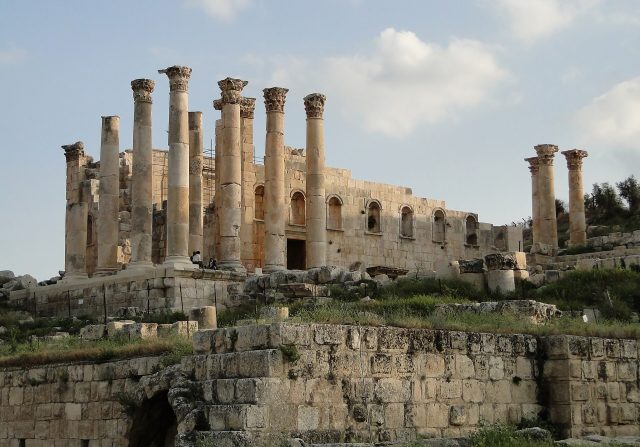
Jerash is a place where the past feels almost tangible, and the Nymphaeum stands as one of its most evocative remnants. Built in the second century, this monumental fountain was more than just a source of water—it was a gathering point, a place of ritual, and a symbol of the city’s prosperity. In a region where water was scarce, such a structure was a statement of wealth and sophistication, a public space where daily life unfolded in the shadow of marble and flowing streams.
The architecture of the Nymphaeum, even in its ruined state, hints at its former grandeur. The two-tiered structure, with its semicircular niche and columns, was once clad in marble and crowned with statues. Water cascaded down the steps into a shallow basin below, creating a sense of movement and life. While little remains of the original decorative elements, the surviving fragments suggest a space designed not just for utility but for beauty—a place where the practical and the sacred intertwined.
Jerash, known in antiquity as Gerasa, was one of the ten cities of the Decapolis, a league of trade and cultural hubs on the eastern frontier of the Roman Empire. The Nymphaeum was a key part of this urban landscape, reflecting both the city’s engineering prowess and its cultural values. In Roman tradition, nymphaea were often dedicated to water deities, imbuing them with a spiritual significance. Here, the fountain would have been a focal point for rituals, a place where the divine and the everyday met.
Today, the Nymphaeum is part of Jerash’s sprawling archaeological park, where visitors can wander among the remnants of a once-thriving city. The site is remarkably well-preserved, with colonnaded streets, temples, and theaters still standing. The Nymphaeum sits near the Oval Plaza and the city’s main thoroughfare, the Cardo, making it an ideal starting point for exploration. The best time to visit is early morning or late afternoon, when the light softens the stones and the absence of crowds allows the ruins to speak for themselves.
What makes Jerash particularly fascinating is its authenticity. Unlike some ancient sites that have been heavily restored, Jerash retains a sense of raw history. The Nymphaeum, like much of the city, is a testament to Roman urban planning, where water was not just a necessity but a luxury to be displayed. The city’s aqueducts, cisterns, and fountains formed an intricate network that sustained its population, and the Nymphaeum was the most visible expression of that system—a place where water was celebrated as much as it was consumed.
Sitting on the steps of the Nymphaeum, it’s easy to imagine the sounds of the past: the murmur of water, the voices of people gathering in its shade, the clatter of carts on the nearby streets. Jerash was a city of merchants, soldiers, and scholars, a crossroads of cultures where Greek, Roman, and local traditions blended. The Nymphaeum was a place where all of this came together, a public space that embodied the city’s identity.
While Petra may draw larger crowds, Jerash offers something different—a quieter, more intimate encounter with history. The Nymphaeum is just one piece of that story, but it’s a piece that matters. It reminds us that cities are not just built of stone but of ideas, of the ways people choose to live and celebrate their world. In Jerash, the past isn’t just preserved; it’s still alive, waiting to be discovered.