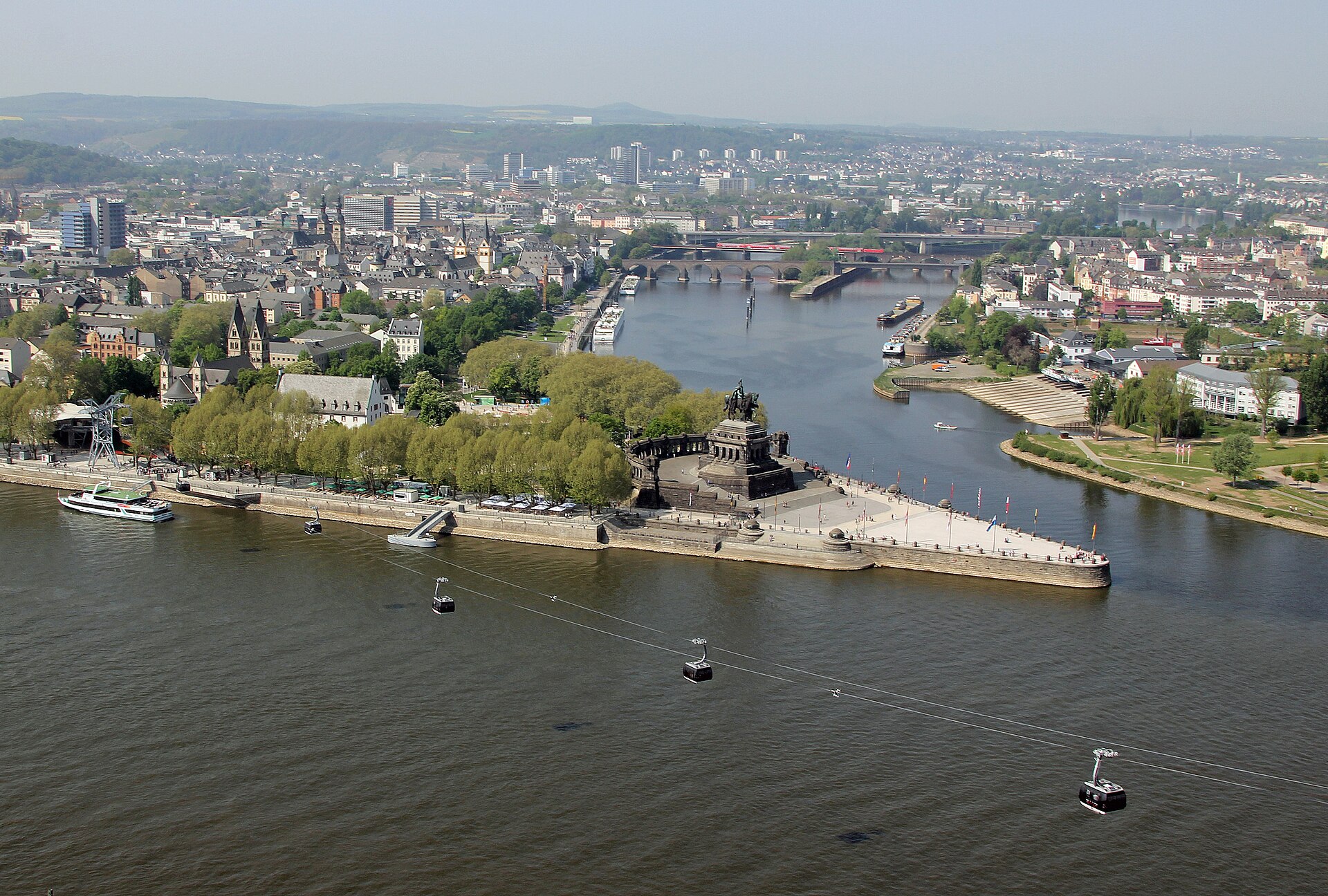
Where the Rhine and Moselle rivers meet, the land narrows into a slender peninsula, creating a natural crossroads in the heart of Germany. This is the Deutsches Eck, or German Corner, a place where geography and history have long intertwined. The confluence of the two rivers has shaped the fate of Koblenz for centuries, serving as both a strategic stronghold and a gathering point for trade, culture, and national identity. Today, the spot is best known for its monumental statue, but its significance runs deeper than the bronze figure that dominates the skyline.
The name German Corner dates back to the Middle Ages, when the Teutonic Knights established a commandery here. The order, known for its role in the Crusades and the expansion into Eastern Europe, chose the site for its commanding view of the rivers and the trade routes they carried. The fortress they built eventually lost its military purpose, but the name endured, shifting over time from a reference to the knights to the broader idea of German unity. By the late 19th century, the corner had become a symbol of something far larger than its medieval origins—a physical representation of the newly unified German Empire.
The statue of Kaiser Wilhelm I, unveiled in 1897, was meant to celebrate the first emperor of a united Germany. At the time, the monument was a statement of national pride, a way to honor the man who had played a key role in bringing together the fragmented German states. The design reflects that ambition: Wilhelm sits astride a horse, towering over the rivers, while allegorical figures at the base represent the virtues and regions of the empire. Yet the statue’s meaning has never been fixed. Damaged during World War II and nearly demolished in the postwar years, it was eventually restored in the 1950s, though without the imperial crown that once topped it. Today, the monument stands as a reminder of how symbols evolve, how they can be reinterpreted, and how history is never as straightforward as it seems.
The architecture of the German Corner balances grandeur with restraint. The statue itself is imposing, but the surrounding park softens its presence, offering a place to sit and take in the view. The rivers here move at different speeds—the Moselle, calm and winding, meets the faster, broader Rhine in a quiet swirl of currents. On clear days, the hills on the opposite bank rise like a painted backdrop, their vineyards and villages adding to the sense of timelessness. The park is well-kept but unpretentious, with benches and pathways that invite lingering. In summer, it fills with locals and visitors alike, while in winter, the bare trees and mist over the water give the place a quieter, almost melancholic beauty.
For Koblenz, the German Corner is more than just a landmark; it’s a living part of the city. Throughout the year, it hosts festivals, open-air concerts, and markets, particularly in the warmer months. On weekends, families stroll along the riverside, stopping at cafés or simply watching the boats pass by. During national holidays, like German Unity Day, the area becomes a focal point for celebrations, with lights and decorations transforming it into a festive gathering place. Yet even on ordinary days, the corner retains its everyday charm, a place where people come to relax rather than just to sightsee.
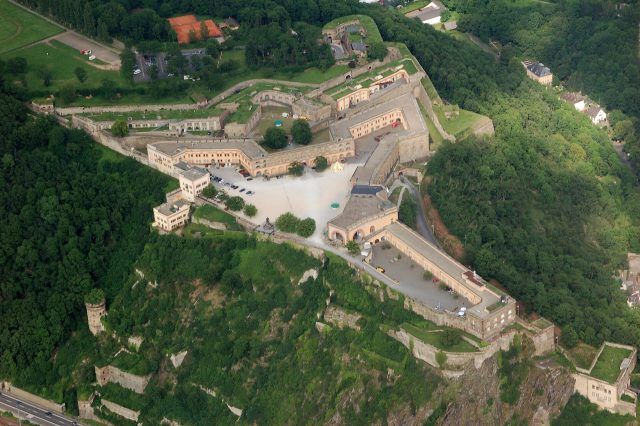
Beyond the monument, the German Corner serves as a gateway to the rest of Koblenz. From here, it’s easy to explore the old town, with its narrow streets and half-timbered houses, or to take a ferry across the Rhine to the Ehrenbreitstein Fortress. Perched on a hill above the rivers, the fortress offers one of the best views of the confluence, its massive walls a reminder of the region’s strategic importance over the centuries. The walk up is steep, but the reward is a panorama that stretches for miles, putting the German Corner into a broader context.
The monument has also become a backdrop for modern life. Couples often choose the spot for wedding photos, drawn to its symbolic weight and the romantic setting. Political rallies and cultural events occasionally take place here, adding new layers to its history. For tourists, the German Corner offers a chance to reflect on how national symbols are shaped by time—how they can inspire pride, provoke controversy, or simply become part of the landscape. It’s a place where the past is always present, but never static.
What makes the German Corner unusual among famous landmarks is its lack of tourist kitsch. There are no overpriced souvenir shops or crowds jostling for the best photo. Instead, the atmosphere remains understated, almost intimate, as if the city has simply set aside this corner of itself for visitors to experience. The sound of the rivers, the rustle of leaves in the park, the occasional laughter from a nearby café—these are the details that linger long after the visit. It’s the kind of place that doesn’t demand attention, but quietly earns it.
Standing at the confluence of the Rhine and Moselle, it’s hard not to feel the weight of history in the air. The rivers have carried armies, merchants, and travelers for centuries, and the German Corner has watched them all pass by. Yet it’s also a place firmly rooted in the present, where locals go about their daily lives and visitors find a moment of reflection. Whether you spend an hour here or a whole day, the corner leaves an impression—not just of a monument, but of a place where time flows as steadily as the rivers themselves. And like the water that meets here, it’s a spot that invites return.