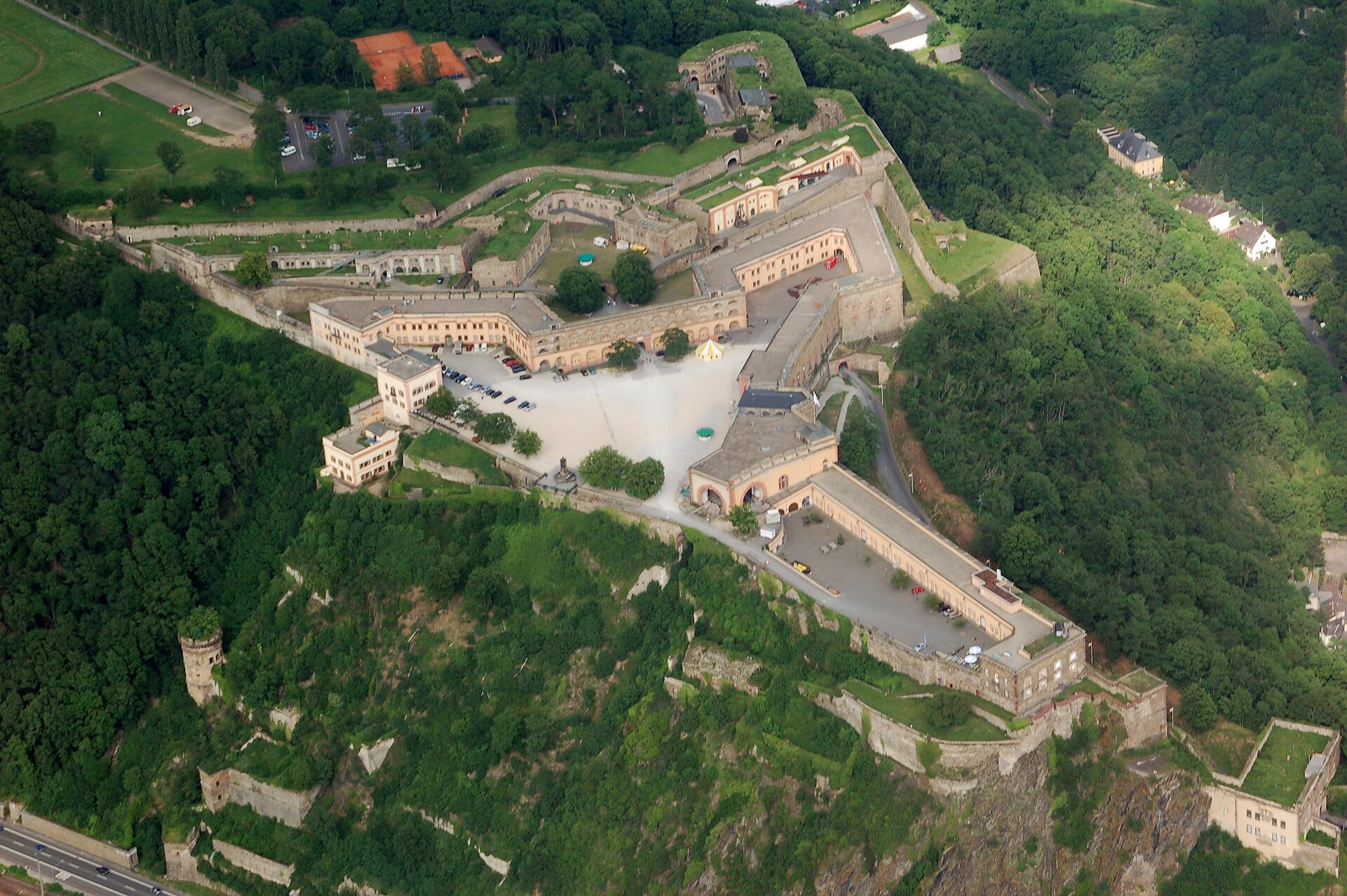
Perched high above the city of Koblenz, Ehrenbreitstein Fortress stands as a silent sentinel over the meeting point of two great rivers, the Rhine and the Moselle. Its imposing walls and bastions dominate the skyline, a reminder of centuries past when control over this strategic vantage point meant power over trade, defense, and the very fate of the region. The fortress didn’t begin as the colossal structure it is today. Its origins trace back to the 9th century, when a modest stronghold was built here under Frankish rule. Over time, its importance grew, and by the 12th century, it had become a key defensive position in the Rhine Valley, a region where fortunes were made and lost along the river’s currents.
During the Middle Ages, Ehrenbreitstein earned its reputation as an impregnable stronghold. Owned by the archbishops of Trier, it was expanded into a formidable military outpost, its high perch making it nearly impossible to besiege. Even during the devastation of the Thirty Years’ War, when much of Germany’s fortifications were reduced to rubble, Ehrenbreitstein remained untaken. Its location wasn’t just about defense—it was about control. The Rhine was the lifeblood of medieval Europe, a bustling trade route carrying goods, wealth, and influence. Whoever held the fortress held a piece of that power, and its walls bore witness to countless struggles for dominance.
The 18th century brought a dramatic transformation. After being heavily damaged by French forces during the War of the Palatine Succession, the fortress was rebuilt in the Baroque style, its defenses modernized with thickened walls, expanded bastions, and an intricate network of underground passages. This was no mere reconstruction; it was a statement. The architects of the time designed Ehrenbreitstein to be more than a military installation—it was a symbol of authority, a fortress that could withstand the changing tides of war. By the time the work was complete, it stood as one of the most advanced fortifications in Europe, a testament to the engineering prowess of the era.
Yet not all of Ehrenbreitstein’s history is written in battles. When Napoleon dissolved the Holy Roman Empire in the early 19th century, the fortress lost its military significance. For a time, it served as a prison before falling into disrepair. But the Prussians, ever mindful of its strategic value, restored it mid-century, turning it into barracks and later a museum. Today, its halls house exhibits on the history of the Rhineland, from medieval weaponry to the industrial age. One of the most striking displays is the collection of historic cannons, their weathered barrels a reminder of the firepower that once defended these walls.
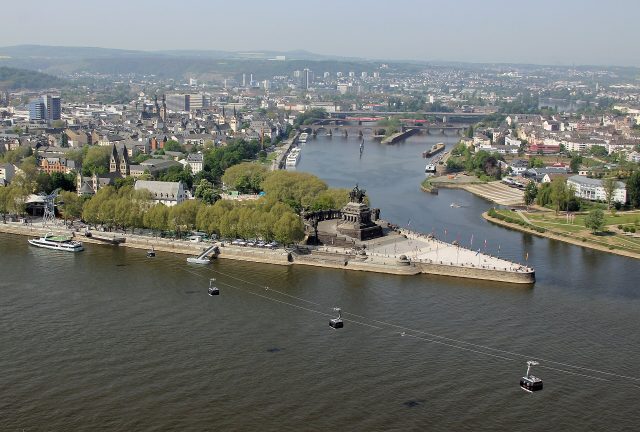
The view from Ehrenbreitstein is reason enough to make the journey. From its heights, the confluence of the Rhine and Moselle unfolds in a sweeping panorama, a landscape of rolling hills, vineyards, and the winding river below. This spot, known as the Deutsches Eck or German Corner, is one of the most photographed in the region. On clear days, the vista stretches for miles, offering a glimpse of the natural beauty that has drawn people to this place for centuries. In summer, the fortress buzzes with visitors—some hiking up the steep paths, others taking the cable car from the riverbank. Winter lends the scene a stark, almost timeless quality, the fortress standing sentinel over a quiet, frost-touched landscape.
Inside, the atmosphere is a world apart. The narrow corridors, vaulted ceilings, and thick stone walls evoke a sense of stepping back in time. Some rooms still bear the marks of their past—faded frescoes, graffiti left by long-gone soldiers, the echoes of voices that once filled these halls. The casemates, once used to store ammunition, now lie silent, but it’s easy to imagine the thunder of cannons shaking the foundations. One of the museum’s most fascinating exhibits is a series of scale models showing how the fortress evolved over the centuries, each iteration a reflection of the military strategies and architectural styles of its time.
Ehrenbreitstein is more than a historical site; it’s a place where the past feels tangible. You could spend hours wandering its ramparts, exploring its hidden corners, or simply sitting on one of the viewing platforms, watching the river flow far below. The fortress has a way of making history feel immediate, as if the stones themselves remember the people who once walked here—knights, soldiers, prisoners, and kings. Throughout the year, it hosts events that bring the past to life, from summer concerts to winter Christmas markets. But even without them, Ehrenbreitstein has a presence, a quiet energy that lingers in the air.
Today, the fortress is a symbol of Koblenz, a monument to the city’s enduring significance in European history. It stands as a reminder of the countless lives shaped by this place, of the battles fought and the trade routes that once made the Rhine Valley the heart of the continent. The climb up is worth it for the view alone, but the real magic of Ehrenbreitstein lies in its ability to make history feel alive. There’s no grand spectacle here, no staged reenactments—just the weight of centuries in the stone, the whisper of the wind, and the river below, carrying stories that have yet to be told.