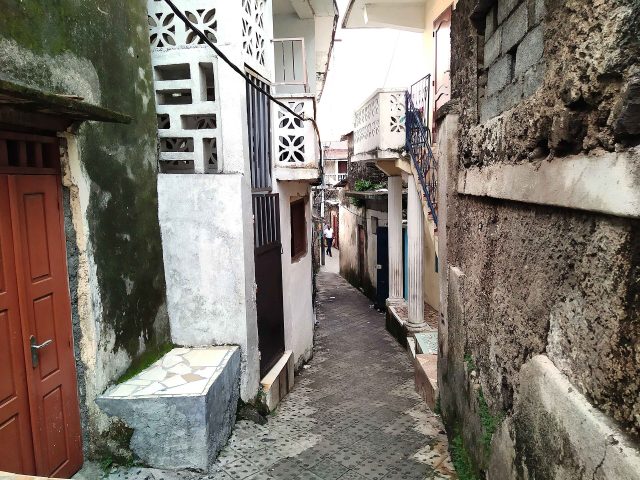
The National Museum of Comoros in Moroni is one of those quiet places where history feels alive, not just preserved. Tucked along Boulevard Karthala in the heart of the capital, it occupies a building that carries its own stories—low-slung, with thick coral-stone walls and wooden shutters that have weathered decades of ocean winds. The museum opened in the 1980s, not long after the islands gained independence, as if the country needed a place to gather its memories before they slipped away. It’s small, but that only makes it more intimate, a space where you can linger over details without the rush of a larger institution.
The exhibits unfold like chapters of a book you didn’t know you wanted to read. One room holds the tools of daily life—carved wooden chests with intricate patterns, clay pots fired in open pits, fabrics dyed with indigo and turmeric, their designs passed down through generations. These aren’t just artifacts; they’re evidence of how people here once lived, how they adapted to an island existence where resources were limited but ingenuity wasn’t. Nearby, fishing gear takes center stage: handwoven nets, harpoons, and models of traditional *ngalawa* canoes, their outriggers designed to cut through rough waters. For Comorians, the sea has always been more than a livelihood—it’s a defining force, shaping everything from diet to folklore, and the museum doesn’t let you forget that.
Islam arrived on these islands over a thousand years ago, carried by Arab traders and Swahili settlers, and the museum dedicates a section to its layered history. You’ll find yellowed pages of the Quran, handwritten in elegant script, alongside brass oil lamps and prayer beads worn smooth by decades of use. Photographs show the whitewashed domes of Moroni’s mosques, including the venerable Vendredi Mosque, its minaret a landmark in the city’s skyline. The displays trace how Islam merged with older beliefs, how it became woven into the fabric of society—not just as a religion, but as a cultural framework that dictated everything from marriage customs to the rhythm of the workday. It’s a reminder that faith here isn’t just observed; it’s lived.
The colonial era gets its own somber corner. France ruled the Comoros for much of the 20th century, and the museum doesn’t shy away from the complexities of that time. Black-and-white photographs show French administrators alongside Comorian laborers, their expressions unreadable. Documents detail the push for independence, the protests, the negotiations—moments that must have felt both exhilarating and uncertain. There’s no glorification here, just a straightforward presentation of how the islands found their footing after centuries of foreign control. It’s not an easy story, but it’s an essential one, especially for visitors who might only know the Comoros as a postcard-perfect destination.
Archaeology offers a glimpse even further back, to a time before written records. The islands were settled as early as the 6th century, and the museum displays stone tools, fragments of pottery, and shell beads that hint at those first communities. These objects are modest—no gold or grand sculptures—but they carry weight. They speak of people who crossed the Indian Ocean in fragile boats, who built homes from coral and thatch, who survived on what the land and sea provided. It’s a humbling reminder that the Comoros have always been a crossroads, a place where African, Arab, and Malagasy influences collided long before Europeans arrived.
The museum isn’t stuck in the past, though. Temporary exhibits often focus on contemporary issues, like the fight to protect the islands’ fragile ecosystems or the revival of traditional crafts. You might see a display of *shigoma* baskets, woven from palm leaves by women in rural villages, or photographs of the endemic Livingstone’s fruit bat, one of the world’s rarest mammals. Local artists occasionally showcase their work here, blending modern techniques with motifs that have been around for centuries. It’s a way of showing that Comorian culture isn’t static—it’s still evolving, still adapting.
The building itself is part of the experience. Constructed in the traditional *style comorien*, it uses materials that have defined island architecture for generations: coral stone for the walls, hardwood for the beams, and woven palm leaves for the roof. The interior is airy, with high ceilings and open courtyards that let in the scent of frangipani from the garden. There are no flashy interactive screens or guided tours in multiple languages—just a few well-lit rooms where you can wander at your own pace. The staff, often volunteers or local historians, are usually happy to chat if you have questions, though they won’t push themselves on you.
What makes the museum special isn’t its size or its budget, but its sense of purpose. For Comorians, it’s a place to reconnect with their heritage, to show their children the objects and stories that define who they are. For outsiders, it’s a rare opportunity to see beyond the beaches and volcanoes, to understand that these islands have a depth that isn’t immediately obvious. There’s no grand narrative here, no attempt to oversimplify a complex history. Instead, it’s a collection of fragments—some beautiful, some painful, all real—that together paint a picture of a place that has always been more than it seems.