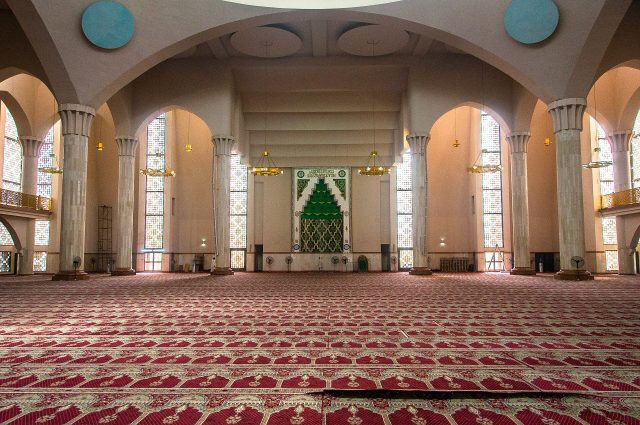
The National Church of Nigeria in Abuja is more than just a place of worship—it stands as a quiet testament to the country’s search for unity and spiritual renewal. Built in the late 20th century, it emerged during a time when Nigeria was redefining its identity, both as a nation and as a society shaped by diverse faiths. Perched on a hill, the church’s imposing silhouette is visible from afar, a subtle yet constant reminder that shared beliefs can bridge even the deepest divides in a country as varied as Nigeria.
The architecture of the church reflects this balance between the modern and the traditional. Its cruciform structure immediately signals its Christian purpose, yet the design incorporates elements of local craftsmanship and artistic expression. The soaring ceilings and expansive interiors allow natural light to fill the space, creating an atmosphere that feels both solemn and welcoming. The main altar, in particular, draws the eye with its intricate details, blending Christian symbolism with motifs that echo Nigeria’s cultural heritage.
Beyond its role as a house of prayer, the church was conceived as a gathering place for the community. It hosts not only religious services but also concerts, art exhibitions, and public events that bring together people of different backgrounds. This dual purpose makes it a living part of Abuja’s social fabric—a place where faith intersects with everyday life, where visitors can witness the rhythm of a country where old traditions and new ideas coexist in unexpected ways.
Abuja itself is a city of contrasts, where gleaming skyscrapers stand alongside bustling markets, and luxury neighborhoods border more modest districts. The National Church fits into this landscape as a symbol of continuity and hope. In a rapidly changing capital, it offers a sense of stability, a space where the pace slows and the noise of the city fades into the background.
The church’s origins are closely tied to Nigeria’s post-independence journey. After gaining sovereignty in 1960, the country faced numerous challenges, including tensions between different religious and ethnic groups. The National Church was one of several initiatives aimed at fostering national unity, funded by donations from worshippers across Nigeria. This collective effort underscores its significance as a project that transcends individual communities, representing something larger than itself.
Stepping inside the church is an opportunity to engage with Nigeria’s spiritual and cultural life. The interior features works by local artists, and during services, traditional hymns blend with contemporary worship music. After prayers, visitors might find themselves sharing a meal with parishioners, sampling dishes that reflect the country’s culinary diversity. The atmosphere is warm and unpretentious, a reflection of the church’s role as a place where people come not just to pray, but to connect.
While its primary purpose is religious, the church welcomes everyone. Tourists and residents of Abuja often stop by to admire the architecture or simply sit in the quiet, away from the city’s hustle. It’s a space where the mind can wander, where the weight of daily life feels a little lighter.
The National Church of Nigeria is not a static monument but a living institution, evolving alongside the society it serves. For the faithful, it offers solace; for artists, inspiration; and for travelers, a glimpse into the soul of a nation that is as complex as it is vibrant. In a country where change is constant, it remains a steady presence—a reminder that some things endure.