Aso Rock rises abruptly from the heart of Abuja, a massive granite outcrop that has watched over the Nigerian capital since long before the city existed. Its sheer walls and weathered surface tell a story far older than the modern metropolis sprawling at its feet. For centuries, this geological formation was a silent witness to the rhythms of local life, a landmark for travelers and a place of quiet significance for the Gwari people who lived in its shadow. Today, it stands as both a natural monument and a symbol of Nigeria’s political identity, its name now synonymous with the seat of power in the country.
The rock itself is impossible to ignore. Stretching nearly a kilometer in length and towering over 400 meters above the surrounding landscape, Aso Rock dominates the skyline of Abuja. Its rugged face, striated with veins of quartz and feldspar, glows golden in the late afternoon sun, a stark contrast to the greenery that clings to its lower slopes. From certain angles, the rock appears almost like a fortress, its sheer sides offering a sense of permanence in a city that has transformed rapidly over the past few decades. While the area around it is now home to government buildings, embassies, and residential districts, the rock remains untouched, a rare constant in a place defined by change.
Aso Rock’s modern significance began in the 1970s, when Nigeria’s military government decided to move the capital from Lagos to a more central location. Abuja was chosen for its neutrality, its space, and its potential to become a symbol of national unity. The name Aso, derived from the Gwari word for victory, was adopted for the presidential complex built at the base of the rock, reinforcing the idea of strength and resilience. Over time, the term Aso Rock became shorthand for the Nigerian presidency, much like the White House or the Kremlin in other nations. The rock itself, however, remains a public space, accessible to those who wish to see it up close, though the areas immediately around the presidential villa are understandably restricted.
Visitors to Aso Rock won’t find the kind of manicured gardens or tourist infrastructure that surround other famous landmarks. There are no guided tours, no souvenir stalls, and no grand entrances. Instead, the experience is more about the quiet presence of the rock itself. The best views come from the roads winding around its base, where you can pull over and take in the scale of the formation. On clear days, the vista extends far beyond the rock, offering glimpses of Abuja’s low-slung skyline and the rolling hills that surround the city. For those who venture closer, the base of the rock is a place of contrasts—modern security fences stand alongside patches of untamed bush, a reminder of how quickly the natural and the political have become intertwined here.
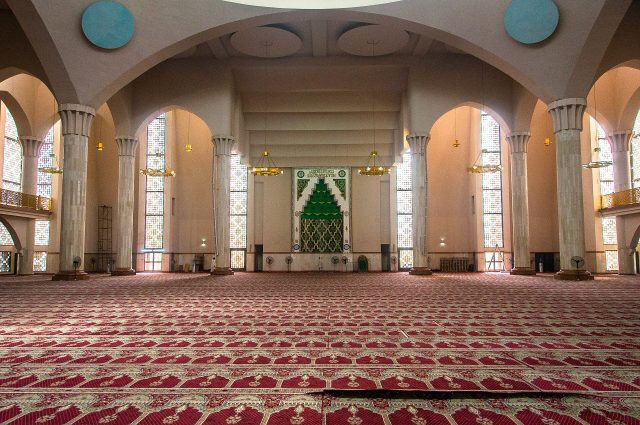
The area around Aso Rock is also home to some of Abuja’s most important institutions. The Nigerian Presidential Complex, the National Assembly, and the Supreme Court are all located within a short distance, making this one of the most politically charged patches of land in the country. The architecture here is a mix of the grand and the functional, with wide boulevards, imposing government buildings, and the occasional splash of greenery. The Nigerian National Mosque and the National Christian Centre, both located nearby, reflect the country’s religious diversity, while the Three Arms Zone—where the executive, legislative, and judicial branches of government are housed—embodies the balance of power in a young democracy.
Despite its political associations, Aso Rock retains a sense of mystery. There are no plaques explaining its history, no official narratives about its significance. For many Nigerians, it is simply there—a silent guardian of the capital, a backdrop to the daily workings of government, and a reminder of the land’s deep history. For outsiders, it offers a glimpse into the soul of Abuja, a city that was built with purpose but has grown in ways no one could have predicted. The rock doesn’t demand attention; it commands it, not through spectacle, but through its sheer, unyielding presence.
The best time to visit Aso Rock is in the early morning or late afternoon, when the light softens the harsh lines of the granite and the air is cooler. There’s no need to plan an elaborate itinerary—just drive along the roads that circle the rock, stop where it feels right, and take a moment to appreciate the view. The rock doesn’t change, but the city around it does, and that tension between permanence and transformation is what makes Aso Rock so compelling. It’s a place where history, politics, and nature intersect, not in a grand, orchestrated way, but in the quiet, unspoken language of the land itself.
For those who spend time in Abuja, Aso Rock becomes a familiar sight, a reference point in a city that can feel overwhelming in its scale and ambition. It’s a reminder that even in a capital built from scratch, there are echoes of the past, traces of the earth’s own story. Whether you’re a first-time visitor or someone who has seen the rock a hundred times, there’s always something new to notice—the way the light hits the stone at a certain angle, the shadows cast by the surrounding trees, or the sense of stillness that settles over the area as the day winds down. Aso Rock doesn’t offer answers, but it invites reflection, a rare quality in a place defined by power and progress.