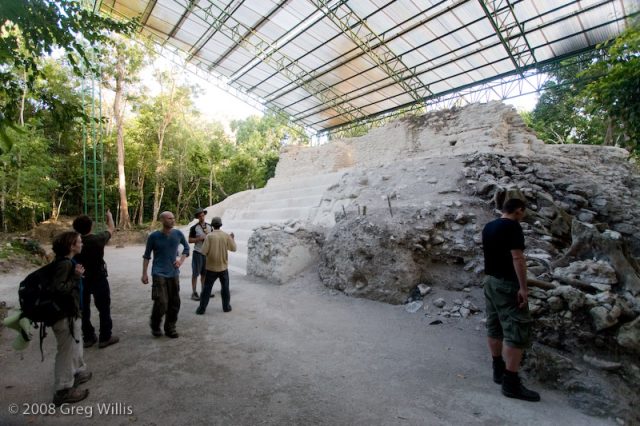
Nakbé is one of those rare places in Guatemala where time seems to have paused, leaving behind a quiet corner of the Petén jungle untouched by the modern world. Long before the rise of Tikal or El Mirador, this ancient Maya city thrived as one of the region’s most significant settlements. Its name, meaning "Great Way," hints at its former importance, though today the only sounds breaking the silence are the rustle of leaves and the distant calls of tropical birds. The ruins, half-swallowed by moss and vines, stand as silent witnesses to a civilization that vanished over a thousand years ago.
Archaeologists have traced Nakbé’s origins back to the Middle Preclassic period, around 1000 BCE, with its golden age spanning from 600 to 400 BCE. This was no mere cluster of huts—Nakbé was a city of monumental ambition, where towering pyramids, grand platforms, and acropolises were adorned with carved stelae and masks of gods. Among its most striking structures is Structure 1, one of the earliest pyramids in Mesoamerica, a testament to Nakbé’s role as a religious and political powerhouse long before the Maya perfected their limestone architecture.
The city’s layout reveals a sophisticated society. Its core was divided into distinct zones: temples, royal palaces, and public plazas where rituals and gatherings took place. Beyond these lay residential neighborhoods, and further still, farmland where maize, beans, and squash were cultivated. Unlike many Maya cities, Nakbé lacked defensive walls, suggesting either a period of relative peace or the unchallenged authority of its rulers. The absence of fortifications also gives the ruins an open, almost serene quality, as if the city once existed in harmony with its surroundings.
Yet Nakbé’s decline remains a mystery. By the start of the Classic period, around 250 CE, the city was abandoned, its people likely migrating to nearby centers like El Mirador. The reasons are still debated—climate shifts, exhausted soils, or internal strife may have played a role. Whatever the cause, this abandonment preserved Nakbé in a way few other Maya sites were. Without later modifications or expansions, the ruins offer a rare glimpse into the early stages of Maya urban development, unaltered by the hands of time.
Visiting Nakbé is not a casual outing. The journey itself is part of the experience: a long drive over rough roads, followed by a hike through dense jungle trails. There are no crowds here, no souvenir stands or neatly labeled signs—just the occasional group of researchers or intrepid travelers drawn by the allure of the unknown. The isolation makes the place feel almost sacred, as if the past lingers just beneath the surface.
The ruins themselves are awe-inspiring, even in their incomplete state. Some pyramids rise above the treetops, their steps leading upward like a bridge to another era. The Great Acropolis, a complex of platforms and temples, was likely the heart of the city’s ceremonial life. Though many carvings have been worn away by time and humidity, fragments of mythological figures still cling to the stone, hinting at the stories once told here.
Local guides, who know the jungle’s secrets as well as its paths, often share legends passed down through generations. One tale speaks of the spirits of Nakbé’s rulers still wandering the ruins, guarding their lost treasures. Whether or not you believe in such stories, there’s a sense of reverence in the air, a feeling that this place is more than just stone and earth.
Nakbé is a reminder of how fleeting human achievement can be. A city that once dominated its world now lies almost forgotten, reclaimed by the jungle. Yet that very obscurity is what makes it special. Here, history isn’t just observed—it’s felt. For those willing to venture off the beaten path, Nakbé offers something far more profound than a typical tourist experience. It’s a chance to step into the past, to walk among the echoes of a civilization that shaped a continent, and to leave with a quiet understanding of how small we are in the grand sweep of time.