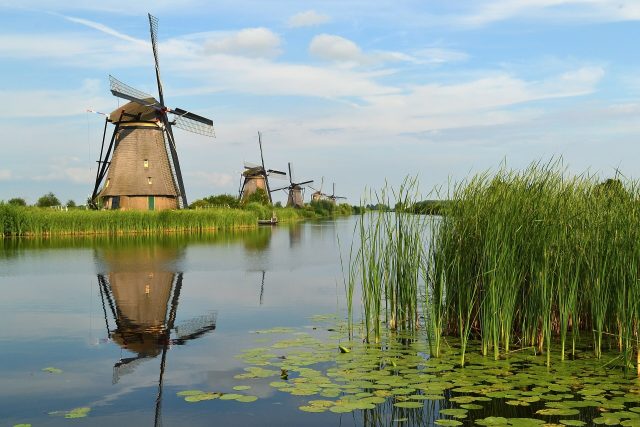
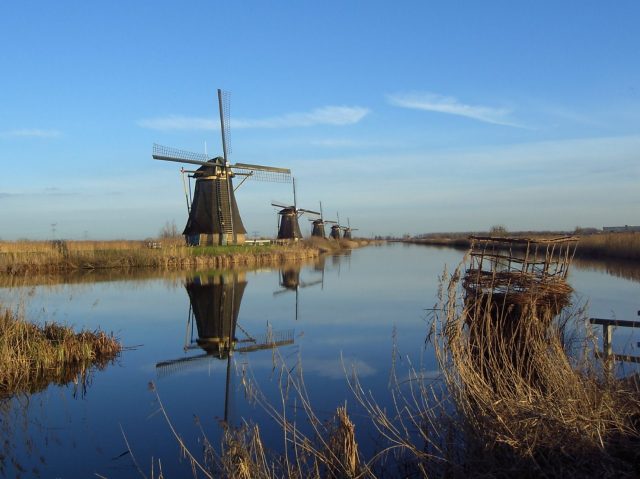
Kinderdijk’s Nieuwe-Lekkerland Quay is where the Netherlands reveals itself in its most iconic form. Here, among the flat green meadows and winding canals, seventeen eighteenth-century windmills stand in a perfect line, their sails turning against the sky. They weren’t built for show. These mills tell the story of a country shaped by water, where every inch of land has been claimed, drained, and defended for centuries. Unlike static monuments, they remain part of an active system, still capable of pumping water from the low-lying polders into the higher canals when needed.
The quay itself runs along the water, connecting the mills in a quiet procession. This isn’t a polished tourist attraction but a working part of the village, where daily life once unfolded in rhythm with the turning sails. Today, the pace is slower. Visitors come not for crowds or entertainment but to see what the Netherlands looked like three hundred years ago. Wooden footbridges cross narrow waterways, paths follow the canal’s edge, and the millers’ houses—each with its tidy garden—stand as they have for generations. Even the bike paths that run alongside feel like a natural part of the scene, proof that life here hasn’t frozen in time.
The mills were constructed between 1738 and 1740, when it became clear that older drainage systems could no longer keep up with the water’s relentless pressure. Designed by engineers of the time, the project was so effective that it’s still considered a masterpiece of hydraulic engineering. Each mill wasn’t just a structure but a link in a larger chain. Working together, they lifted water from the low polders into higher canals, where it could flow toward the rivers. This system functioned until the mid-twentieth century, when electric pumps took over, but the mills haven’t been retired. A few remain operational, and some are open to visitors, revealing the intricate wooden gears, grinding stones, and control levers inside.
Some of the mills still contain the living quarters where millers and their families once resided. These aren’t staged museum displays but real homes, some still inhabited by descendants of those who kept the mills running. They speak of a demanding life—rising before dawn to start the mechanisms, standing watch during storms to prevent flooding. The work was hard, but it was essential. Without these mills, the land would have remained a swamp, unusable for farming or settlement.
Kinderdijk sits in the delta of the Rhine and Meuse rivers, a landscape literally shaped by human hands. The surrounding polders are the result of centuries of effort to drain marshes and hold back the water. There are no natural hills here, no high ground to retreat to. Every patch of land had to be won, and the mills were a crucial part of that struggle. They weren’t built for aesthetics but out of necessity. Today, the neat fields and straight canals make it hard to imagine that this was once an impassable wetland, but the mills stand as a reminder of how much work went into creating it.
Nieuwe-Lekkerland Quay isn’t just a place for pictures, though the views are undeniably striking. It’s also a chance to understand how life in the Netherlands has always been tied to water. Here, water isn’t an obstacle—it’s a presence, flowing through the canals, bordering the fields, reflecting the sky. The Dutch didn’t fight it; they learned to work with it, bending it to their needs. The mills at Kinderdijk are proof of that. They’re beautiful, yes, but their real value lies in their function. Even now, as their role has changed, they remain a defining feature of the landscape, showing how people and nature can coexist when there’s respect on both sides.
The best time to visit is in spring or early summer, when the fields are lush and green, and the air carries the scent of grass and water. The mills blend seamlessly into the scenery, their silhouettes mirrored in the canals. Autumn can be lovely too, though the weather turns unpredictable—rain and wind serve as a reminder that water is never far away. Winter brings a quieter kind of beauty, with fewer visitors and a sense of stillness. Even in peak season, Kinderdijk doesn’t feel crowded. The village retains its calm, as if the mills themselves set the pace.
The mills are a UNESCO World Heritage site, and the designation is more than symbolic. Nowhere else in the world will you find so many windmills in one place, still serving their original purpose. But what makes them truly special is that they’re alive. This isn’t a place where the past is preserved behind glass. It’s where you can touch it, walk through it, and understand that history isn’t just about dates and events—it’s about the daily labor of people who built their lives on this land. Nieuwe-Lekkerland Quay isn’t an open-air museum. It’s a place where past and present exist side by side, each making the other richer.