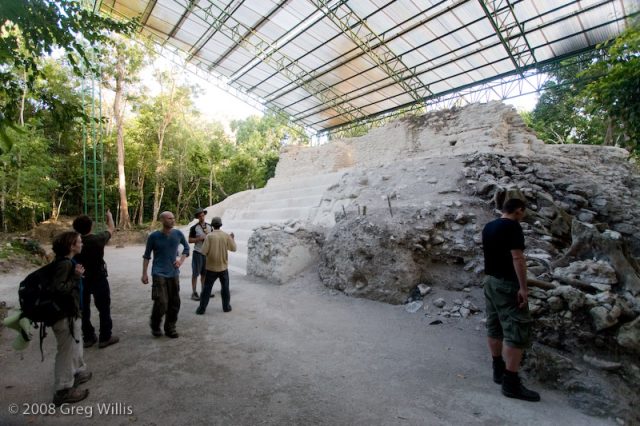
Naachtun is one of those rare places where the journey feels as meaningful as the destination itself. Tucked deep within the Petén jungle of Guatemala, it remains hidden from the well-trodden paths of mass tourism, accessible only by rugged trails that wind through dense forest. The last stretch of the trip is often made on foot or in a four-wheel-drive vehicle, navigating muddy paths where howler monkeys swing through the trees and toucans dart between branches. This isolation has preserved Naachtun almost untouched, making it one of the most atmospheric yet least explored Maya sites in Central America.
The city flourished during the Classic period of Maya civilization, rising to prominence between the 6th and 9th centuries. Strategically positioned between major centers like Tikal and Calakmul, it played a key role in regional politics and trade. Inscriptions refer to it as *Danháabnáak*, meaning "city on the distant hill," a name that suits its elevated position amid the jungle canopy. Forgotten for centuries, Naachtun was rediscovered in 1922 by American archaeologist Sylvanus Morley. Since then, intermittent excavations have revealed layers of history, each discovery reshaping our understanding of Maya life.
The architecture of Naachtun reflects the grandeur of the Classic period while bearing its own distinct character. The central area is organized around plazas and pyramids, with the tallest structure, known as Structure I, rising 20 meters high. Likely used as a temple or observatory, its steep staircases and intricate facades are adorned with carved masks of deities and geometric patterns. Nearby, low-slung palace complexes once housed rulers and nobility. Unlike larger Maya cities, Naachtun lacks monumental scale but compensates with meticulous detail—stone stelae, altars, and carved panels that recount battles, royal marriages, and celestial observations.
One of Naachtun’s most remarkable features is its water management system. While many Maya cities relied on natural sinkholes called cenotes, Naachtun’s inhabitants engineered reservoirs and canals to collect rainwater during the wet season, sustaining the city through dry months. This innovation allowed the settlement to thrive far from rivers or lakes, a rarity for its time. Some of these ancient reservoirs are still visible today, though the jungle slowly reclaims them.
The atmosphere here is one of quiet grandeur. There are no crowds like those at Chichén Itzá or Tikal, and even locals rarely venture this deep into the forest. Most visitors are small groups of researchers or adventurous travelers willing to endure the journey for the chance to stand in a place where time feels suspended. The jungle hums with life—birds calling, leaves rustling—as if the city still holds secrets just out of sight. At dusk, the ruins cast long shadows, and the air grows thick with the sense that something ancient lingers.
In recent years, Naachtun has begun to reveal more of its past. Excavations have uncovered well-preserved murals depicting rulers and mythological scenes, offering insights into the city’s religious beliefs. Workshops where pottery and tools were crafted have also been found, shedding light on daily life. These discoveries confirm that Naachtun was not just a provincial outpost but a cultural hub where ideas and technologies from across Mesoamerica converged.
Visiting Naachtun requires preparation and respect. There are no tourist amenities—no cafes, no souvenir stands, not even clear signage. The path winds through protected forests, demanding caution for both the environment and personal safety. Mosquitoes, heat, and humidity can be challenging, so the dry season, from November to April, is the best time to visit. Local guides, familiar with the terrain and customs, can help navigate the journey and point out details that might otherwise go unnoticed.
Naachtun is more than just ruins. It’s a testament to how a civilization thrived in the heart of the jungle, building a complex society that left behind a legacy still felt today. There are no sensational legends of curses or lost treasures here, just the quiet magic of a place where history breathes through every stone. For those who make the journey, it offers something rare—a chance to stand on an ancient pyramid and gaze across the endless green expanse that was once home to an entire world. In an age where so much has been explored, Naachtun still feels like a discovery.