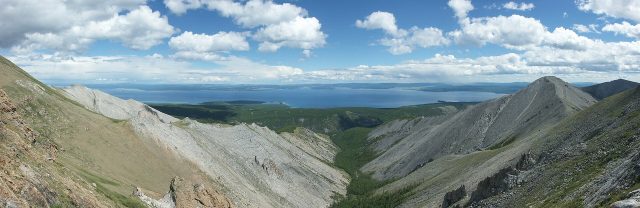
Lake Khövsgöl is often called the younger sibling of Siberia’s Lake Baikal. The small museum in Khatgal shows why that comparison holds. Housed in a modest wooden building, it feels more like a local’s living space than a formal institution. The air inside carries the scent of aged wood and old paper, and the displays are arranged with care.
The lake formed nearly two million years ago when tectonic shifts carved one of Central Asia’s deepest freshwater bodies. Its waters remain among the clearest in the world. The museum traces this history through geological samples, maps, and preserved fish—pike and grayling—that live in its depths. Rocks from the shoreline, fishing tools, and mounted specimens fill simple cases. The presentation leaves room for the lake’s presence to stay with you: its vastness, its stillness, the way it shapes the landscape.
For those who live along its shores, Khövsgöl has always meant more than water or food.
The museum includes the lake’s spiritual significance in Mongolian culture. Shamans once saw it as a dwelling of spirits. Buddhist monks performed purification rituals on its banks. Photographs and artifacts from these traditions sit quietly, as if reverence here is a daily practice. The exhibits don’t explain these beliefs. They let them exist alongside scientific and historical narratives, suggesting all ways of understanding the lake matter.
A corner of the museum focuses on scientific expeditions that studied Khövsgöl over the decades, especially during the Soviet era. Joint Mongolian and Russian teams explored its geology, hydrology, and biology. Faded maps, handwritten field notes, and jars of preserved plankton with yellowed labels fill the displays. These remnants of past research show how knowledge about such a remote place was gathered over time.
The museum also highlights the Darhad people, an ethnic group tied to Khövsgöl for centuries. Unlike steppe nomads, the Darhad traditionally herded reindeer. Embroidered clothing, wooden saddles, and tools used in reindeer husbandry fill the exhibits. These objects hint at a way of life adapted to the taiga’s harsh environment.
Khatgal is a cluster of buildings along the lake’s southern shore. It feels like a threshold, a place to pause before venturing onto the water or into the mountains.
After visiting the museum, walk down to the lake. In summer, the water is a deep blue, reflecting the sky so perfectly the horizon blurs. In winter, the lake freezes solid, becoming a vast plain crossed on foot or by vehicle. The seasons here transform the landscape itself.
The museum doesn’t compete with Khövsgöl’s grandeur. It offers a way to see the lake through the eyes of those who know it best. Fishermen, herders, scientists, and shamans have all found something essential here. For travelers who want more than scenery, the museum provides context. It shows how some places are shaped by time, belief, and the persistence of those who call them home.