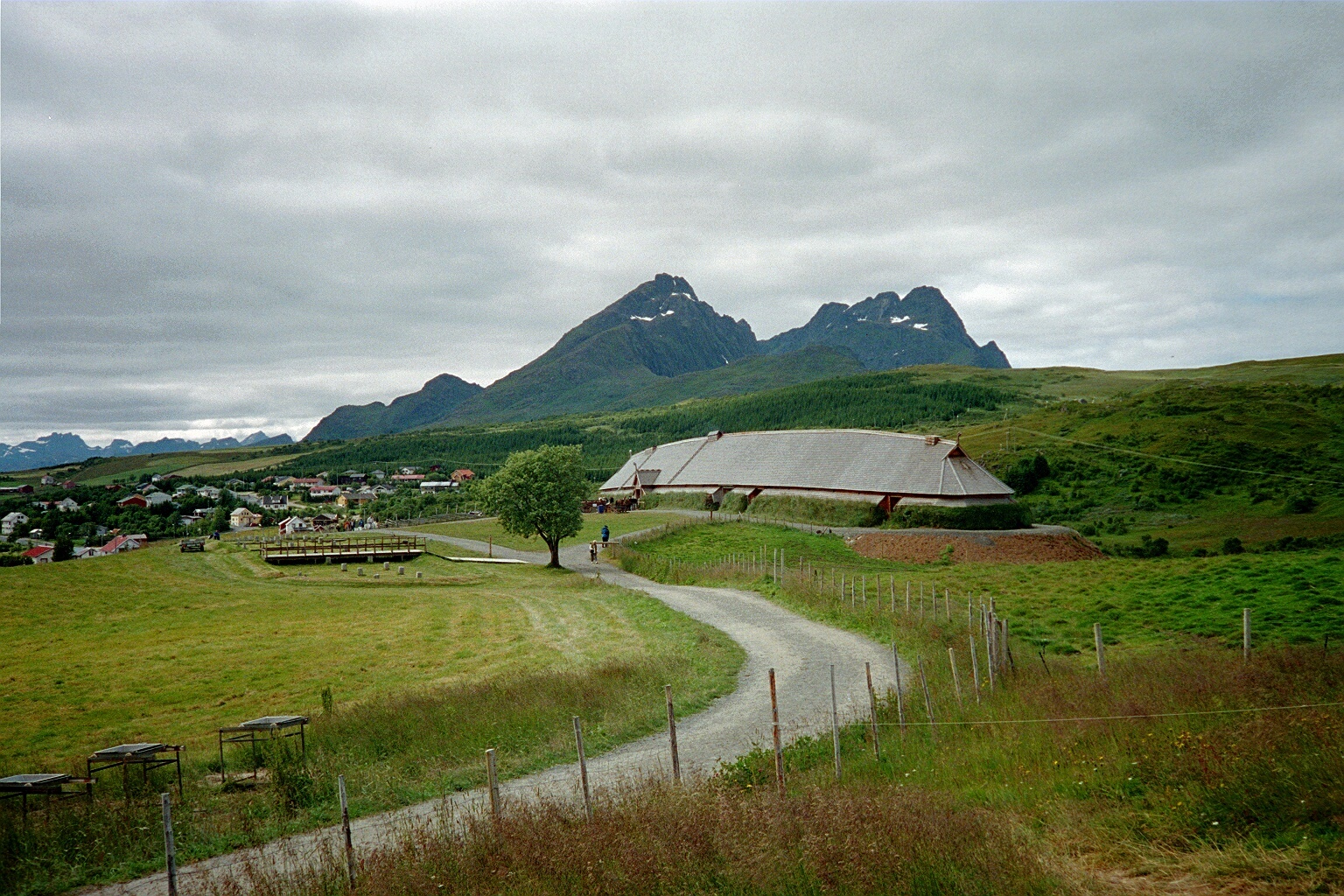
Perched on the edge of the Lofoten archipelago, where jagged peaks plunge into the sea and the aurora borealis dances across the winter sky, the Lofotr Viking Museum feels less like a museum and more like a doorway into another era. This isn’t a place of glass cases and silent artifacts—it’s a living reconstruction of a Viking chieftain’s estate, built on the very site where archaeologists uncovered the remains of a powerful household from the 9th and 10th centuries. The landscape itself tells half the story: the same windswept shores, the same dramatic mountains, and the same endless horizon that shaped the lives of the people who once called this place home.
At the heart of the museum stands the great longhouse, a towering structure of timber and stone with a sod roof that blends seamlessly into the hillside. Inside, the air is thick with the scent of woodsmoke and tar, just as it would have been a thousand years ago. The longhouse wasn’t just a home—it was the social and political center of the community, where meals were cooked over open fires, stories were told, and alliances were forged. The walls, lined with replicas of shields and tools, echo with the quiet hum of daily life. Around the longhouse, smaller buildings—a forge, a boathouse, a barn for livestock—complete the picture of a self-sufficient settlement where every structure had a purpose.
What sets Lofotr apart is its insistence on experience over observation. Visitors aren’t just passive observers; they’re invited to step into the roles of the people who lived here. You can try your hand at blacksmithing, hammering out a simple nail or hook under the guidance of a modern-day craftsman. Or you might learn to twist hemp into rope, a skill as essential to Viking life as shipbuilding. In summer, the museum comes alive with demonstrations—archery, bread-baking in clay ovens, even the construction of traditional boats. Winter transforms the place entirely. Snow blankets the ground, the sea freezes at the edges, and the longhouse’s flickering firelight feels like the only warmth in a world of ice and darkness. It’s easy to imagine the Vikings huddled inside, preparing for the long polar night, their voices low as they planned the next voyage.
The story of Lofotr began in the 1980s, when archaeologists uncovered the foundations of what was clearly a high-status Viking estate. Among the finds were everyday objects—combs, cooking pots, fishing hooks—as well as weapons, jewelry, and the remnants of a ship. The most remarkable discovery was the Lofotr hoard, a cache of silver coins and ornaments hidden away, likely during a time of conflict. These artifacts, now displayed in the museum, offer a glimpse into the wealth and connections of the people who lived here. The chieftain who ruled this land wasn’t just a local leader; he was part of a vast network that stretched from the British Isles to the rivers of Russia.
The Lofoten Islands have always been a crossroads. Their position between mainland Norway and the wider world made them a natural hub for trade, raiding, and exploration. The Vikings who settled here didn’t just survive—they thrived. They fished for cod in the rich Arctic waters, smelted iron from local bog ore, and built ships that could withstand the treacherous North Atlantic. The museum doesn’t just focus on the domestic side of Viking life; it also explores their role as traders, warriors, and pioneers. The artifacts on display—Arabic coins, Irish brooches, Russian furs—hint at the vast distances these people traveled and the cultures they encountered. This was a society that looked outward, not inward, and the Lofoten Islands were its launching point.
Today, Lofotr is more than a tourist attraction. It’s an active research site where archaeologists and historians continue to piece together the past. Every summer, new excavations uncover fragments of history—a coin, a piece of pottery, a posthole from a long-gone building. These discoveries are incorporated into the museum’s exhibits, ensuring that the story it tells is always evolving. The staff, many of whom are experts in Viking-era crafts, are as much a part of the experience as the buildings themselves. They don’t just recite facts; they bring the past to life, whether by demonstrating how a Viking sword was forged or explaining the significance of a particular artifact.
A visit to Lofotr is immersive in the truest sense. There are no ropes keeping you from touching the walls of the longhouse, no signs forbidding you from sitting by the fire. Children can try on replica helmets, search for hidden "treasures" in the grass, or play games that Viking kids might have enjoyed. Adults, meanwhile, can wander the shoreline, watching the waves crash against the rocks, and imagine the sight of a longship appearing on the horizon, its sails billowing as it returns from a voyage. The museum doesn’t shy away from the more brutal aspects of Viking life—raids, battles, the harshness of survival—but it also highlights their creativity, their resilience, and their deep connection to the natural world.
What lingers after a visit to Lofotr isn’t just the image of Vikings as fierce warriors, but the realization that they were also farmers, traders, poets, and explorers. Their world was one of contrasts—violence and artistry, isolation and connection, tradition and innovation. Standing on the shore, with the wind in your face and the mountains looming in the distance, it’s easy to see why this place mattered so much to them. The landscape hasn’t changed all that much in a thousand years. The same sea still laps at the same rocks, the same birds wheel overhead, and the same northern lights paint the sky. In that continuity, there’s a strange kind of comfort—the sense that some things, no matter how much time passes, remain unchanged.