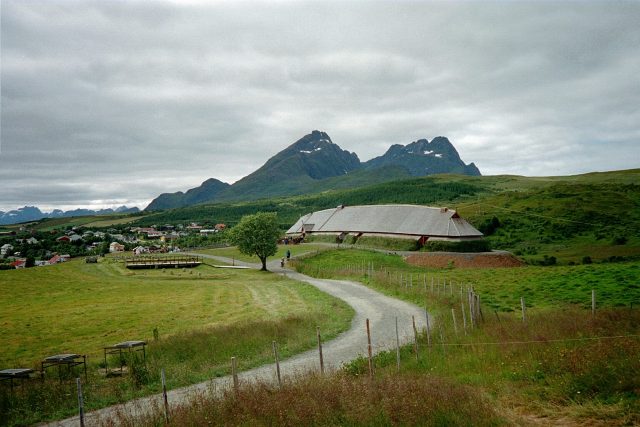
Båstad Lighthouse stands on a windswept headland where the Norwegian Sea crashes against the rocks with a force that makes you feel small. It’s not just a beacon for ships—it’s a place where the raw power of nature and the quiet persistence of human history come together in a way that lingers long after you leave. Built in the late 19th century, when Norway’s coastline was becoming more navigable but no less dangerous, the lighthouse was a lifeline for fishing villages and merchant vessels caught in fog or storms. It sits on a tiny island connected to the mainland by a narrow causeway, one that disappears beneath the tide, as if the sea itself decides whether to let visitors pass.
The design is simple and unyielding, built to endure. The base is made of local granite, sturdy and weathered, rising into a white tower topped with a red roof—a classic maritime look that stands out even in the worst weather. Inside, the old mechanisms that once powered the rotating light are still there, though the lighthouse now runs on automation. The rooms bear the marks of the keepers who lived here for decades, their lives dictated by the rhythm of the sea. Their work wasn’t just about keeping the light burning; they tracked the weather, recorded tides, and sometimes pulled shipwrecked sailors from the water. The place feels lived-in, even now, as if the walls remember the hands that turned the gears and the voices that called out warnings over the wind.
These days, no one lives at the lighthouse, but it hasn’t been left to decay. The structure is maintained, and the area around it has become a quiet spot for walks and photographs. People come here to feel the open sea, to listen to the gulls and watch the waves explode against the rocks, sending spray high enough to mist the road. On clear days, the view stretches endlessly, the horizon blurring where the sky meets the water. When storms roll in, the scene becomes dramatic—the sea roaring, the wind howling, the lighthouse standing firm against it all.
Båstad itself is a small fishing village where life moves at the pace of the tides. There are no crowds, no souvenir shops, no tourist traps. Instead, there are wooden houses, docks lined with boats, nets drying in the sun, and the ever-present smell of salt in the air. The locals still fish, just as they have for generations, and in the summer, a few visitors join them, casting lines from the shore or paddling kayaks along the coast. It’s a place where time feels slower, where the biggest event of the day might be the return of the boats at dusk.
Winter changes everything. Snow drifts over the roads, the wind whistles through the power lines, and the sea turns a cold, steely gray. The lighthouse looks even more isolated then, a solitary figure against the elements. It’s not a tourist attraction in these months—it’s a reminder of what it means to endure. There’s no central heating out here, no modern comforts to soften the harshness of the coast. But for those who know this place, there’s nowhere else they’d rather be. The people who live here don’t just tolerate the weather; they belong to it.
Getting to Båstad isn’t easy. The roads twist along narrow peninsulas, winding past fjords and private properties marked by gates. There’s no public transport, so most people arrive by car, staying in small guesthouses or renting rooms from locals. This isn’t a place for shopping or nightlife. It’s a place for silence, for solitude, for the kind of quiet that makes you realize how vast and untamed the world still is.
The lighthouse and the village around it are part of a Norway that doesn’t always make it into guidebooks. There are no grand palaces or ancient cathedrals here, just the quiet, unshakable presence of the sea and the people who have lived alongside it. It’s a place where history isn’t written in stone monuments but in the lives of fishermen, the ships that passed by in the night, and the generations who depended on the ocean for survival. To visit is to step into that history, not as a spectator, but as someone willing to listen to the wind and the waves and understand what they’ve seen.
That might be why Båstad Lighthouse has never become a tourist hotspot. It doesn’t need flashy signs or interactive exhibits. All it needs is for someone to climb its steps, look out at the water, and feel the weight of the place. It’s a reminder that some things don’t need to be dressed up—they just are. And if you’re lucky, that feeling stays with you long after you’ve driven away.