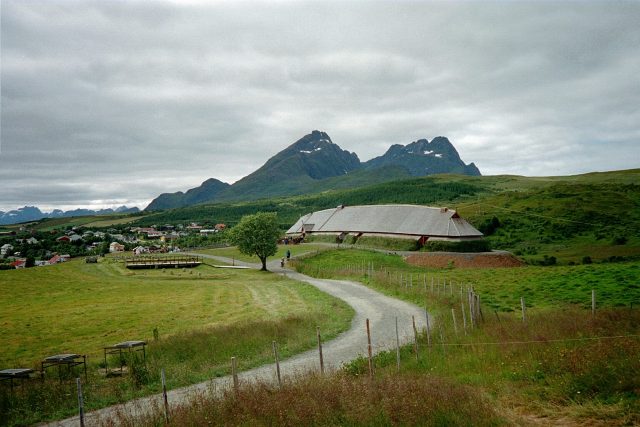
Perched on a gentle rise above the quiet village of Båstad, the whitewashed Bøstad Church stands as a quiet sentinel over the land, its steep roof cutting a sharp silhouette against the sky. From a distance, it’s easy to spot—whether framed by the stark beauty of a winter landscape, where snow softens the contours of the hills, or set against the lush greens of summer meadows and rolling slopes. This isn’t a place that draws crowds, and that’s precisely what makes it special. Here, Norway reveals itself in its unhurried rhythm, where time moves to its own pace, and history unfolds slowly, like the turning of pages in an old book.
Built in 1867, the church is a fine example of Norway’s timber-framed ecclesiastical architecture, a style that flourished in the 19th century as communities across the country constructed simple yet sturdy wooden churches. The design of Bøstad Church is typical of rural Norwegian churches from that era: clean lines, a symmetrical façade, and a tall bell tower rising above the entrance. Inside, the space is divided into a nave and an altar area, with walls adorned by modest paintings executed by local craftsmen. What sets this church apart is its remarkable state of preservation—it has remained largely untouched by the renovations and modernizations that have altered the character of so many similar buildings over the years.
The church’s location hasn’t always been its current one. Originally, it stood closer to the coast, but in the late 19th century, it was dismantled and reassembled on its present site. The reason was practical: the old location had become inconvenient for parishioners, many of whom lived deeper in the valley. Moving a church might seem like an extraordinary undertaking, but for Norwegian farmers of the time, it was a familiar practice. Wooden structures were designed to be taken apart and rebuilt with relative ease, a tradition that stretched back to the Middle Ages, when entire buildings were often relocated to better suit the needs of their communities.
Surrounding the church is a small cemetery, where generations of local families rest beneath simple headstones. Many of the graves are weathered, their surfaces softened by moss and lichen, lending the place a sense of quiet dignity. Some stones bear faint inscriptions—names and dates that hint at lives lived in these valleys, where time moves slowly but never stands still. Cemeteries are an integral part of Norwegian churches, and Bøstad’s is no exception. It serves as a reminder of the unbroken thread connecting past and present, where faith and memory are passed down like an heirloom from one generation to the next.
For the people of Båstad, the church has always been more than just a building. It has been the heart of the community, a place where children were baptized, couples married, and loved ones laid to rest. On feast days, the church would fill with voices raised in song, while on ordinary days, it stood in silence, its peace broken only by the tolling of the bells. Today, services are less frequent than they once were, but the church remains open to both parishioners and visitors. Inside, the scent of aged wood and beeswax lingers in the air, while sunlight filters through the tall windows, casting a warm glow over the worn pews. If you’re fortunate, you might hear the sound of the organ—a well-preserved instrument whose notes resonate with a solemn beauty that seems to echo through the years.
The locals treat the church with quiet reverence, not as a tourist attraction, but as a living part of their daily lives. It’s a place to pause, to reflect, or to offer a prayer. In the summer, the church occasionally hosts small concerts or exhibitions of local art, while in winter, especially around Christmas, it becomes a gathering place for the entire community. During these times, the church glows with candlelight, the scent of pine fills the air, and the soft strains of traditional hymns bring to life customs that have been cherished here for centuries.
Reaching Båstad requires a bit of effort, but the journey is part of the experience. The village lies off the beaten path, far from the usual tourist routes, and the best way to get there is by car. The road winds through hills and past lakes, offering sweeping views of fjords and mountain peaks along the way. You might stop at a roadside café or a scenic overlook to take in the landscape, where the vastness of the Norwegian countryside stretches out before you. Båstad itself is little more than a handful of houses, a farm, and the church on its hill. There’s no hustle here, no crowds—just the quiet and the open space that define so much of northern Norway.
If you find yourself in Båstad, take your time. Wander the surrounding area, climb the nearest hill for a better view of the church, or simply sit and watch as the light changes over the landscape. You might be lucky enough to witness the sunset painting the sky in shades of rose and gold, or hear the wind rustling through the grass while a gull cries in the distance. Places like this remind you that Norway isn’t just about dramatic fjords and bustling cities—it’s also about these quiet corners, where time seems to slow down, allowing you to feel the weight of history in the stillness.