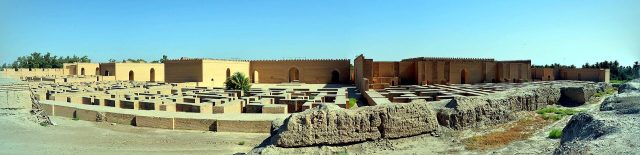
The museum sits among the ruins of the city that once ruled an ancient world. It’s small, unassuming—built to preserve what remains of Babylon’s memory, not to impress. The past here isn’t polished; it’s raw, tangible, and still breathing in the fragments left behind.
Opened in the late 20th century, the museum was a response to a quiet fear: that without a home, Babylon’s legacy would slip away. The building doesn’t fight the landscape. It’s low, sturdy, designed to endure the heat and dust while letting the ruins take center stage.
Inside, the story begins with clay. Tablets carved in cuneiform, their edges worn smooth by time, tell of Hammurabi’s laws and Nebuchadnezzar’s ambitions. Broken reliefs show kings and gods, their faces still sharp despite centuries of neglect. Seals, tools, and pottery—ordinary objects that once filled ordinary lives—hint at how people moved through this city: trading, praying, arguing over prices at the market.
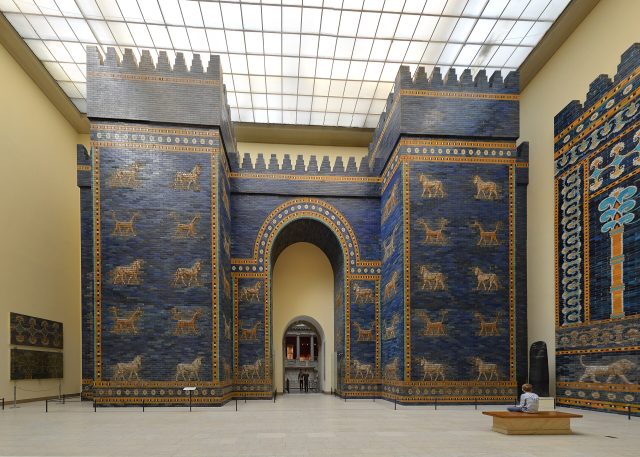
The Ishtar Gate dominates one corner. The original now lives in Berlin, but this replica, with its glazed blue bricks and marching lions, is enough to make you pause. For a moment, you can almost see the procession of priests and soldiers passing through, the gate towering above them like a promise of the city’s might.
Then there’s the Tower of Babel. Not just a myth, but a real structure—the ziggurat Etemenanki, which once scraped the sky. Models here try to reconstruct its height, its purpose, the way it must have loomed over the city like a finger pointing to the gods. Nearby, displays on astronomy and mathematics reveal how Babylon’s scholars mapped the stars and invented the 60-minute hour. You’ll find yourself calculating time differently after seeing this.
Babylon wasn’t just a city; it was a stage for empires. The exhibits trace its wars with Assyria, its alliances with smaller kingdoms, the way it absorbed and reshaped the cultures around it. Religion was the thread running through it all—gods borrowed, adapted, reinvented. One display shows how Marduk, once a minor deity, became the king of the Babylonian pantheon. Another explains why the city’s priests insisted on precise astronomical observations: because the gods, they believed, wrote their will in the stars.
The museum doesn’t end with the fall of Babylon’s kings. Later artifacts—Greek coins, Parthian pottery, fragments of Alexander the Great’s ambitions—show how the city refused to die. Alexander wanted to rebuild it as his capital. He never did, but his presence lingers, a ghost in the ruins.
Step outside, and the past feels closer. The ruins stretch out in every direction: low walls, half-buried foundations, the occasional column still standing against the sky. It’s quieter now than it was then, but not silent. The wind carries dust the way it once carried voices—merchants, priests, children playing in the streets.
This isn’t a place for quick visits. The museum asks you to slow down, to look at the cracks in a tablet and wonder who last held it. To stand in front of the Ishtar Gate and imagine the weight of history pressing down on your shoulders. Because so much of what we are—our laws, our science, our stories—started here, in this dusty corner of Iraq.