Borsippa is one of those forgotten names from Mesopotamia’s deep past, a city that once held real significance but now lingers in the margins of history. Just a short distance south of Babylon, along the banks of the Euphrates, it wasn’t merely a satellite settlement but a place of spiritual and intellectual weight. Today, only ruins remain, yet even in their silence, they carry echoes of what was once a thriving center of faith and learning.
The city’s origins stretch back to the third millennium BCE, when the first Sumerian city-states were taking shape. Borsippa’s fate was always intertwined with Babylon’s—not just by proximity, but by shared culture and governance. Its most famous landmark was the ziggurat of Ezida, dedicated to Nabu, the god of wisdom and writing, and son of Babylon’s patron deity, Marduk. Like other Mesopotamian ziggurats, it wasn’t just a temple but a bridge between earth and sky, a place where priests believed they could commune with the divine. The structure’s towering presence must have dominated the skyline, a physical manifestation of the city’s devotion.
Architecturally, Borsippa mirrored Babylon in many ways, though it had its own distinct character. The ziggurat, built from fired brick, rose in stepped tiers, its broad staircases leading upward toward the sanctuary at the summit. Around it clustered other temples, residential quarters, administrative buildings, and workshops, all enclosed within protective walls. These fortifications weren’t just for defense; they also shielded the city from the Euphrates’ unpredictable floods, which could turn the surrounding plains into a watery expanse in a matter of days.
Nabu, the deity worshipped here, was more than a god of wisdom—he was the keeper of fate itself. In Mesopotamian belief, he inscribed the destinies of people and cities on sacred tablets, making Borsippa a natural center for scribes and scholars. The city became a place where knowledge was preserved, where clay tablets recorded everything from astronomical observations to legal codes. It wasn’t just a religious hub but an intellectual one, where generations passed down the skills of writing, mathematics, and ritual.
When Babylon’s empire fell, Borsippa’s influence waned with it. Conquerors came and went—Persians, Greeks, Parthians, Arabs—but the city never regained its former stature. The Euphrates shifted its course, the land grew less fertile, and people drifted away. By the Middle Ages, Borsippa was little more than a scattering of ruins, known only to locals and a handful of scholars. Time buried its streets under layers of dust and silt, leaving only the ziggurat’s skeletal remains to mark its existence.
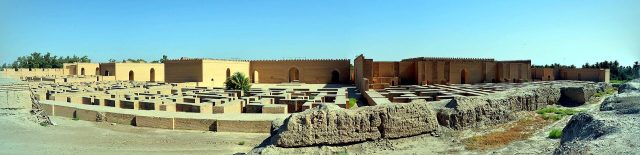
Today, Borsippa is an archaeological site, where teams carefully uncover the remnants of its past. The ziggurat of Nabu still stands, though heavily eroded, its brickwork bearing the scars of ancient repairs. Excavations have revealed fragments of statues, temple artifacts, and countless cuneiform tablets—each one a piece of the puzzle that was daily life in the city. The site is quiet, far removed from the bustle of modern tourism, offering a rare chance to walk through history without distraction.
Visiting Borsippa feels like stepping into a different era. There are no crowds, no souvenir stalls, just the wind sweeping across the open plains and the ruins themselves, silent witnesses to a civilization that shaped the world. The landscape is stark, but there’s a quiet beauty in its emptiness—the same endless sky that arched over the city thousands of years ago still stretches overhead.
For anyone drawn to Mesopotamia’s history, Borsippa is a place of real significance. It offers a glimpse into how cities were built, how religion shaped society, and how knowledge was preserved. More than that, it’s a chance to feel the weight of the past, to imagine the priests chanting in the temples or the scribes bent over their tablets, recording the words that would outlast empires.
Nowadays, Borsippa lives in the shadow of more famous sites like Babylon or Ur. But that obscurity is part of its appeal. Here, you can stand among the ruins without the noise of the present, surrounded by the same earth and sky that once bore witness to a city that was, for a time, at the heart of the world. It’s not just a pile of stones—it’s a place where history feels tangible, where the past isn’t just remembered but still lingers.