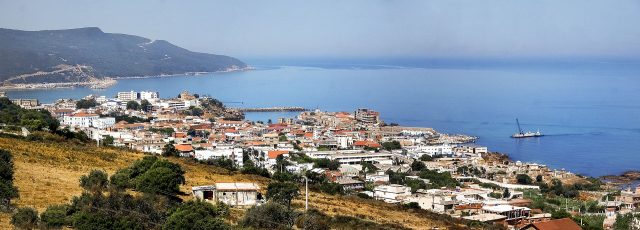
El Tarf sits quietly in the northeastern corner of Algeria, close enough to the Tunisian border that the histories of both countries seem to blur at the edges. The land here has seen Phoenician traders, Roman legions, and Arab conquerors pass through, each leaving faint traces in the soil and the stories people tell. But the Museum of Folk Traditions and Crafts isn’t concerned with grand narratives or official histories. Instead, it gathers the small, everyday things that once filled the lives of local people—the tools they used, the clothes they wore, the food they cooked—preserving them not as relics, but as threads still woven into the present.
The museum occupies an old house built in the style typical of this region, with thick walls to keep out the summer heat and a central courtyard where light and air circulate freely. The building itself feels like a living thing, its wooden doors carved with simple patterns, its shutters worn smooth by time. Inside, the rooms are arranged in a way that mimics the layout of a traditional Algerian home, each space dedicated to a different craft or aspect of daily life. There’s no rigid chronology here, just a sense of walking through the rooms of someone’s memory, where objects tell their own quiet stories.
Textiles take up a significant part of the collection, and for good reason. The region has long been known for its weaving, particularly wool and linen, and the museum displays both the tools and the finished products. Ancient looms stand in one corner, their wooden frames still sturdy, while nearby hang carpets with bold geometric designs, their colors faded but still vibrant. Some patterns were meant to ward off evil, others to bring good fortune or fertility. The threads themselves were often dyed using natural pigments—indigo, madder root, pomegranate skins—methods that are still used in nearby villages today. Nearby, spindles and distaffs lie scattered, their purpose clear even to those who’ve never spun wool before.
Pottery has an equally deep history here, and the museum’s collection spans centuries of craftsmanship. The earliest pieces are rough and heavy, their surfaces uneven, while later works show a refinement of technique—thin walls, delicate rims, and intricate patterns pressed into the clay with fingers or wooden tools. Some vessels were purely functional, used for storing grain or water, while others were decorative, their surfaces adorned with swirls or lines that seem almost modern in their simplicity. The potter’s wheel, the shaping tools, the kilns—all are displayed alongside the finished pieces, offering a glimpse into the labor behind each one.
Metalwork holds its own place in the museum, with displays of tools and objects that reveal the skill of local blacksmiths. There are anvils and hammers, tongs and bellows, their iron surfaces darkened by years of use. But the most striking pieces are the household items—copper trays with hammered patterns, brass lamps with intricate cutouts, locks and hinges that once secured doors. Many of these were made for wealthier families, their surfaces engraved with Arabic calligraphy or floral motifs. The craftsmanship is evident in the precision of the work, each line and curve deliberate, as if the metal itself had been coaxed into shape rather than forced.
A separate room is devoted to the region’s culinary traditions, where the tools of cooking take center stage. There are clay pots for slow-cooked stews, copper cauldrons for boiling water, wooden spoons worn smooth by years of stirring. Mortars and pestles stand ready for grinding spices—cumin, coriander, saffron—while sieves and baskets hint at the labor of preparing flour or sifting grains. Old photographs show traditional ovens, their domed shapes unmistakable, and grills where meat was cooked over open flames. The food itself is represented too: jars of olive oil, bundles of dried herbs, woven baskets of dates and figs. These were the staples of life here, simple but essential, the foundation of meals shared among families for generations.
What makes the museum different from others is its refusal to treat the past as something sealed behind glass. Some rooms go beyond displays, recreating entire scenes—a weaver at her loom, a blacksmith at his forge, a farmer tending to his animals. These setups aren’t just for show; they’re meant to give visitors a sense of how these crafts were practiced, how the tools were held, how the work was done. Occasionally, the museum offers workshops where people can try their hand at weaving, pottery, or metalwork, guided by local artisans. It’s one thing to see a loom; it’s another to feel the tension of the threads beneath your fingers, to understand the rhythm of the work.
The museum doesn’t exist in isolation. Many of the crafts it showcases are still alive in the villages around El Tarf. Weavers continue to make carpets, potters shape clay, blacksmiths forge tools—using the same methods, the same tools, as their ancestors did. The museum isn’t just a record of what was; it’s a bridge to what still is. That connection is what makes a visit here feel different from a typical museum experience. There’s no sense of distance, no feeling that these traditions are gone. Instead, there’s a quiet understanding that the past isn’t something to be preserved in amber, but something that continues to shape the present.
Beyond the museum, El Tarf itself is a place where history and landscape intertwine. The city is surrounded by forests and hills, with the Medjerda River flowing nearby, its waters sustaining life for centuries. The museum touches on this too, with displays of agricultural tools—plows, sickles, baskets—showing how the land was worked and the crops harvested. There are photographs of terraced fields, of farmers guiding oxen through the soil, of women carrying bundles of firewood on their heads. These images remind visitors that the culture here wasn’t just about crafts or food, but about a way of life shaped by the land itself.
A visit to the Museum of Folk Traditions and Crafts isn’t about ticking off exhibits or admiring artifacts from a distance. It’s about stepping into a world where history isn’t confined to books or monuments, but lives in the things people made and used every day. There’s no grandiosity here, no attempt to impress with scale or spectacle. Instead, there’s a sense of authenticity, of warmth, of things that were touched by human hands and passed down through generations. For those who want to understand Algeria beyond its cities and landmarks, this museum offers something rare—a glimpse into the lives of ordinary people, and the quiet resilience of their traditions.