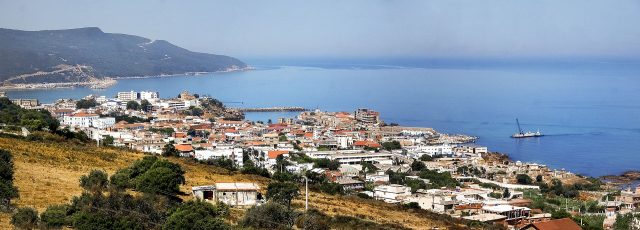
El Tarf’s mosque is the kind of place that doesn’t announce itself at first glance but lingers in memory long after you’ve left. Tucked into the heart of this small Algerian town, it stands among low-slung houses with flat roofs and narrow streets where life moves at the same unhurried pace it has for centuries. Unlike the grand mosques of the capital or the coastal cities, this one doesn’t overwhelm with scale. Instead, its quiet presence feels like a natural part of daily life, woven into the rhythm of the community around it.
The architecture is classic for North Africa—square minaret, walls of pale stone, and an inner courtyard paved with tiles that seem almost white under the harsh sun. The entrance is adorned with simple yet elegant geometric patterns, the kind typical of Islamic art, though here they’re understated, emphasizing harmony rather than excess. Inside, the space is divided as is common in Maghrebi mosques, with separate areas for men and women. The mihrab, the niche pointing toward Mecca, is unadorned but dignified, a reflection of the mosque’s unassuming character.
The history of the mosque is closely tied to that of El Tarf itself, a town that has long existed on the edges of larger events. Founded during the Ottoman period, it was never a major trade or political hub, which may be why it has retained its provincial calm. The mosque likely dates to the 18th or 19th century, a time when small towns across the region flourished as gathering points for nomads and farmers. Back then, such buildings weren’t just places of worship but also centers of community life—where disputes were settled, news was shared, and children learned to read in the courtyard.
Today, the mosque still serves its purpose, though the town around it has changed. New neighborhoods have sprung up, modern buildings now stand nearby, but the old streets still lead to its gates. On Fridays, worshippers from across the district fill the space, while on weekdays, you might see elderly men sitting on benches in the courtyard, counting prayer beads, or women in traditional dress hurrying to morning prayers. There’s nothing performative about it—just life unfolding as it always has, with the mosque at its center.
For travelers passing through El Tarf, the mosque offers an unexpected glimpse into local life. There are no crowds of tourists, no guided tours, no souvenir stalls—just silence broken only by the call to prayer or the rustle of palm leaves in the wind. If you’re lucky, you might catch the moment when the setting sun casts the minaret in golden light, stretching shadows long and soft across the courtyard. In those quiet minutes, it’s easy to see why this place matters to the people who live here. It’s not just a building; it’s a living symbol of their faith, their history, and their everyday existence.
Of course, El Tarf’s mosque can’t compete with Algeria’s architectural marvels like the Ketchaoua Mosque in Algiers or the ruins of Timgad. But that’s precisely its charm. It doesn’t try to impress or astonish—it simply exists, much like the steady passage of time in this corner of the country. For those who seek more than just landmarks, who want to feel the pulse of a place rather than just see it, the mosque has more to say than any guidebook. The key is to slow down, listen to the sounds of the town, and let yourself see it through the eyes of those for whom this mosque is a part of life.