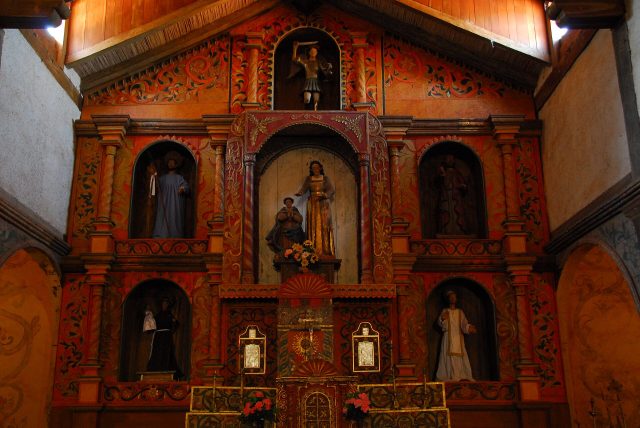
San Ignacio de Velasco sits in Bolivia’s eastern lowlands, where ceiba trees cast long shadows and life moves slowly. The town is one of six former Jesuit missions in the Chiquitos region, established in the 18th century to blend European and Indigenous ways of life. While UNESCO-recognized mission churches stand in nearby towns, San Ignacio preserves its history differently—through a museum that tells the story of Chiquitos not with grand architecture, but with the objects people once used every day.
The museum occupies a building typical of Jesuit mission design. Thick adobe walls, high wooden ceilings, and simple rooms create a quiet space. Inside, the collection mixes the sacred and the ordinary: religious artifacts, farming tools, musical instruments, and fragments of murals that once decorated mission churches. The wooden saints carved by Indigenous artisans under Jesuit guidance stand out. Their faces and postures show European iconography adapted to local traditions.
San Ignacio was founded in 1748, one of the last Chiquitos missions before the Jesuits were expelled in 1767. Unlike other towns, it no longer has its original mission church—the 20th-century replacement lacks historical character. The museum fills this gap, showing life as it was three centuries ago. Exhibits include clay pots for cooking, looms for weaving, and tools for building and farming. The missions were more than religious outposts; they were self-sustaining villages where Indigenous people and Europeans lived side by side.
Music played a key role in this coexistence. The Jesuits used it to bridge cultural divides, fostering a Baroque tradition that survives today. The museum displays instruments made locally—violins, cellos, flutes, and organs built from wood and leather. Some are still played during festivals, especially the International Festival of Chiquitos Mission Music, held every July in San Ignacio and other towns. During the festival, the museum becomes a gathering place for musicians and visitors who come to hear the sounds that once filled these spaces.
The museum also hosts temporary exhibitions. Old photographs of the missions from the early 1900s appear alongside contemporary art inspired by the region’s heritage. But even without these displays, the museum leaves an impression. There are no crowds, no rushed tourists. The quiet lets you take your time, examining details and imagining the voices that once filled these rooms—prayers, hymns, the sounds of daily work.
San Ignacio de Velasco is not easy to reach. It lies far from Bolivia’s usual tourist routes, accessible only by long, dusty roads through lowland forests. The isolation is part of what makes the museum special. It hasn’t been turned into a spectacle; it remains a living archive where history feels present in the air. Many of the town’s residents are descendants of the Indigenous people who lived in the missions. Their stories add depth to the exhibits. Some still speak the languages used here centuries ago, and traditions introduced by the Jesuits live on in local festivals and crafts.
Visiting the Chiquitos Missions Museum isn’t about checking off a sightseeing list. It’s about stepping into a story that continues today. The legacy of the missions isn’t just in the objects on display; it’s in the people who call this place home. In San Ignacio, the past isn’t locked away—it’s part of daily life, from the languages spoken to the music played at celebrations. The museum doesn’t just document history; it shows how the Chiquitos missions shaped a culture that still thrives in this remote corner of Bolivia.