Santa Ana Church in San Ignacio de Velasco feels like a place where time has paused, leaving behind the quiet rhythm of another era. Built in the 18th century, it stands at the heart of the town, surrounded by low adobe houses with terracotta roofs, their weathered walls blending into the landscape. From the outside, the church appears unassuming—whitewashed walls, a simple wooden door, a modest bell tower. There are no grand facades or elaborate carvings, just the quiet dignity of a building that has witnessed centuries pass. Yet this very simplicity makes it striking. It doesn’t demand attention; it earns it, brick by brick, year by year.
San Ignacio de Velasco was founded in 1748 by Jesuit missionaries as part of a network of reductions spread across eastern Bolivia. These settlements were more than just religious outposts; they were self-sustaining communities where agriculture, craftsmanship, and education flourished alongside faith. The Jesuits sought to blend European traditions with local customs, and Santa Ana became the spiritual center of this experiment. The church’s architecture reflects this fusion. While its design follows Baroque principles, the hand of indigenous artisans is evident in the details—wooden columns carved by hand, patterns on the facade that echo traditional motifs. It’s a building that speaks two languages at once, neither fully European nor entirely indigenous, but something uniquely its own.
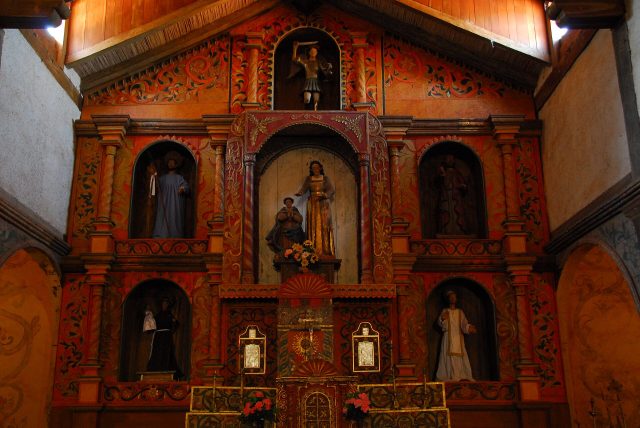
Step inside, and the contrast between the church’s humble exterior and its rich interior is immediate. The main altar gleams with gilded woodwork, its intricate carvings a testament to the skill of local craftsmen. Saints and angels share space with depictions of regional flora and fauna, a reminder that this was never just a European import, but a place shaped by the land and its people. Some of the wooden statues date back to the 18th century, their paint still faintly visible in places, applied by indigenous hands under Jesuit guidance. Old crucifixes and chalices, some brought from Europe, others made locally, fill the space, each object carrying its own quiet story.
The church has seen its share of decline and revival. When the Jesuits were expelled from the Spanish colonies in 1767, the missions fell into disrepair. For decades, Santa Ana stood half-forgotten, its roof sagging, its walls crumbling under the weight of time and the relentless tropical climate. Restoration efforts in the mid-20th century brought it back to life, though not without leaving traces of its past. The wooden beams are darker now, the paint chipped in places, the stone worn smooth by generations of footsteps. These imperfections don’t detract from the church; they make it feel alive, as if the past isn’t just remembered here, but still present.
Visiting Santa Ana is as much about the town as it is about the church itself. San Ignacio de Velasco moves at its own unhurried pace, and the plaza in front of the church is where much of that life unfolds. In the mornings, vendors set up stalls selling fresh fruit, empanadas, and sweets made from local honey. By evening, the square fills with people—children playing, elders chatting on benches, the occasional stray dog weaving between legs. On feast days, the church becomes the heart of the celebration. Villagers from the surrounding countryside arrive in their finest clothes, filling the air with music, the scent of grilled meat, and the rhythmic beat of traditional dances. The festival of San Ignacio, in particular, transforms the town into a vibrant display of color and sound, a reminder that faith here is as much about community as it is about devotion.
Santa Ana isn’t a place you’ll find on most tourist itineraries. There are no crowds, no souvenir stands, no guides rushing you through. Instead, there’s the quiet hum of daily life—the clink of a spoon against a coffee cup, the laughter of children, the distant toll of the church bell. It’s a rare kind of stillness, the kind that lets you hear the layers of history in the walls, the way the past and present coexist without fuss. The church has stood here for nearly three hundred years, and in that time, it has become more than just a building. It’s a witness, a keeper of stories, a place where the spirit of the Chiquitania region feels tangible.
For those interested in the history of the Jesuit missions, Santa Ana is one piece of a larger puzzle. Along with other churches in eastern Bolivia, it’s part of a UNESCO World Heritage site, though it doesn’t draw the same attention as the more famous missions in Chiquitos. Still, there’s something special about this particular church. It’s not just a relic; it’s a living part of the community. Services are still held here, and the locals treat it with a reverence that goes beyond preservation. To them, it’s not just a historic site—it’s a place where baptisms, weddings, and funerals have taken place for generations, where the rhythms of life and faith intertwine.
On weekdays, the church is quiet. A few visitors might wander in, snapping photos or sitting in the pews for a moment of reflection. But on Sundays, it comes alive. The organ plays, the choir sings, and the scent of incense lingers in the air. Outside, the plaza buzzes with activity—women in brightly embroidered dresses, men leaning against the walls of the church, children darting between the trees. It’s a scene that hasn’t changed much in centuries, a snapshot of life in a place where time moves differently.
If you find yourself in San Ignacio de Velasco, take a moment to sit on one of the benches in the plaza. Watch the sunlight filter through the trees, listen to the rustle of leaves, feel the warmth of the evening as it paints the church walls in gold. There’s no grand spectacle here, no overwhelming beauty that demands admiration. Instead, there’s something quieter, something that seeps in slowly—the sense of a place that has endured, that has seen empires rise and fall, that has remained, steadfast, through it all. Santa Ana won’t dazzle you with opulence or scale, but it will offer something far more valuable: a glimpse into a way of life that values simplicity, community, and the quiet persistence of history.