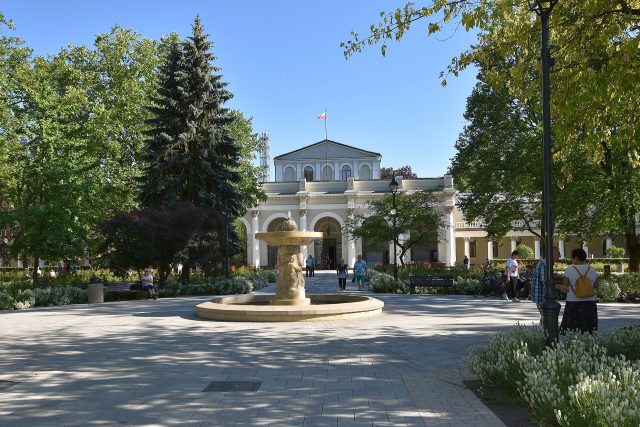
Busko-Zdrój has long been known for its healing springs, and the Mineral Water Museum is where the story of this small Polish town’s unlikely fame unfolds. Housed in a 19th-century villa that once belonged to a local sanatorium family, the museum feels less like an institution and more like a quiet conversation with the past. The building itself is a relic of its time—high ceilings, heavy wooden doors, and delicate plasterwork still intact—so stepping inside is like being welcomed into a home where history hasn’t been staged, but simply preserved.
The exhibits trace the evolution of Busko-Zdrój from a modest spa town to a destination that drew visitors from across Europe. One of the first things you notice are the old bottles of mineral water, their labels a record of changing tastes and medical trends. Some are plain and functional, others ornate, with intricate engravings or bold typography that once promised miracles. The early 20th-century advertisements are particularly striking, selling water as a cure-all with the kind of confidence that only comes before modern skepticism. It’s easy to imagine how these bottles once lined pharmacy shelves or were packed into trunks as travelers carried home a piece of Busko-Zdrój’s reputation.
The museum doesn’t just display artifacts—it explains the science behind the town’s waters. A collection of old instruments—hydrometers, glass flasks, and early carbonation devices—shows how seriously the springs were studied. Chemists and doctors analyzed the mineral content, and their work laid the foundation for balneology, the study of therapeutic bathing. The exhibits break down which minerals are present in the water, how they interact with the body, and why this particular region of Poland became a hotspot for such deposits. It’s a reminder that the town’s success was never just about folklore; it was built on research and experimentation.
A separate room is dedicated to the people who shaped Busko-Zdrój’s history. Photographs, letters, and personal belongings tell the stories of those who came seeking healing—aristocrats, artists, and ordinary workers, all drawn by the promise of relief. The images capture the town’s transformation over the decades, from simple wooden bathhouses to grand sanatoriums. There’s a subtle shift in fashion, too, from the stiff collars and long skirts of the late 1800s to the more relaxed styles of the mid-20th century. These details make the past feel tangible, as if the people in the photos might step out of the frames at any moment.
The museum also bridges the gap between past and present. Modern exhibits explain how the waters are used today, from traditional baths to cutting-edge treatments. Visitors can see samples of water from different springs and learn which conditions they’re still used to treat. There’s a focus on how the town has adapted—how ancient healing practices now coexist with new technologies, and how the local government works to protect the springs from overuse. It’s a practical look at how a place rooted in tradition manages to stay relevant in a changing world.
The most evocative space in the museum is the basement, where the original storage rooms for bottled water have been preserved. Dimly lit and lined with wooden barrels and glass containers, it feels like stepping into a 19th-century laboratory. The air is cool, the scent of old wood lingers, and the tools of early researchers are laid out as if they were just used yesterday. There are no flashy displays here, just the quiet weight of history—an atmosphere that makes it easy to imagine the first scientists hunched over their work, trying to unlock the secrets of the springs.
What makes this museum different is its lack of pretension. There are no grand narratives or exaggerated claims, just a straightforward account of how a small town became a place of healing. The exhibits don’t try to impress with spectacle; they let the objects speak for themselves. An old bottle, a faded photograph, a rusted instrument—each has its own story, and together they paint a picture of persistence. Busko-Zdrój wasn’t always a destination; it was a place where people believed in something greater than themselves, where science and nature intersected in a way that changed lives.
Walking through the museum, you get the sense that this isn’t just about water. It’s about the people who believed in its power, the researchers who studied it, and the town that grew around it. The exhibits don’t romanticize the past, but they don’t dismiss it either. Instead, they offer a quiet appreciation for what has endured—the faith in healing, the curiosity about the natural world, and the way a single resource can shape a community. It’s a place that leaves you with more questions than answers, and that’s what makes it feel real.