Busko-Zdrój is a town where time seems to move at its own gentle pace, a place where the past lingers in quiet corners and unassuming landmarks. Among them, the Church of Saint Stanislaus stands as a quiet witness to the town’s evolution—from a modest settlement to a spa destination known for its healing waters. Perched on a low hill, the church overlooks the streets below, its slender spire cutting a familiar silhouette against the sky. Built in the early 20th century, it was designed in the Neo-Gothic style, a nod to the grand cathedrals of Europe, though scaled down to suit the intimate character of this small Polish town.
The church’s origins are tied to Busko-Zdrój’s transformation into a health resort. By the late 19th century, the town’s mineral springs had begun to attract visitors seeking relief from various ailments, and with them came the need for a larger place of worship. The old wooden church that had served the community since the 17th century could no longer accommodate the growing number of parishioners. In 1908, plans were drawn up for a new brick church, and the task fell to architect Jan Sas-Zubrzycki, whose work in the Neo-Gothic style had already left its mark on other Polish towns. His design for Saint Stanislaus was restrained yet elegant, avoiding the excesses of larger religious buildings while still capturing the essence of Gothic tradition.
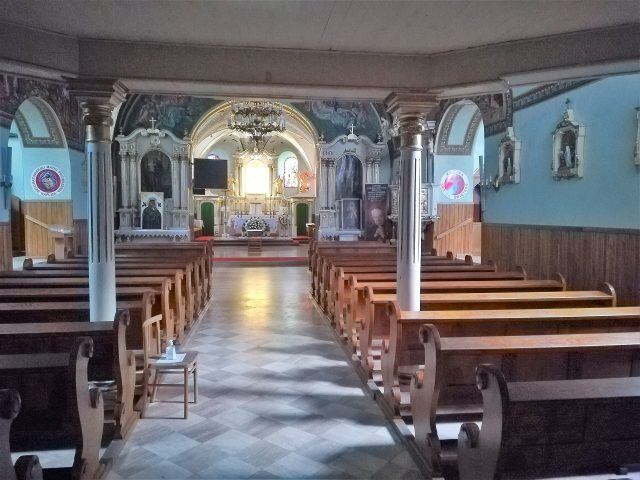
From the outside, the church presents a striking but understated appearance. Its red-brick walls are punctuated by white stone accents—window frames, doorways, and cornices—that lend a sense of precision to the structure. The main entrance is framed by a pointed arch, above which sits a large rose window, a classic feature of Gothic architecture. The tower, crowned with a slender spire, rises just high enough to dominate the town’s skyline without overwhelming it. Inside, the church feels surprisingly airy, thanks to the tall, narrow windows that flood the space with natural light. The interior is a study in simplicity, with clean lines, unadorned wooden pews, and a vaulted ceiling that draws the eye upward. There is no opulence here, only a sense of quiet reverence.
The high altar is dedicated to Saint Stanislaus, the patron saint of Poland, and serves as the focal point of the church. Carved from wood, the saint’s figure is central to the composition, flanked by smaller depictions of other holy figures. Unlike the lavish altars found in more famous cathedrals, this one is modest, its craftsmanship speaking more to devotion than to grandeur. Flanking the main altar are two smaller ones, one dedicated to the Virgin Mary and the other to Saint Joseph, both executed in the same restrained style. The walls are adorned with a handful of stained-glass windows, their designs depicting biblical scenes and saints. Though few in number, they add a touch of color to the otherwise muted palette of the interior.
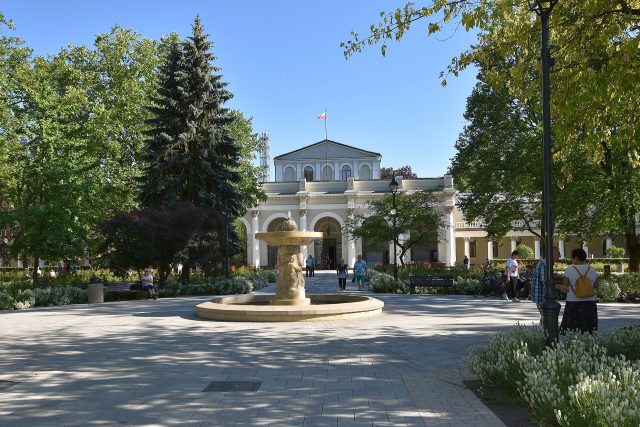
For the people of Busko-Zdrój, the Church of Saint Stanislaus is more than just a place of worship; it is a living part of the town’s history. It has witnessed generations of baptisms, weddings, and funerals, its bells marking the passage of time for those who call this place home. On feast days, the church fills with parishioners, its pews crowded with families who have gathered to celebrate together. In the summer, when tourists arrive to take the waters, the church becomes a point of interest for those drawn to its architectural charm. A small park surrounds the building, offering a quiet place to sit and admire the structure or to wander along the paths that lead to other parts of town.
The church has seen its share of hardship. During the Second World War, Busko-Zdrój endured bombing raids, yet the church emerged largely unscathed—a fact that locals still speak of with a sense of quiet gratitude. In those difficult years, the building served not only as a house of prayer but also as a refuge for those in need. After the war, it was carefully restored, and today it looks much as it did when it was first built, save for a few modern updates like heating and electric lighting. These changes are subtle, ensuring that the church retains its historic character.
What makes the Church of Saint Stanislaus special is its unassuming nature. It doesn’t demand attention like the great cathedrals of Kraków or Warsaw, nor does it overwhelm visitors with its size or decoration. Instead, it offers something far more intimate: a chance to step into a space that has remained largely unchanged for over a century. Inside, the scent of wax and aged wood lingers in the air, while sunlight filters through the stained glass, casting soft, colored patterns across the floor. The silence is broken only by the occasional footsteps of a visitor or the distant murmur of a prayer.
For those who come to Busko-Zdrój not just for its healing waters but to explore the region’s culture, the church provides a glimpse into the town’s soul. It stands as a reminder that history isn’t always found in grand monuments or famous landmarks. Sometimes, it’s in the quiet, everyday places—the ones that have seen the comings and goings of ordinary lives, the ones that have stood firm through wars and peacetime, the ones that continue to serve their communities with quiet dignity. The Church of Saint Stanislaus is one such place, a small but enduring symbol of a town that has found its own way to bridge the past and the present.