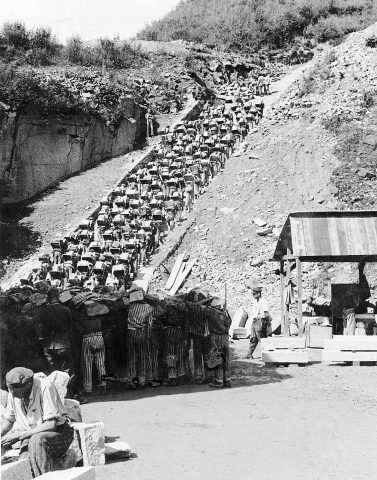
Mauthausen is a quiet town in Upper Austria with a heavy past. Most know it for the concentration camp on its outskirts during World War II. The Local History Museum in the town center tells another story—one that spans centuries, not just those years. Housed in a historic building, it shows Mauthausen before, during, and after the war.
The museum sits in a former judge’s residence from the late 19th century. Tall windows line the symmetrical facade, and the original stucco ceilings and woodwork remain inside. The building is part of the exhibit, its preserved interiors setting the stage for the artifacts. Displays blend into the space, letting the architecture and objects share the story. Walking through, you notice the layers—this house once belonged to a family, then to the town, now to history.
The main exhibition starts with Mauthausen under the Austro-Hungarian Empire and the First Republic. Furniture, tools, photographs, and household items fill the rooms. These objects show daily life in the 19th and early 20th centuries. The town grew during industrialization, when the Danube and the railway turned it into a transport hub. Models of docks, steamships, and train carriages sit next to documents about bridge construction and warehouses. Before the war, this was a place where people worked and traded.
A separate section covers the Nazi occupation and the camp’s impact. Unlike the memorial outside, this museum doesn’t show camp artifacts. Instead, it looks at how townspeople were part of those years. Some built the camp, others supplied goods, many lived nearby, hearing distant sounds. Diaries, letters, and newspapers from the 1940s reveal how normal life continued alongside horror.
After the war, Mauthausen had to ask: how to move forward? The museum shows this struggle. Documents cover reconstruction, visits from former prisoners, and efforts to distance the town from its past. Materials on the memorial’s creation reveal how it became part of the town’s identity. Mauthausen still lives with its history—not by hiding it, but by facing it.
The museum also hosts temporary shows. Some focus on crafts, others on architecture or natural history. One traced the Danube’s role in trade, another winemaking in the hills. These exhibitions show Mauthausen’s rhythms and traditions.
The Local History Museum doesn’t offer a grand narrative. It doesn’t shock or entertain. Instead, it invites you to see how history shapes small places. The building, the objects, the stories—they all show that history lingers. For anyone trying to understand Austria beyond its wars, this is a place to begin.