Perched on a gentle hill overlooking the Danube, St. Nicholas Church in Mauthausen feels like a quiet witness to centuries of ordinary lives. Its whitewashed walls and simple steeple don’t demand attention, yet there’s something undeniably compelling about this unassuming building. Unlike the grand cathedrals of Vienna or Salzburg, it doesn’t overwhelm with ornate details or towering spires. Instead, it offers something rarer—a sense of continuity, as if the same breeze that rustles the nearby vineyards today once carried the voices of medieval merchants and farmers who gathered here long ago.
Mauthausen itself has always been a place of passage. The Romans knew it as a stop along the Danube, and by the Middle Ages, it had grown into a bustling hub for trade and craftsmanship. The church likely dates back to the 12th or 13th century, though no one knows for certain. In those days, it wasn’t just a place of worship but a refuge during raids and conflicts, a stone sanctuary where the townspeople could seek shelter. Over time, the settlement grew around it, and today, the church remains the heart of the old town, a thread connecting the past to the present.
The architecture is a textbook example of Romanesque style, built to endure. Thick walls, small arched windows, and sturdy buttresses give the church a solid, almost fortress-like appearance. Inside, the space feels surprisingly airy, with high vaulted ceilings supported by columns that draw the eye upward. The walls still bear traces of faded frescoes, their colors muted by time, while the altar area reveals later Gothic influences, added when the church was expanded in the 14th or 15th century. It’s a mix of eras, each layer telling its own story without fanfare.
St. Nicholas was a fitting patron for this riverside town. As the protector of merchants, travelers, and children, he embodied the concerns of Mauthausen’s residents, who depended on the Danube for trade and livelihood. In the Middle Ages, the church would have been a hive of activity—merchants praying for safe journeys, families marking feast days, and farmers seeking blessings for their crops. Today, the town is quieter, but the church still holds services, its bells ringing out over the rooftops as they have for centuries. The rhythm of life here moves at a different pace, one measured by the changing seasons rather than the ticking of a clock.
The old town of Mauthausen unfolds around the church like a living postcard. Narrow lanes wind between houses with terracotta roofs, their windowsills bright with geraniums in summer. The medieval town hall still stands in the main square, its timbered facade a reminder of the town’s long history. From the church steps, you can see the Danube curving gently below, its waters reflecting the green hills and vineyards that stretch toward the horizon. It’s a view that hasn’t changed much in hundreds of years, and that’s part of the charm. There’s no need for grand gestures here; the beauty lies in the everyday—the way the light falls on the cobblestones in the afternoon, or the scent of freshly baked bread drifting from a nearby bakery.
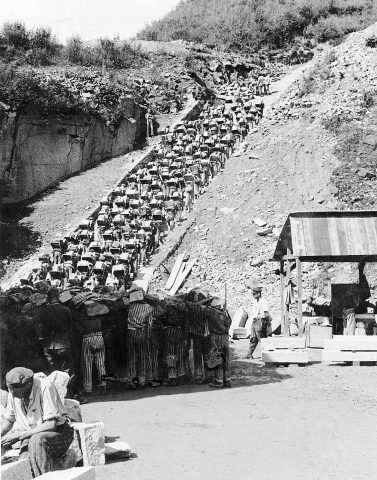
Mauthausen is often associated with darker chapters of history, particularly the concentration camp that once stood nearby. But St. Nicholas Church endured those years as a place of solace, a reminder that life, in all its quiet resilience, carries on. Today, it stands as a counterpoint to that history, not by erasing it, but by offering a different perspective. Visitors can sit on the bench outside, listening to the birds or the distant chime of the bells, and feel the weight of time in a way that’s both humbling and strangely comforting.
If you find yourself in Mauthausen, take your time. Wander the old streets, step inside the church, and then make your way down to the river. The best view of the church is from the Danube’s edge, where the water mirrors the sky and the building appears almost suspended between earth and heaven. It’s not a place that shouts for attention, but that’s precisely why it lingers in the memory. In a world that often feels transient, St. Nicholas Church is a rare constant—a small, unassuming monument to the idea that some things, like faith and community, are built to last.