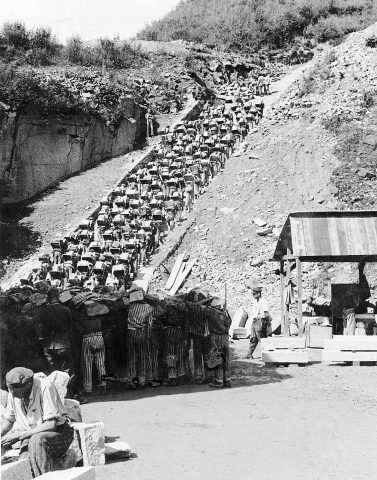
Perched on a hill overlooking the quiet Austrian town of Mauthausen, the memorial that now stands here carries the weight of a history that refuses to be forgotten. This was once the site of one of Nazi Germany’s most brutal concentration camps, where tens of thousands of people from across Europe were imprisoned, exploited, and murdered. Today, the former camp has been preserved as a place of remembrance, a stark reminder of the atrocities committed during World War II and the human capacity for both cruelty and resilience.
Mauthausen was established in 1938, shortly after Austria’s annexation by Nazi Germany. Initially intended for political prisoners, the camp soon expanded to hold a diverse population—Soviet prisoners of war, Poles, Spaniards, French resistance fighters, Jews, Romani people, and others deemed enemies of the regime. Unlike the extermination camps built for mass killing, Mauthausen was a labor camp, but the conditions were designed to break and destroy. Prisoners were forced to work in the nearby granite quarries under backbreaking conditions, starved, beaten, and subjected to medical experiments. The death rate was staggering, not from gas chambers, but from exhaustion, disease, and systematic violence.
The physical remnants of the camp still stand, offering a chilling glimpse into its past. The main gate, with its cynical inscription *Arbeit macht frei* ("Work sets you free"), remains as it was when prisoners first passed through it, unaware of the horrors that awaited. Beyond the gate lies the roll-call square, where inmates were forced to stand for hours in all weather, counted and recounted like livestock. The barracks, though partially reconstructed, retain the oppressive atmosphere of overcrowding and despair. Some now house exhibitions detailing the daily lives of prisoners, the bureaucratic machinery of the camp, and the personal stories of those who perished.
One of the most harrowing sites is the quarry, where prisoners were worked to death hauling massive slabs of granite up the infamous "Stairs of Death." The narrow steps, worn smooth by decades of rain, lead down to the pit where men collapsed under the weight of their loads or were pushed to their deaths by guards. Nearby, the execution wall still bears the scars of bullets, a silent testament to the countless lives taken in an instant. The quarry itself is eerily quiet now, but the weight of what happened here lingers in the air, heavy and unshakable.
At the heart of the memorial stands a monument erected in the 1960s, a towering sculpture of figures locked in struggle, symbolizing both suffering and defiance. Adjacent to it is the international cemetery, where thousands of victims are buried in mass graves. Many of the headstones bear only numbers, a stark reminder of how thoroughly the Nazis sought to erase the identities of those they murdered. A memorial wall lists the names of known victims—politicians, artists, scientists, and ordinary people whose lives were cut short. The sheer scale of the loss is overwhelming, a sea of names that can never fully capture the individual tragedies behind them.
Mauthausen is more than a memorial; it is an educational site dedicated to ensuring that the lessons of the past are not forgotten. Guided tours, workshops, and seminars are held here, often attended by students and young people from around the world. The museum on the grounds houses artifacts, photographs, and personal belongings of prisoners—letters, diaries, and everyday items that humanize the statistics. These objects tell stories of survival, resistance, and, too often, of final moments. The goal is not just to inform but to provoke thought, to challenge visitors to consider how such horrors could happen and what responsibility each generation bears in preventing them.
The atmosphere at Mauthausen is one of solemn reflection. Visitors speak in hushed tones, if at all, moving through the spaces with a sense of reverence. There are no distractions here, no attempts to soften the reality of what occurred. Occasionally, the memorial hosts commemorative events, bringing together survivors, their families, and dignitaries from various countries. These gatherings serve as a powerful reminder that history is not just a collection of facts but a living, breathing legacy that demands attention.
A visit to Mauthausen is not an easy experience. It is not a place for sightseeing or casual curiosity but for confronting the darker chapters of human history. The memorial forces visitors to grapple with uncomfortable questions: How could ordinary people participate in such cruelty? What does it mean to resist in the face of oppression? And how do we ensure that such atrocities are never repeated? There are no simple answers, but the silence of the camp speaks volumes. It is a silence that demands to be heard, a silence that carries the voices of those who were silenced too soon.
Mauthausen does not offer closure, nor does it claim to. Instead, it serves as a bridge between past and present, a place where history is not just remembered but felt. The stories of the victims, the remnants of the camp, and the quiet dignity of the memorial all work together to create an experience that is as unsettling as it is necessary. It is a place that challenges visitors to look inward, to consider their own role in shaping a world where such horrors are never allowed to happen again. The past may be unchangeable, but the future is still ours to write.