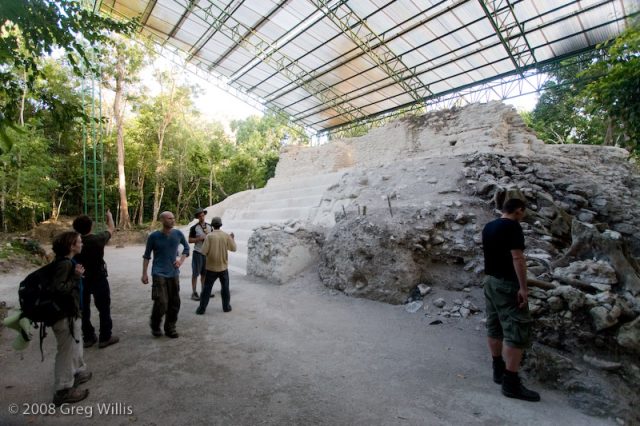
El Petén region of Guatemala is home to some of the most evocative remnants of the Maya civilization, and among them, Mundo Perdido stands as a quiet testament to a world that once thrived here. Tucked away in the dense jungles near Santa Elena de la Cruz, this archaeological site feels like a place suspended in time. The name, which translates to Lost World, suits it perfectly—here, the past lingers in the air, untouched by the noise of modernity. The ruins are not as grand or as meticulously restored as those in Tikal, but that only adds to their allure. There’s a sense of discovery in wandering through these overgrown structures, where nature and history intertwine in a way that feels almost intimate.
Mundo Perdido flourished during the Classic period of Maya history, roughly between the 3rd and 9th centuries AD. Back then, it was a bustling center of trade, religion, and astronomy, connected to a network of cities that stretched across Mesoamerica. The Maya were master builders, and their understanding of mathematics and celestial movements is evident in the layout of the site. Many of the structures align with the solstices and equinoxes, a testament to their advanced knowledge. The main pyramid, though weathered by time, still offers a commanding view of the surrounding jungle, a reminder of how deeply the Maya revered the natural world. It’s easy to imagine priests standing at its summit, tracking the sun’s path or performing rituals that once defined daily life here.
What remains of Mundo Perdido today are the skeletal outlines of a city that has long since faded into the forest. The ruins consist of stepped platforms, crumbling temples, and the remnants of what were once elaborate stone carvings. Moss and vines cling to the ancient stones, softening their edges and blurring the line between man-made and natural. The jungle has reclaimed much of the site, but traces of its former glory are still visible—if you know where to look. The absence of large crowds means you can explore at your own pace, listening to the rustle of leaves and the distant calls of howler monkeys. There’s a stillness here that makes it easier to imagine the sounds of the past: the murmur of a marketplace, the chanting of priests, or the crackle of ceremonial fires.
Visiting Mundo Perdido is as much about the journey as it is about the destination. The path to the ruins winds through thick vegetation, where sunlight filters through the canopy in dappled patches. The air is thick with the scent of damp earth and tropical foliage, and the humidity wraps around you like a second skin. Local guides often share stories of the site’s history, blending facts with legends of spirits that are said to linger among the ruins. Whether you believe in such tales or not, there’s an undeniable atmosphere of mystery here, a sense that the past is not as distant as it seems.
Unlike the more famous Maya sites, Mundo Perdido doesn’t attract busloads of tourists. There are no souvenir stalls or guided tours with loudspeakers—just the quiet hum of the jungle and the occasional rustle of wildlife. This lack of commercialization is part of what makes the experience so special. You’re not just observing history; you’re stepping into it, surrounded by the same landscape that shaped the lives of the Maya. The absence of modern distractions allows for a deeper connection to the place, one that feels personal rather than performative.
Of course, the remoteness of Mundo Perdido comes with its challenges. The infrastructure is minimal—there are no luxury hotels or restaurants nearby, and the roads leading to the site can be rough. But for those willing to make the effort, the rewards are worth it. The sense of solitude, the untouched beauty of the jungle, and the quiet dignity of the ruins create an experience that’s hard to find elsewhere. It’s a place that demands patience and curiosity, and in return, it offers something rare: a glimpse into a world that has long since vanished, yet still feels strangely alive.
What makes Mundo Perdido particularly poignant is the way the jungle has reclaimed it. Trees grow through the cracks in the stone, roots twist around ancient walls, and the relentless march of nature serves as a reminder of how fleeting human achievements can be. In a few centuries, these ruins might disappear entirely, swallowed by the forest. That thought adds a layer of urgency to a visit here—not just as a chance to see history, but to reflect on how quickly it can fade. The Maya left behind an incredible legacy, but even their most enduring monuments are not immune to the passage of time.
For travelers who seek more than just a photo opportunity, Mundo Perdido offers something deeper. It’s a place where you can sit on a weathered stone and listen to the wind moving through the trees, where the past feels tangible in a way that’s hard to describe. There’s no need for grand narratives or dramatic reconstructions; the ruins speak for themselves, quietly and powerfully. In a country filled with extraordinary archaeological sites, Mundo Perdido stands out not for its size or fame, but for its ability to make history feel immediate, personal, and alive. It’s a reminder that some of the most profound experiences come not from the places we expect, but from those we stumble upon by chance.