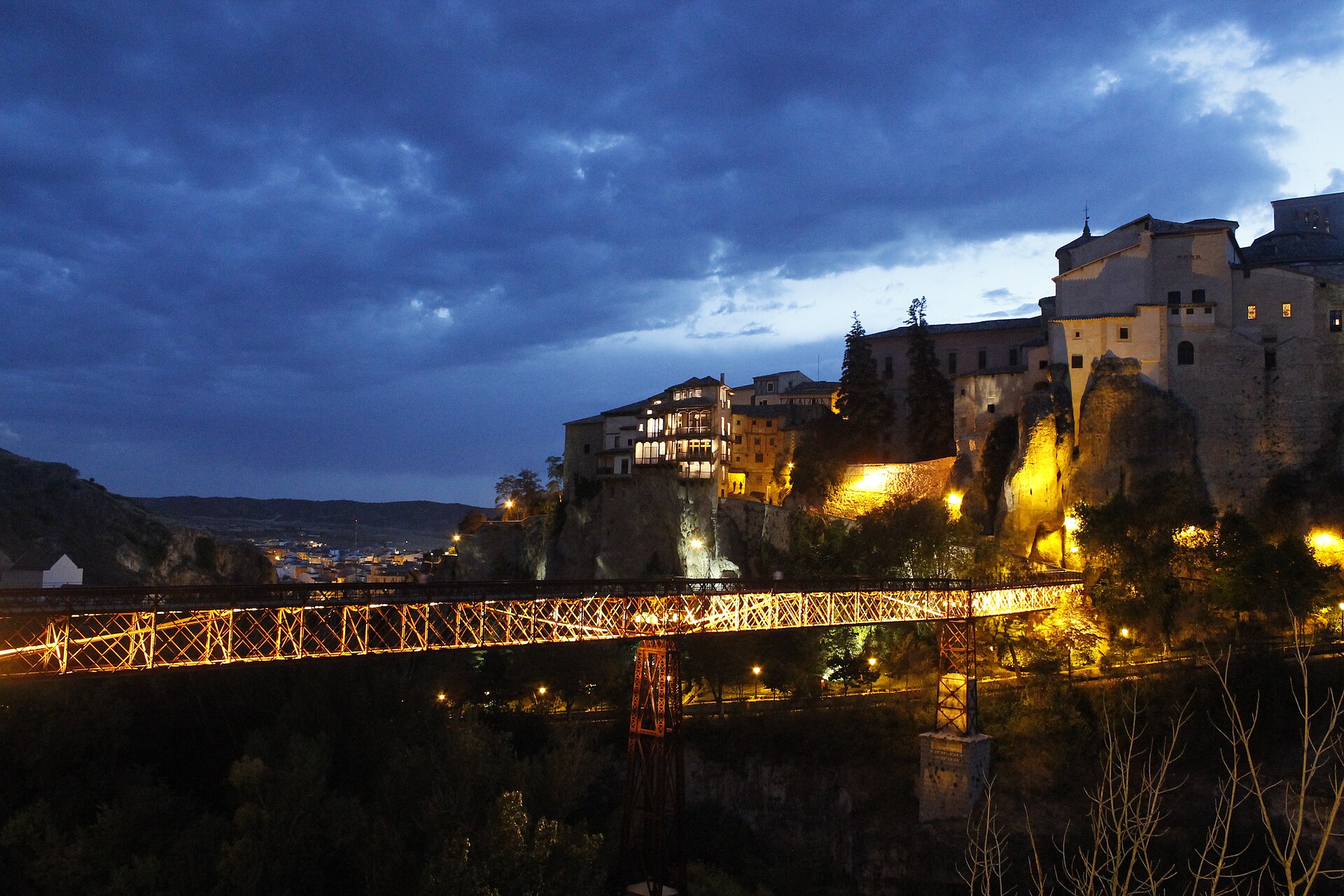
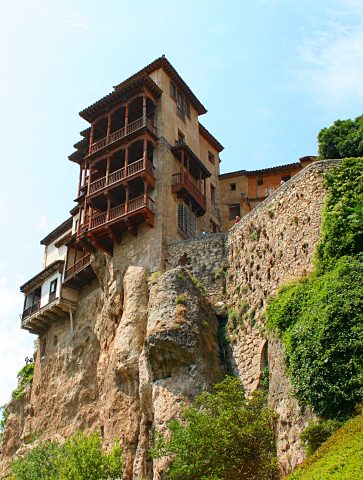
Cuenca’s San Pablo Bridge isn’t just a way to cross the Huécar River gorge—it’s a quiet statement of how the city balances on the edge of its own dramatic landscape. The bridge connects the old town with the former San Pablo Monastery, its namesake, and from its height, the famous Casas Colgadas appear to hover over the abyss, their wooden balconies jutting out as if defying gravity. The structure itself is deceptively light, a single metal arch anchored by stone piers that seem to grow straight from the rock. It’s sturdy enough to carry daily foot traffic, yet delicate enough to blend into the scenery, especially when the evening light softens its outlines.
The bridge’s history stretches back to the 16th century, when a wooden footbridge first spanned the gorge. It served pilgrims heading to the monastery and locals moving between the two sides of the city, but over time, the wood rotted and the crossing became unreliable. By the early 1900s, the current iron bridge replaced it, built with the industrial techniques of the era—riveted steel beams and precise engineering that still hold up today. The design was practical, but it also carried a certain elegance, a nod to the Art Nouveau influences of the time.
What makes the bridge striking isn’t its size or ornamentation, but how it fits into the landscape. The single arch, supported by massive stone abutments, feels like a natural extension of the cliffs. The metal railings form a simple geometric pattern, unobtrusive by day but catching the light at dusk when the lampposts flicker on. At night, the bridge seems to float above the gorge, its reflection shimmering in the river below. During the day, it’s easy to overlook—just another part of the scenery—until you lean against the railing and realize how far down the water runs.
For those who live in Cuenca, the bridge is part of the rhythm of daily life. Schoolchildren cross it on their way to class, their voices echoing against the stone. Tourists pause to take photos of the Casas Colgadas, while locals use it as a shortcut or a place to meet friends. On weekends, you might find an artist setting up an easel, trying to capture the way the light shifts across the gorge, or a group of teenagers leaning over the railing, daring each other to look down. The bridge isn’t just a thoroughfare; it’s a gathering spot, a place where people stop to talk, to breathe, or to simply watch the river rush by.
The area around the bridge carries layers of history. The remains of old fortifications hint at Cuenca’s past as a frontier town, caught between Christian and Muslim rule. The San Pablo Monastery, now a parador, stands as a reminder of the city’s religious heritage, while the paths leading into the nearby nature park offer a different kind of escape—one where the only sounds are the wind in the pines and the occasional cry of a bird of prey circling overhead. For visitors, the bridge is also one of the best vantage points in the city, offering unobstructed views of the old town’s medieval streets and the rolling hills beyond.
The bridge changes with the seasons. In spring, when the river runs high and the cliffs are lush with greenery, it feels like part of a wild, untamed landscape. Summer brings intense heat, the metal railings too hot to touch at midday, but by evening, the cool air rising from the gorge makes the walk pleasant. Autumn turns the surrounding trees gold and russet, the bridge framed by a riot of color, while winter—if it snows—transforms it into something almost magical, a dark arch against a white expanse. Even the light plays differently depending on the time of year, casting long shadows in winter and a warm, honeyed glow in summer.
What makes the San Pablo Bridge special isn’t just its engineering or its views, but the way it embodies Cuenca’s character. This is a city that clings to the edge of a gorge, where time moves at its own pace. There’s no rush here, no jostling for space—just the quiet hum of life unfolding against a backdrop of stone and sky. The bridge isn’t a monument to be admired from afar; it’s a place to linger, to lean on the railing and watch the river carve its way through the rock below. It’s where the past and present meet, where the city’s history feels tangible, and where the simplest moments—a shared laugh, a deep breath of mountain air—become something worth remembering.