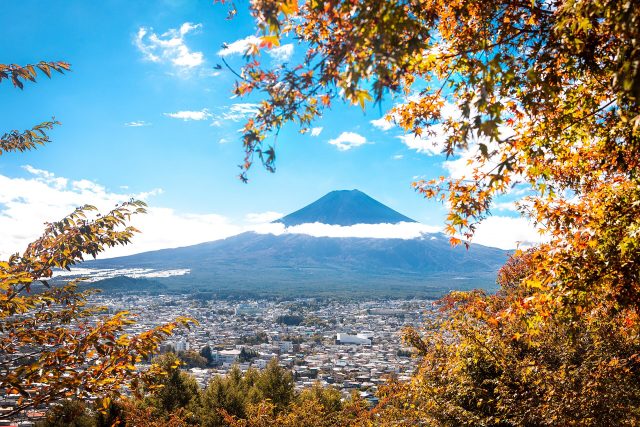
Narusawa Bridge feels like one of those quiet discoveries that lingers in your memory long after you’ve left. Stretching over a narrow stream that winds through the foothills of Mount Fuji, it doesn’t seem built for necessity so much as to frame the landscape itself. The wooden railings, darkened by years of rain and sun, curve gently over the water, while below, the current murmurs around moss-covered stones. On clear days, the snow-capped peak of Fuji floats above the valley like a mirage; on overcast ones, the bridge blends into the scene as if it’s always been part of some old woodblock print—still, unassuming, a little mysterious.
This place has long been tied to the pilgrimage routes that once brought thousands of travelers to Fuji’s slopes. During the Edo period, when climbing the sacred mountain became a widespread practice, the bridge served as a crossing for those making their way toward the volcano, whether to begin the ascent or simply pay their respects from afar. Back then, it was likely nothing more than a simple wooden walkway, functional rather than decorative. Yet even in its modest form, it held significance. Pilgrims would pause here to rest, fill their flasks from the stream, and shed the distractions of the world before the long climb ahead. Over time, stories grew around it—whispers that wishes made on the bridge at dawn, when the first light touches Fuji’s summit, were more likely to come true.
There’s nothing elaborate about the bridge’s construction, and that’s precisely what makes it charming. Built from wood and stone, it’s unadorned but carefully crafted. The railings don’t just keep people from stumbling; they invite you to run your fingers along the weathered grain, to feel the texture of time worn smooth by wind and rain. The stones lining the streambed look as if they’ve always been there, arranged by nature rather than human hands. When the rains come, the water rises, turning the bridge into a narrow island between rushing banks. In winter, snow blankets everything, and the scene becomes something out of a folktale, as if the world has paused just for a moment.
These days, Narusawa Bridge is less a thoroughfare and more a place people come to for quiet. Even during peak travel seasons, you’re unlikely to find crowds here. Most visitors rush past on their way to Lake Kawaguchiko, the Wind Caves, or the Kitaguchi Hongu Sengen Shrine, leaving this corner of the valley to those who seek it out. The ones who do arrive usually come by bicycle or on foot, following paths through bamboo groves and rice paddies. Occasionally, you might spot locals fishing along the banks or sitting by the water, watching the current drift by. In those moments, the bridge feels timeless—much like Fuji itself, standing in the distance, unchanged and majestic.
Spring is when the bridge is at its most delicate. Cherry blossoms arch over the railings, their petals drifting onto the water like pink snow. The stream runs clear, revealing every blade of grass on the streambed. Summer brings lush greenery, and even in the heat, the air stays cool beneath the dense canopy of leaves. In autumn, maple trees blaze red and gold, turning the bridge into the heart of a living fire. And in winter, when everything is still, it becomes a place for reflection—quiet, solitary, a spot where the world feels both vast and intimate.
Narusawa Bridge isn’t the kind of landmark that ends up on postcards. There are no bright colors, no grand monuments, no crowds jostling for the perfect photo. It’s a place for those who appreciate beauty that doesn’t announce itself, who are willing to slow down enough to notice it. You could bring a book and spend an afternoon on the bank, listening to the water and the rustle of leaves. Or you could simply stand on the bridge, looking toward Fuji, and realize how little it takes to feel content—a quiet corner where the line between human and nature blurs.
In recent years, a few small cafés and shops have sprung up nearby, but they haven’t spoiled the atmosphere. If anything, they feel like they belong, as if opened by people who fell in love with the place and wanted to share it. One café serves local tea and sweets on a veranda overlooking the stream. The shops sell handmade ceramics, textiles, and wooden crafts—each piece made with care, much like the bridge itself, which has served travelers for centuries without losing its quiet appeal.
If you find yourself in this part of Japan, don’t rush past. Take a moment to walk across the bridge, to touch the railings, to listen to the water. This is where you might feel what so many come to Japan to find—the sense of harmony between people and the land, which here feels especially tangible. And even if you don’t make a wish at dawn, as the legends suggest, the place will stay with you. It’s the kind of memory that lingers: a reminder of stillness, of beauty, of the quiet understanding that some things endure.