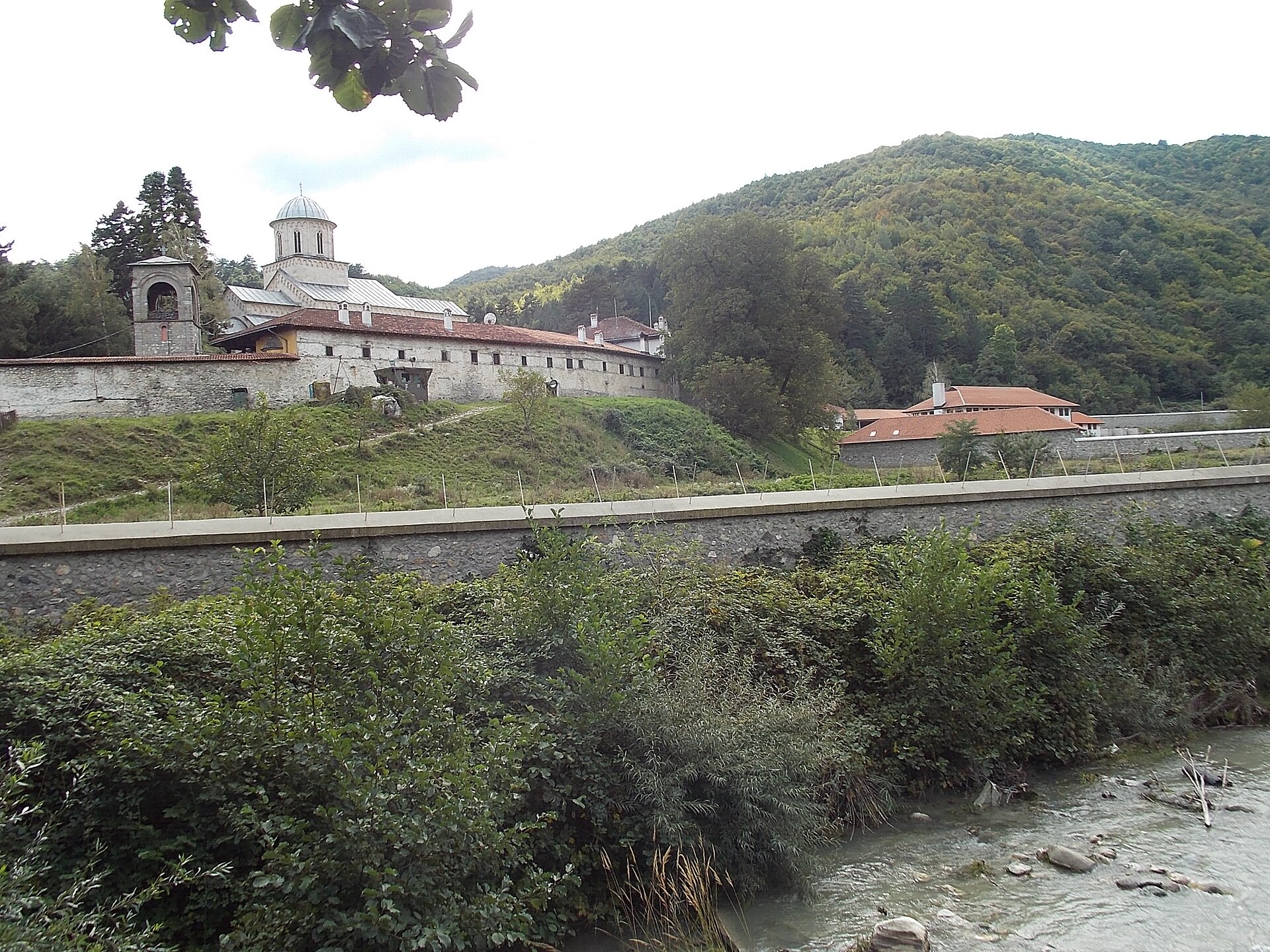
Visoki Dečani Monastery feels like a place where time itself has learned to breathe more slowly. Tucked into the western reaches of Serbia, in a valley carved by the Dečani Bistrica River, it stands surrounded by dense forests and gentle hills, as if nature had deliberately shaped the landscape to frame its quiet grandeur. Founded in the early fourteenth century, the monastery has not only preserved its original beauty but has also witnessed centuries of history that shaped the Balkans, surviving wars, occupations, and the slow march of empires.
The architecture of Visoki Dečani is striking from the moment you see it. The main church, dedicated to Christ the Almighty, was built from marble and stone brought from distant quarries, its walls adorned with frescoes that represent the pinnacle of Serbian medieval art. Inside, the paintings unfold like a visual chronicle of faith—scenes from the Old and New Testaments, portraits of saints, and rulers of the time, all rendered with a precision that makes them feel almost alive. The most remarkable among them is the depiction of the Last Judgment, one of the most detailed and expansive in the Orthodox world. Even after centuries, the colors remain vivid, the expressions sharp, as if the artists had only just stepped away from their work.
The monastery was founded by King Stefan Uroš III Dečanski, who gave it his name. According to legend, the king, suffering from a debilitating illness, found healing within these walls and, in gratitude, decided to build a church that would serve not only as a spiritual center but also as a symbol of unity for the Serbian people. Construction was overseen by a Franciscan monk, Vito of Kotor, which explains the subtle Western influences in the design. After Stefan’s death, his son, the future Emperor Dušan, completed the project, turning the monastery into one of the most important religious sites in medieval Serbia.
Over the centuries, Visoki Dečani endured its share of hardships. It was looted, damaged, and threatened by invasions, yet each time it was restored, its spiritual and cultural significance intact. The Ottoman occupation was particularly brutal for Serbian monasteries, many of which were destroyed or repurposed. Dečani survived, in part due to its remote location and the dedication of local communities who protected it. When Serbia regained independence in the nineteenth century, the monastery once again became a beacon of Orthodox tradition, drawing pilgrims, scholars, and travelers from across the world.
Today, life at Visoki Dečani moves at an unhurried pace, deeply rooted in tradition. The monks continue to hold services, preserve ancient manuscripts and icons, and carefully restore the frescoes. A small workshop within the monastery produces candles and religious items using centuries-old methods. Visitors can explore the church and its treasures, but they can also simply sit in the quiet, letting the stillness settle around them. The surrounding forest offers walking paths that wind through peaceful clearings, where the only sounds are the rustling of leaves and the distant murmur of the river.
One of the monastery’s most valuable possessions is its library, home to rare manuscripts and books, some dating back to the fourteenth century. Among them is a hand-copied Gospel and chronicles that offer glimpses into medieval Serbian life. These documents are not just historical artifacts; they reflect the high level of literacy and cultural sophistication that flourished within the monastery’s walls over the centuries.
Visoki Dečani is more than an architectural monument—it is a living connection to the past. Here, the weight of history feels tangible, a reminder of how faith and art have sustained people through some of the region’s darkest times. While it remains an important pilgrimage site for Orthodox Christians, the monastery welcomes anyone seeking a deeper understanding of history, an appreciation for medieval art, or simply a moment of quiet away from the noise of the modern world.
A visit to Visoki Dečani offers a different perspective on Serbia, far from the bustling streets of Belgrade or the lively squares of Novi Sad. There are no crowds here, no rush to capture the perfect photograph—just a sense of timelessness, as if the place exists slightly outside the usual flow of hours and days. That might be why so many people return, drawn back by the quiet harmony that lingers in the air, the feeling that here, at least, the world moves at its own gentle pace.