Uzgen is a quiet town in southern Kyrgyzstan, where the pace of life slows to the rhythm of the surrounding mountains and the past lingers in the streets. On its outskirts, where the last houses give way to foothills, stands a memorial that feels less like a monument and more like a quiet conversation with history. It’s dedicated to those who left to fight in a war far from home and never returned, as well as those who did come back—but carried the weight of that war with them long after.
The memorial honors the soldiers Kyrgyzstan lost in the Afghan War, a conflict that drew young men from across the Soviet Union, including from small towns like Uzgen. The names etched into the granite are a reminder that war doesn’t choose its battlegrounds—its echoes reach even the most unassuming places. Here, the war isn’t an abstract event from the news; it’s personal, tied to faces and families who still live in the town.
The design of the memorial is understated but powerful. A central stele bears reliefs of soldiers in combat, their expressions tense yet human, as if frozen in a moment of both struggle and resolve. Flanking it are granite slabs inscribed with the names of the fallen, each one a life cut short. The surrounding park, with its trees and benches, offers a place to sit and reflect, the shade providing relief from the sun while the silence invites contemplation.
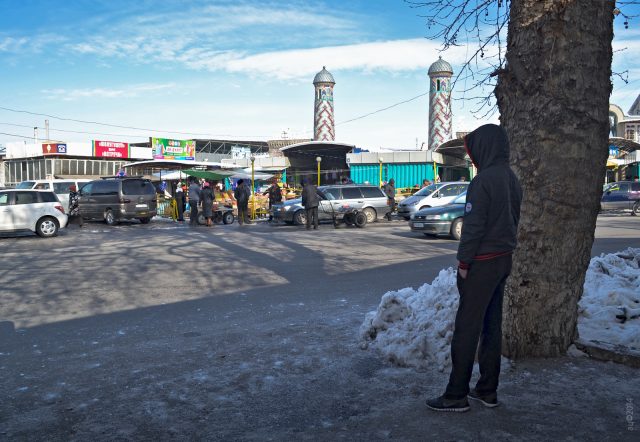
Uzgen itself is a town layered with history. Nearby stand medieval mausoleums and minarets, remnants of a time when these lands were part of vast empires. Those structures speak of glory and grandeur, while the memorial tells a different story—one of more recent sorrow. Together, they create a dialogue between eras, showing how a place can hold both the weight of ancient legacies and the memories of those who lived just decades ago.
The memorial isn’t just visited on official remembrance days. Locals come here often—elderly men paying respects to fallen comrades, mothers bringing children to teach them about sacrifice, or veterans who arrive in quiet groups, their conversations low and measured. For them, this isn’t just a monument; it’s a piece of shared history, a place where the past feels close enough to touch. Sometimes, the air fills with stories, or with the unspoken grief that lingers between old friends.
There’s no grandiosity here, no sweeping declarations. The memorial doesn’t glorify war or wrap it in heroic narratives. Instead, it presents names, dates, and the quiet that follows—a silence that carries more meaning than any speech. Occasionally, someone leaves flowers at the base of the stele, and for a moment, the stone seems to soften, as if acknowledging that memory is kept alive by those who still care.
This place doesn’t offer easy answers. It doesn’t frame war as noble or inevitable, but rather asks a question that hangs in the air: Was it worth it? The answer isn’t carved into the granite; it’s left for each visitor to decide. Some come seeking solace, others a connection to history, and some simply a quiet spot to gather their thoughts. But whatever brings them here, the memorial serves as a reminder that even in a small town, history leaves its mark.
Uzgen moves on with its daily life, but the memorial remains, unobtrusive yet enduring. It doesn’t demand attention, but those who seek it out will always find it. For some, it’s a place of mourning; for others, a lesson in the cost of conflict. And for a few, it’s just a peaceful corner where the world feels a little slower, a little more thoughtful. In the end, it’s a testament to the idea that memory doesn’t need grandeur—just a place to settle, and people willing to remember.