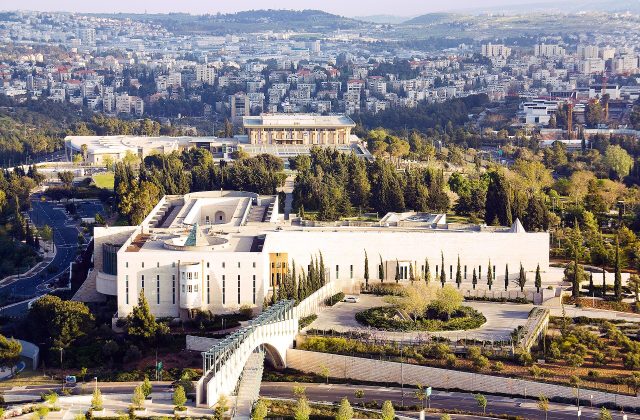
Perched on the slopes of Givat Ram in Jerusalem, Yad Vashem is more than a memorial—it is a place where history is not just remembered but felt. Established in 1953 by an act of the Israeli Knesset, it was conceived as a national response to the unfathomable loss of the Holocaust, a way to honor the six million Jewish victims while grappling with the enormity of what happened. The name itself, meaning "a monument and a name," comes from the Book of Isaiah, a verse that speaks of giving the dead an eternal remembrance. Here, that remembrance is not abstract. It is personal, painful, and necessary.
The architecture of Yad Vashem is deliberate in its restraint. The main museum, designed by Moshe Safdie, is carved into the hillside, its long, sloping corridor guiding visitors through a journey that is both physical and emotional. The walls lean inward, as if bearing the weight of the past, while natural light filters through narrow skylights, casting shifting shadows that mirror the fragility of memory. There are no grand displays or dramatic reconstructions. Instead, the exhibits unfold through photographs, personal belongings, and firsthand testimonies—fragments of lives interrupted. A child’s drawing from the Terezín ghetto, a pair of shoes found at a mass execution site, a letter smuggled out of a concentration camp. These objects are not just artifacts; they are the last traces of people who were erased.
At the heart of the complex stands the Children’s Memorial, a space that feels like stepping into a void. Thousands of tiny lights flicker in the darkness, reflected endlessly by mirrors to create the illusion of an infinite expanse. Each light represents one of the 1.5 million Jewish children murdered during the Holocaust. As names, ages, and places of death are read aloud in a continuous loop, the scale of the loss becomes almost unbearable. There is no narrative here, no attempt to soften the blow. Only the quiet repetition of lives cut short.
The chronological exhibition begins with the vibrant, pre-war world of European Jewry—synagogues, schools, family gatherings—before descending into the darkness of persecution, ghettoization, and mass murder. The progression is relentless, but never sensationalized. Instead of overwhelming visitors with statistics, the museum focuses on individual stories. A suitcase left behind at a deportation point. A diary entry from a teenager in hiding. A wedding ring hidden in a loaf of bread. These details make the horror tangible, not as a distant historical event, but as something that happened to real people. The final section, documenting the liberation of the camps, offers no easy resolution. The survivors’ testimonies speak of guilt, grief, and the struggle to rebuild lives in a world that had moved on.
The Hall of Names is perhaps the most devastating part of Yad Vashem. Towering shelves hold millions of "Pages of Testimony," each one a brief biography of a victim—name, date of birth, place of death, and, if available, a photograph. The ceiling above is a mosaic of faces, a visual representation of the lives lost. In the center of the hall, a circular pit descends into darkness, symbolizing the millions whose names were never recorded. Standing there, surrounded by the sheer volume of loss, it becomes impossible to look away. The Holocaust was not a single event, but six million individual tragedies.
Beyond the museum, the grounds of Yad Vashem hold other memorials, each with its own quiet power. The Avenue of the Righteous Among the Nations is lined with trees planted in honor of non-Jews who risked their lives to save Jews during the war. Each tree bears a plaque with a name and a story—of a Polish farmer who hid a family in his barn, of a Dutch resistance fighter who forged identity papers, of a Japanese diplomat who issued visas to refugees. These stories are a reminder that even in the darkest times, humanity persisted. Nearby, the ruins of a European synagogue, dismantled and reassembled here, stand as a ghostly testament to the communities that were destroyed. Its broken walls and empty windows speak louder than any monument.
Yad Vashem is not just a place of mourning; it is also a center of scholarship and education. Historians here work to document every possible detail of the Holocaust, collecting testimonies, preserving artifacts, and publishing research that challenges simplistic narratives. The archives hold over 200 million pages of documents, from Nazi decrees to personal letters, ensuring that the evidence of what happened cannot be erased or distorted. Educational programs bring students, teachers, and researchers from around the world, fostering a deeper understanding of how such a catastrophe occurred—and how it might be prevented in the future. The museum’s approach is unflinching: it does not shy away from the complicity of collaborators, the indifference of bystanders, or the systematic nature of the genocide. The goal is not to provide closure, but to provoke thought.
Visiting Yad Vashem is not easy. There is no uplifting message at the end, no sense of triumph over evil. Many people leave in silence, the weight of what they’ve seen lingering long after they’ve walked out. That silence is part of the experience. It is a recognition that some losses cannot be put into words. But the memorial’s very existence is an act of defiance—a refusal to let the past fade into abstraction. The Holocaust was not just a historical event; it was a rupture in the fabric of humanity. Yad Vashem ensures that the names, the faces, and the stories of those who were lost are not forgotten.
For those who come to Jerusalem, Yad Vashem is often the last place they expect to visit. It is not a site of beauty or inspiration, but of raw, unfiltered truth. And yet, it is one of the most important places in the city. Because here, on this quiet hillside, history is not just something you read about. It is something you carry with you. The memory of the Holocaust is not just about the past; it is a warning for the future. And in a world where hatred and indifference still exist, that warning matters more than ever.